Travel
Venice: The Grand Canal, Palazzo Hotels & the Art of Getting Lost
Venice is the most improbable city ever built — 118 islands connected by 400 bridges, with no roads, no cars, and a canal system that has served as the city's streets for over 1,000 years. It is also one of the most beautiful places on earth, and entirely unlike anywhere else.
Venice is the most improbable city ever built — 118 islands connected by 400 bridges, an entire urban civilization constructed on wooden piles driven into a lagoon, with no roads, no cars, and a canal system that has served as the city's streets for over a thousand years. It is also one of the most beautiful places on earth, and entirely unlike anywhere else.
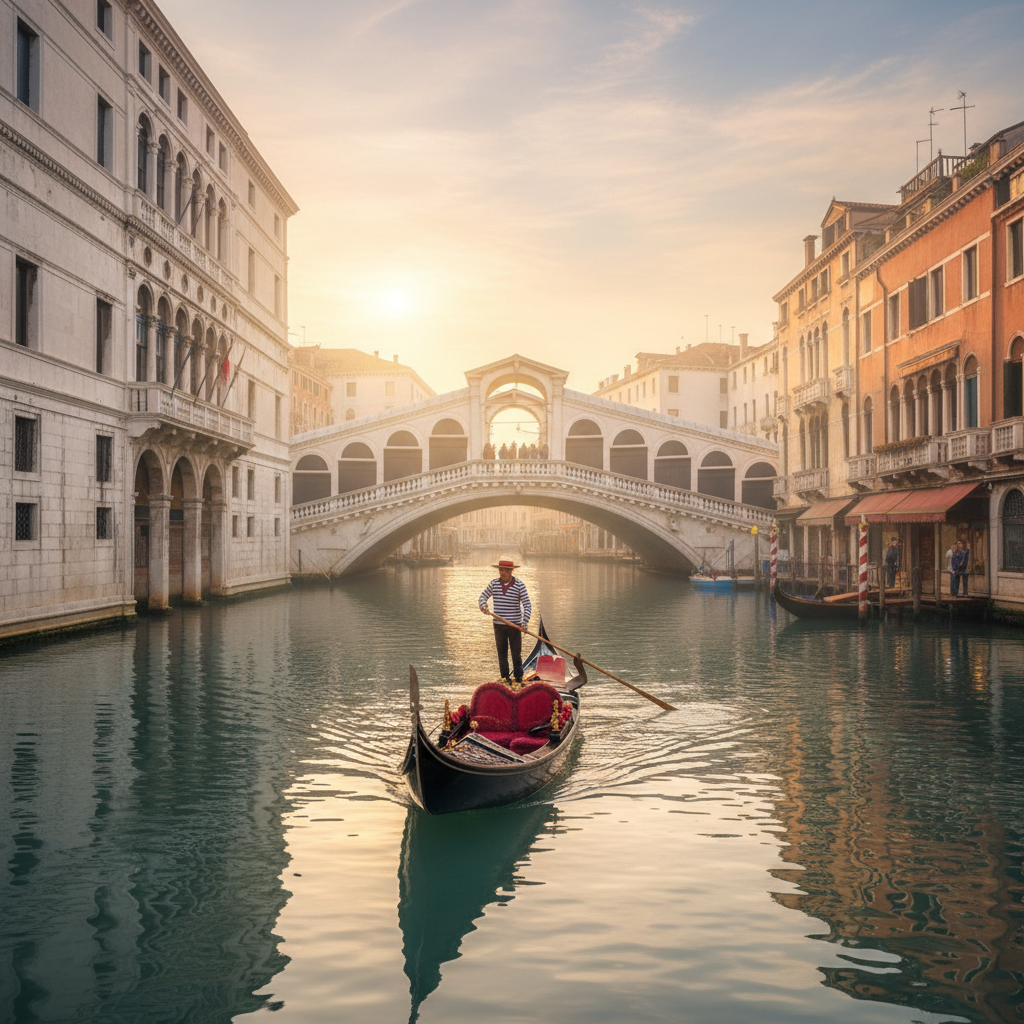
To arrive in Venice by water — whether by the vaporetto from Marco Polo Airport across the lagoon or by a private water taxi along the Grand Canal — is to enter one of the great theatrical sets of European civilization. The Grand Canal, two miles long and lined with over 200 palazzi dating from the 13th to the 18th centuries, is perhaps the single greatest street in the world.
Where to Stay: The Palace Hotels
Aman Venice (aman.com/hotels/aman-venice) occupies the Palazzo Papadopoli — a 16th-century Grand Canal palace with original frescoed ceilings, a private garden (one of only a handful in Venice), and 24 suites decorated with museum-quality period furniture. Aman's approach here is one of reverential restoration: no design statement overlays the extraordinary original fabric of the palace. The garden suite, opening directly onto a wisteria-draped terrace above the Grand Canal, is among the most romantic rooms in Italy. Suites from $3,000/night.
The Gritti Palace (marriott.com/hotels/travel/vcegs-the-gritti-palace) on the Grand Canal opposite the Salute church is Venice's grand dame — a 15th-century doge's residence converted to a hotel in 1895 and beloved by Hemingway, Churchill, Maugham, and virtually every major literary and artistic figure of the 20th century. The terrace restaurant, overlooking the Grand Canal with the dome of Santa Maria della Salute directly opposite, is one of the finest dining views in Europe. Suites from $1,500/night.
Bauer Palazzo (bauerivenezia.com) on Campo San Moisè offers direct Grand Canal access at a slightly lower price point — elegant, formal, with one of the best rooftop bars in the city. Suites from $900/night.
For a different experience entirely, the Hotel Cipriani (belmond.com/hotels/europe/italy/venice/belmond-hotel-cipriani) on the Giudecca island is reached by private launch from San Marco and exists in a state of almost hallucinatory calm — an oasis of gardens and pools while Venice across the water seethes with visitors. This was where the Bellini cocktail was invented by its founder Giuseppe Cipriani (white peach purée and Prosecco), and the tradition continues at the bar. Suites from $2,000/night.
Getting Around: Gondola, Traghetto and Vaporetto
The gondola is the most romantic form of transport in Venice but also the most expensive for point-to-point travel. For a proper experience, hire a private gondola for a 45-minute evening circuit of the quieter inner canals — away from the tourist gondola thoroughfares — through neighborhoods like Cannaregio and Dorsoduro, where the Renaissance palaces have no crowds and the sound of the gondolier's oar is the only noise. Licensed gondola stations (gondolavenezia.it) charge a fixed rate of approximately €80–100 per 30 minutes.
The traghetto is the working gondola — a flat-bottomed ferry that crosses the Grand Canal at several fixed points, costing €2 and used daily by Venetians who stand in the boat as it crosses. It is the most Venetian thing a visitor can do.
The Venice Card (veneziaunica.it) covers unlimited vaporetto (water bus) travel — the public boat network that connects the islands and the Grand Canal line is the city's essential transport and offers a constantly changing view of the architecture.
What to Eat: The Cicchetti Tradition
Venice's culinary tradition is distinct from the rest of Italy — shaped by centuries of trade with the East (reflected in the use of spices, sweet-sour preparations, and ingredients like raisins and pine nuts in savory dishes) and by an extraordinary lagoon larder: soft-shell crabs (moleche) available briefly in spring and autumn, wild sea bass, tiny Venetian castraure artichokes from Sant'Erasmo island, and the white asparagus of Bassano del Grappa.
Cicchetti — the Venetian equivalent of tapas — are small portions of food served at traditional wine bars called bacari. The route of bacari in the Rialto market area and Cannaregio is one of the great food walks in Italy: stop for a glass of local Soave or Valpolicella and a plate of baccalà mantecato (salt cod whipped with olive oil into a creamy mousse on grilled polenta) at Cantina Do Mori (cantinastoricadomori.com) — Venice's oldest wine bar, established 1462. All'Arco (allarcovenezia.it) near the Rialto is equally beloved for its cicchetti. For a formal dinner, Osteria alle Testiere (osterialletestiere.it) in Castello is considered the finest small restaurant in Venice — 22 seats, Venetian lagoon fish only, a short and perfect wine list, and a genuine culinary point of view.
Getting There
Venezia Marco Polo Airport (VCE) receives flights from all major European hubs. The private water taxi from the airport across the lagoon takes 30–40 minutes and costs €100–120 — the most dramatic airport transfer in the world. The Alilaguna public boat service (alilaguna.it) is a far cheaper alternative, stopping at key vaporetto stations. The Orient-Express overnight train from Paris (Venezia Simplon-Orient-Express, belmond.com) arrives at Santa Lucia station at the head of the Grand Canal — the most theatrical arrival in all of rail travel.



Continue Reading