Food & Drink
Gelato: Italy's Frozen Art and the Difference That Makes It Superior
Here's the thing most people get wrong about gelato: it's not just Italian ice cream. It's a distinct frozen dessert with a centuries-old tradition, a slower churning process, less fat, and a warmer serving temperature that create a texture found nowhere else.
Here's the thing most people get wrong about gelato: it's not just Italian ice cream. Call it that in front of an Italian and you'll get a look. Gelato is a distinct frozen dessert with a centuries-old tradition, a slower churning process, less fat, and a warmer serving temperature that together create a texture and flavor experience you won't find anywhere else. It's its own art form, and Italy has been perfecting it for centuries.
**A Renaissance Origin**
The history of gelato stretches back to the Italian Renaissance, when the Medici court in Florence hosted competitions among the city's chefs. The most famous early gelato maker was Bernardo Buontalenti, a 16th-century Florentine chef, architect, and stage designer who is credited with creating the first true gelato by combining milk, cream, eggs, and sugar with chilled ingredients. His creation, served at a banquet for a visiting Spanish delegation, so impressed the guests that the recipe spread across Italy and eventually to France.
Another key figure was Francesco Procopio dei Coltelli, a Sicilian who opened Café Procope in Paris in 1686 and is often credited with introducing gelato to the wider European public. His café became one of the most famous intellectual gathering places in Paris, frequented by Voltaire, Rousseau, and Benjamin Franklin.
**Three Things That Make It Different: Fat, Air, and Temperature**
**Fat content:** Gelato uses more milk and less cream than ice cream, and usually fewer or no egg yolks. The result is a lower fat content — typically 4 to 8 percent for gelato, compared to 10 to 20 percent or more for American ice cream. Less fat means the flavors come through more directly, without the tongue-coating richness that cream imparts.
**Overrun (air):** Ice cream is churned fast and hard to whip in plenty of air — a process called overrun. High-end ice creams have an overrun of about 25 percent, while cheaper commercial versions can reach 50 to over 90 percent, which gives them a light, thin, fast-melting texture. Gelato is churned at a much slower speed, introducing less air — about half as much as ice cream. This is why gelato tastes denser. Because it is. The slower churning produces a denser, silkier texture that delivers flavor with greater intensity.
**Serving temperature:** Gelato is served slightly warmer than ice cream — typically 10 to 22 degrees Fahrenheit, about 8 degrees warmer than ice cream's 6 to 10 degrees. This warmer temperature makes it easier to scoop, makes the flavors more pronounced, and gives it that soft, elastic texture that is the hallmark of a great gelateria.
**The Artisan Tradition**
In Italy, gelato is more than dessert — it's part of everyday food culture. A *passeggiata* through an Italian town in the evening will find locals of every age stopping at the gelateria for a cone or a cup, choosing from flavors that change with the seasons: pistachio in the south, hazelnut from Piedmont, stracciatella from Bergamo, lemon from the Amalfi Coast. The *gelatai* who make it are artisans, trained in a tradition that values fresh ingredients, natural flavor, and a delicate hand.
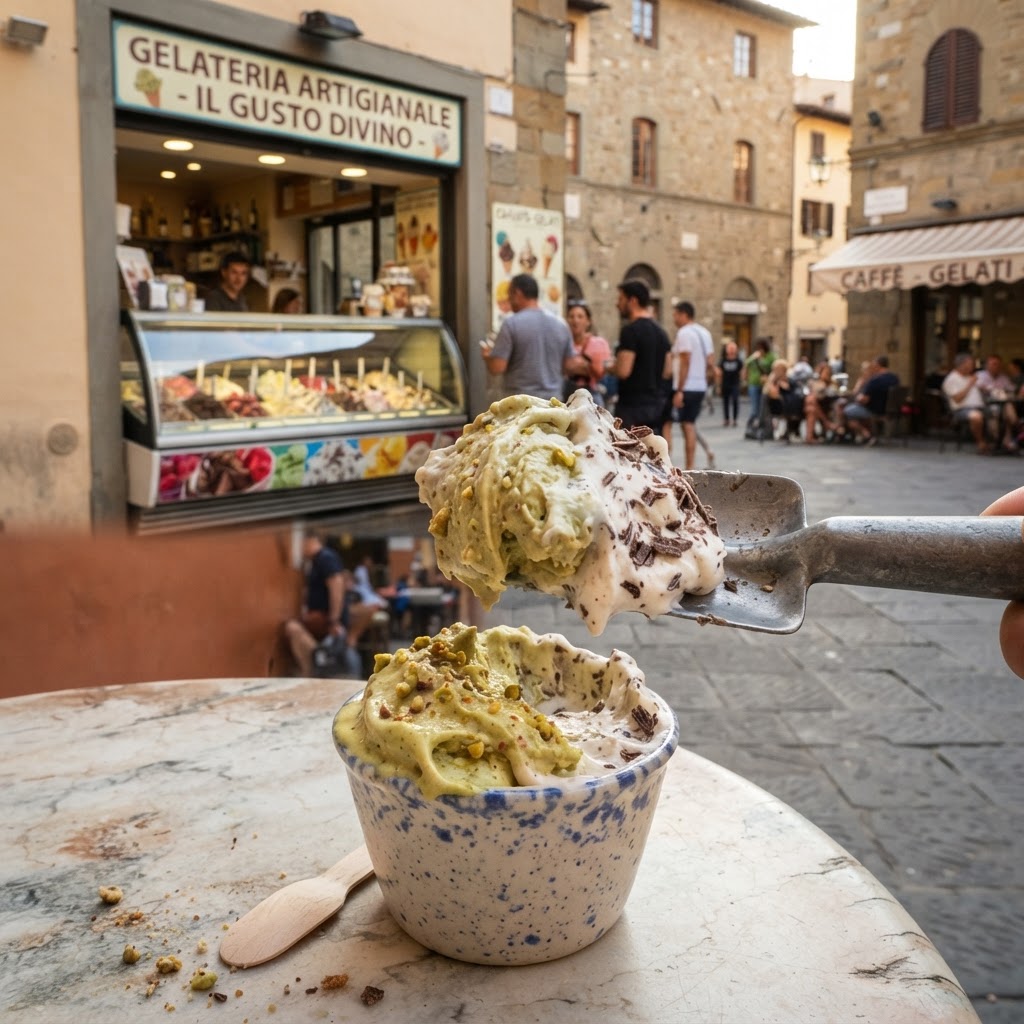
The classic Italian gelato flavors are a study in restraint. Stracciatella — vanilla gelato drizzled with thin streams of melted chocolate that shatter into shards — was invented in Bergamo in 1961. Pistachio, made from the prized pistachios of Bronte in Sicily, is the benchmark by which a gelateria is judged. Fior di latte, the pure sweet-cream gelato with no other flavoring, is the test of a gelatai's skill, as there is nothing to hide behind.
**How to Eat Gelato Like an Italian**
The proper way to eat gelato is slowly, and at the right temperature — never straight from the freezer. A good gelateria will store gelato in covered metal tubs called *carapine*, kept at the correct serving temperature, and will use a spade-shaped spatula rather than a round scoop to shape the gelato into gentle curls. The spade, rather than a scoop, allows the gelato to be shaped without compressing it, preserving the airy-yet-dense texture.
Gelato is meant to be enjoyed in small portions — a *coppetta*, a small cup, or a *cono*, a cone — and savored rather than rushed. A glass of water alongside is traditional, to cleanse the palate between flavors.
**The Brunch Connection**
Gelato is a natural partner for brunch and aperitivo. A scoop of stracciatella or pistachio alongside a Peach Bellini Mimosa or a Rosé & Raspberry Mimosa creates a dessert course that is both indulgent and refreshing. For a more sophisticated pairing, a Lavender Elderflower Mimosa alongside a scoop of fior di latte offers a floral, creamy interplay that captures the elegance of an Italian afternoon.
**References**
- Serious Eats: What Is Gelato? — https://www.seriouseats.com/what-is-gelato
- Wikipedia: Gelato — https://en.wikipedia.org/wiki/Gelato
- Eater: A Brief History of Gelato — https://www.eater.com/2015/7/15/8965767/gelato-ice-cream-difference
- La Cucina Italiana: The History of Gelato — https://www.lacucinaitaliana.com/trends/the-history-of-gelato/



Continue Reading