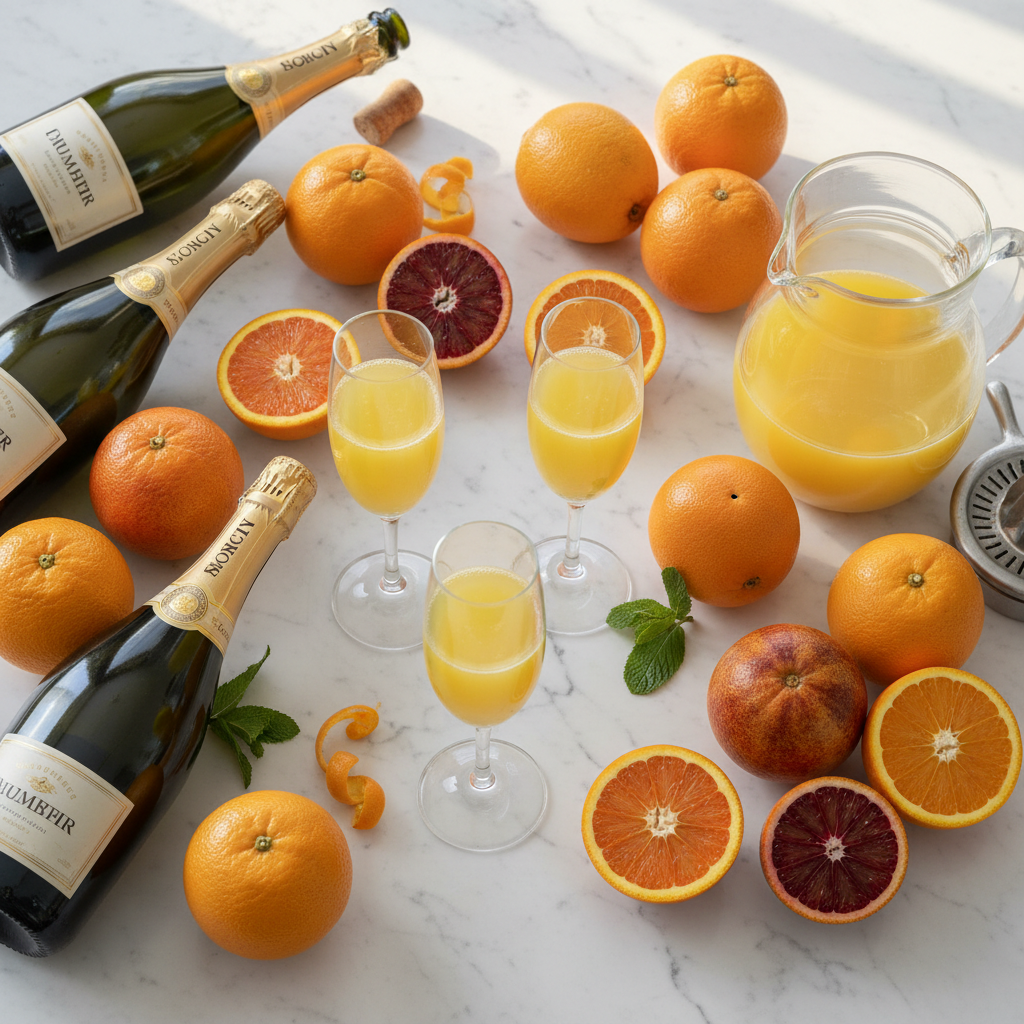
The Definitive Pairing Guide
Champagne × Orange Juice
Matched by sweetness, acidity, body & flavor
The perfect mimosa is not accidental. Every champagne house produces a wine with a distinct dosage (residual sugar), acid level, body, and flavor signature — and each of these variables demands a different orange juice variety to achieve true balance. This guide matches 9 of the world's most beloved champagnes to their ideal OJ partner, with precise ratios and the sensory rationale behind each pairing.
The Orange Juice Profiles
Five juice varieties — each with a distinct sweetness, acidity, and body that determines its champagne match.
Valencia Orange
Year-round (peak Mar–Oct)
Juicy, tangy, bright citrus with balanced sweet-tart character. The gold standard for fresh-squeezed OJ — high juice yield, classic orange flavor.
Navel Orange
Nov–May
Mildly sweet, less acidic, clean and uncomplicated. Easy-drinking with a soft orange flavor. Can turn slightly bitter if pressed too far ahead.
Cara Cara (Red Navel)
Dec–Apr
Remarkably sweet, low acidity, with a hint of raspberry and rose. The most delicate and luxurious OJ for mimosas — pairs beautifully with refined champagnes.
Blood Orange (Moro/Tarocco)
Dec–Mar
Rich, complex, with notes of raspberry, pomegranate, and citrus. Full-bodied, dramatic color, slightly tannic finish. The most visually striking mimosa base.
Mandarin / Clementine
Oct–Feb
Intensely sweet, light-bodied, floral and perfumed. Delicate and aromatic — creates a fragrant, light mimosa with a bright orange hue.
The Pairings
Each champagne matched to its ideal OJ by flavor chemistry, balance, and sensory harmony.
Moët & Chandon Impérial Brut
Dosage: ~7 g/L (Brut)
"Green apple, fresh citrus, white flowers, brioche, mineral freshness. Crisp and lively with fine persistent bubbles."
Ideal OJ Pairing
Valencia Orange
Year-round (peak Mar–Oct)
Juicy, tangy, bright citrus with balanced sweet-tart character. The gold standard for fresh-squeezed OJ — high juice yield, classic orange flavor.
Ratio
50/50
Why This Pairing Works
Moët's bright apple-citrus character and mineral freshness needs the classic tangy backbone of Valencia to create a clean, vibrant mimosa without either element overwhelming the other. The equal ratio preserves the champagne's delicate effervescence.
Veuve Clicquot Yellow Label Brut
Dosage: ~9 g/L (Brut)
"Ripe yellow fruits (peach, pear, apple), brioche, vanilla, toasted nuts. Fuller-bodied with a long, round finish."
Ideal OJ Pairing
Cara Cara (Red Navel)
Dec–Apr
Remarkably sweet, low acidity, with a hint of raspberry and rose. The most delicate and luxurious OJ for mimosas — pairs beautifully with refined champagnes.
Ratio
55/45 (champagne-forward)
Why This Pairing Works
Veuve's rounder, fuller body and slight sweetness pairs exquisitely with the delicate raspberry-tinged sweetness of Cara Cara. The champagne-forward ratio prevents the Cara Cara's low acidity from making the drink cloying, while both contribute floral, fruity elegance.
Perrier-Jouët Grand Brut
Dosage: <5 g/L (Extra Brut–style Brut)
"White flowers, fresh jasmine, pear, white peach, light minerality. One of the most floral and delicate champagnes available."
Ideal OJ Pairing
Cara Cara (Red Navel)
Dec–Apr
Remarkably sweet, low acidity, with a hint of raspberry and rose. The most delicate and luxurious OJ for mimosas — pairs beautifully with refined champagnes.
Ratio
50/50
Why This Pairing Works
Perrier-Jouët's signature floral character — jasmine, white flowers, pear — is uniquely complemented by Cara Cara's natural floral rose note. Two floral profiles amplify each other into something greater than either alone. The low dosage keeps it refreshing rather than sweet.
Bollinger Special Cuvée Brut
Dosage: ~7 g/L (Brut)
"Apple compote, plum, dried fruit, brioche, toasted almonds, coffee, smoke. Rich, complex, Pinot Noir-dominant — the most structured everyday champagne."
Ideal OJ Pairing
Blood Orange (Moro/Tarocco)
Dec–Mar
Rich, complex, with notes of raspberry, pomegranate, and citrus. Full-bodied, dramatic color, slightly tannic finish. The most visually striking mimosa base.
Ratio
55/45 (champagne-forward)
Why This Pairing Works
Bollinger's bold Pinot Noir-driven structure — dark fruits, smoke, brioche — demands a juice with equivalent depth. Blood orange's berry-pomegranate complexity and full body are the only OJ that can hold its own alongside Bollinger. The result is a deeply complex, visually dramatic mimosa.
Billecart-Salmon Brut Rosé
Dosage: ~8 g/L (Brut)
"Fresh red fruits (strawberry, raspberry, redcurrant), rose petals, citrus zest, delicate and precise."
Ideal OJ Pairing
Blood Orange (Moro/Tarocco)
Dec–Mar
Rich, complex, with notes of raspberry, pomegranate, and citrus. Full-bodied, dramatic color, slightly tannic finish. The most visually striking mimosa base.
Ratio
60/40 (champagne-forward)
Why This Pairing Works
Rosé champagne and blood orange is one of the great natural pairings — the strawberry-raspberry notes of the Billecart echo and amplify the berry-pomegranate depth of the blood orange, while the champagne-forward ratio keeps the wine's elegance at the fore. The color is extraordinary.
Nicolas Feuillatte Réserve Exclusive Brut
Dosage: ~9 g/L (Brut)
"Brioche, honey, almond, white fruits. Smooth and approachable with a soft mousse — the best value Champagne for entertaining at scale."
Ideal OJ Pairing
Valencia Orange
Year-round (peak Mar–Oct)
Juicy, tangy, bright citrus with balanced sweet-tart character. The gold standard for fresh-squeezed OJ — high juice yield, classic orange flavor.
Ratio
50/50
Why This Pairing Works
Nicolas Feuillatte's honey-almond softness pairs perfectly with Valencia's classic tangy brightness — the acidity of the OJ lifts and sharpens what is a very smooth, mellow champagne, creating a balanced, crowd-pleasing mimosa that works at any scale.
Ruinart Blanc de Blancs
Dosage: ~6 g/L (Brut)
"100% Chardonnay: vivid citrus, white peach, chalk, Granny Smith apple, crystalline mineral finish. The purest, most precise champagne expression."
Ideal OJ Pairing
Cara Cara (Red Navel)
Dec–Apr
Remarkably sweet, low acidity, with a hint of raspberry and rose. The most delicate and luxurious OJ for mimosas — pairs beautifully with refined champagnes.
Ratio
60/40 (champagne-forward)
Why This Pairing Works
Ruinart Blanc de Blancs is too precise and mineral to pair with a high-acid OJ — the result would be sharp and unpleasant. Cara Cara's sweetness and low acidity provide the exact gentle counterbalance the Chardonnay structure needs, while the champagne-forward ratio preserves the wine's extraordinary purity.
Taittinger Brut Réserve
Dosage: ~8.5 g/L (Brut)
"Chardonnay-dominant: fresh brioche, white flowers, fresh almonds, citrus, honey. Light, elegant, and delicate — the most Chardonnay-expressive grande marque Brut."
Ideal OJ Pairing
Cara Cara (Red Navel)
Dec–Apr
Remarkably sweet, low acidity, with a hint of raspberry and rose. The most delicate and luxurious OJ for mimosas — pairs beautifully with refined champagnes.
Ratio
55/45 (champagne-forward)
Why This Pairing Works
Taittinger's Chardonnay-forward elegance — white flowers, fresh brioche, delicate citrus — mirrors Cara Cara's floral sweetness in a harmonious way. The champagne-forward ratio keeps the wine's delicacy intact; equal parts would let the OJ overwhelm its subtlety.
Krug Grande Cuvée
Dosage: ~6 g/L (Brut)
"Extraordinary complexity: toasted brioche, hazelnut, honeycomb, dried apricot, ginger, cocoa, aged wood. The most complex non-vintage champagne made."
Ideal OJ Pairing
Blood Orange (Moro/Tarocco)
Dec–Mar
Rich, complex, with notes of raspberry, pomegranate, and citrus. Full-bodied, dramatic color, slightly tannic finish. The most visually striking mimosa base.
Ratio
65/35 (strongly champagne-forward)
Why This Pairing Works
Krug is best enjoyed with minimal dilution. Blood orange at 35% is enough to provide visual drama and a complementary berry-pomegranate accent without obscuring the wine's extraordinary complexity. Any more OJ and you're wasting the most exceptional champagne you can buy.
The Golden Rules of the Perfect Mimosa
Always use fresh-squeezed juice
Carton and bottled OJ are pasteurized, which cooks away volatile aromatics and concentrates sweetness. Fresh juice, squeezed 30 minutes before service, has a brightness that no bottled product can replicate.
Serve your champagne deeply cold
Champagne should be 45–48°F (7–9°C) when poured. Cold suppresses sweetness and amplifies acidity, creating a livelier, more refreshing mimosa. Never use ice in a mimosa.
Pour champagne into juice, not juice into champagne
Pouring champagne last minimizes effervescence loss and avoids the OJ's acids from prematurely degassing the wine.
Do not stir
Stirring destroys the bubbles. The gentle density difference between champagne (lighter) and juice (heavier) creates natural stratification that blends beautifully as you sip.
Use a proper Champagne flute or tulip glass
The narrow bowl preserves carbonation; the tapered rim concentrates aromas directly to the nose. Coupe glasses are beautiful but lose carbonation within minutes.