Travel
Tuscany: Hilltop Villages, Chianti Vineyards & the Art of the Slow Journey
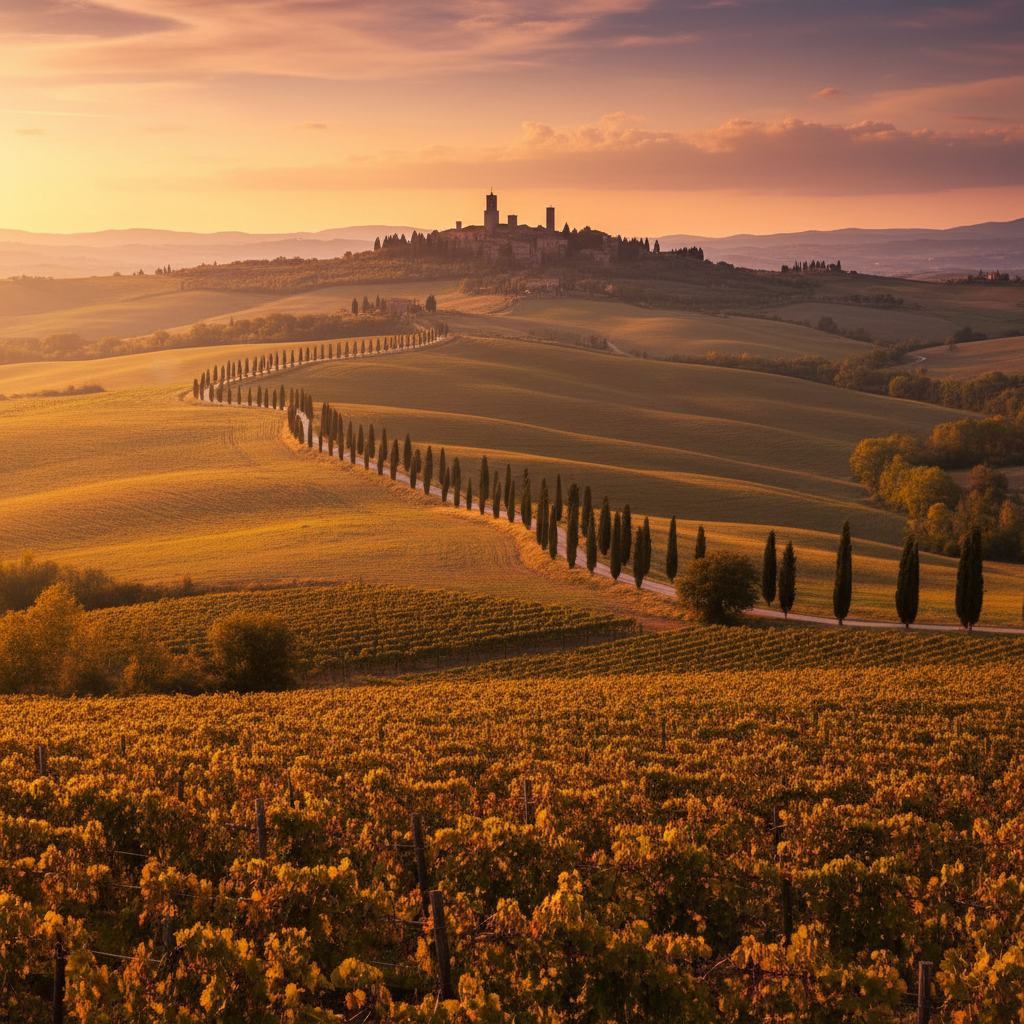
Tuscany is the landscape that has defined the Western world's idea of beauty since the Renaissance — rolling hills of olive groves and vineyards, cypress-lined roads, and medieval hilltop towns that seem to have grown organically from the earth itself. No other region rewards slow travel more generously.
Tuscany is the landscape that has defined the Western world's idea of beauty since the Renaissance — rolling hills of olive groves and vineyards, cypress-lined roads ascending to fortified hilltop towns, and a quality of light in the late afternoon that transforms even an ordinary hillside into something worthy of a painting. No other region in the world rewards slow, unhurried travel more generously.
The region's genius is its layering: world-class art and architecture in Florence and Siena, extraordinary wine in the Chianti Classico and Brunello di Montalcino zones, a cuisine of remarkable depth and simplicity, and a landscape that changes character from valley to valley. A week here is never enough.
Where to Stay: The Finest Addresses
Rosewood Castiglion del Bosco (rosewoodhotels.com/en/castiglion-del-bosco) near Montalcino occupies a medieval Sienese castle estate of 4,200 acres in the Val d'Orcia — a UNESCO World Heritage landscape. The 42 suites and villas are distributed across the borgo (hamlet), with a 9-hole golf course, a working Brunello di Montalcino wine estate, and a spa built into a 12th-century tower. This is the benchmark luxury agriturismo experience. Villas from $3,000/night. The estate's own Brunello DOCG is one of the finest produced in the zone.
Adler Thermae (adler-resorts.com/thermae) in Bagno Vignoni — a thermal spa village in the Val d'Orcia whose main piazza is a Renaissance bathing pool — is the premier wellness destination in Tuscany. The thermal baths (fed by natural 126°F sulphurous springs), the vast indoor/outdoor spa complex, and the panoramic hillside setting combine for one of the most restorative hotel experiences in Europe. Rooms from $600/night.
Il Pellicano (ilpellicanohotel.com) on the Monte Argentario peninsula of the Tuscan Maremma is the most glamorous hotel in Tuscany — perched above the Tyrrhenian Sea on a private headland, with a seawater pool cut into the rocks, rooms decorated with the refined personal taste of its American founder Patricia Cicogna, and a Michelin-starred restaurant. Suites from $1,200/night.
The Chianti Classico Wine Road
The Strada del Vino Chianti Classico (stradachianti.it) runs through the heart of the zone between Florence and Siena — the 40km of hills that produce Sangiovese-based red wines at their most elegant. The Black Rooster (Gallo Nero) on a bottle of Chianti Classico is the denomination's mark of origin, established by the Consorzio del Vino Chianti Classico (chianticlassico.com).
The estates most worth visiting include Antinori nel Chianti Classico (antinori.it/en/winery/antinori-nel-chianti-classico) — a spectacular underground winery designed by Marco Casamonti, burrowed into a hillside vineyard between Bargino and Tavarnelle, open for tours and tastings. Castello di Ama (castellodiama.com) near Gaiole is as celebrated for its contemporary art collection (site-specific works by Anish Kapoor, Louise Bourgeois, and Daniel Buren, among others) as for its wines. Badia a Coltibuono (coltibuono.com) near Gaiole offers stays in a converted 11th-century Vallombrosan monastery estate, with excellent wine, olive oil, and a cooking school.
Beyond Chianti: The Val d'Orcia
South of Siena, the Val d'Orcia — inscribed as a UNESCO World Heritage Cultural Landscape in 2004 — is Tuscany at its most cinematically beautiful: the rounded clay hills (crete senesi), the isolated farmhouses (poderi), the cypress-lined tracks (strade bianche), and the medieval villages of Pienza, Montalcino, Montepulciano, and Bagno Vignoni arranged across the landscape like an open-air museum.
Pienza (comune.pienza.si.it), planned in the 1460s by Pope Pius II as an ideal Renaissance city, contains the finest concentration of 15th-century urban design in Italy within its tiny cathedral square. The Pecorino di Pienza — sheep's milk cheese aged in walnut leaves, terracotta, or oak barrels — is the local delicacy and sold at several shops around the main piazza.
Getting There
Florence Peretola Airport (FLR) and Pisa Galileo Galilei (PSA) are the main entry points. A hire car is essential for exploring the countryside — Tuscany without a car is a lesser experience. The strade bianche (white gravel roads) of the Crete Senesi are best driven in a vehicle with reasonable ground clearance, ideally in the early morning when the dust has settled and the light is golden.
Continue Reading