Home
The English Tudor Revival Cottage: Mock Tudor and the Romance of Merrie England
Half-timbering, leaded glass, and a steeply pitched roof — the mock-Tudor cottage that romanticised the medieval English village for the modern world.
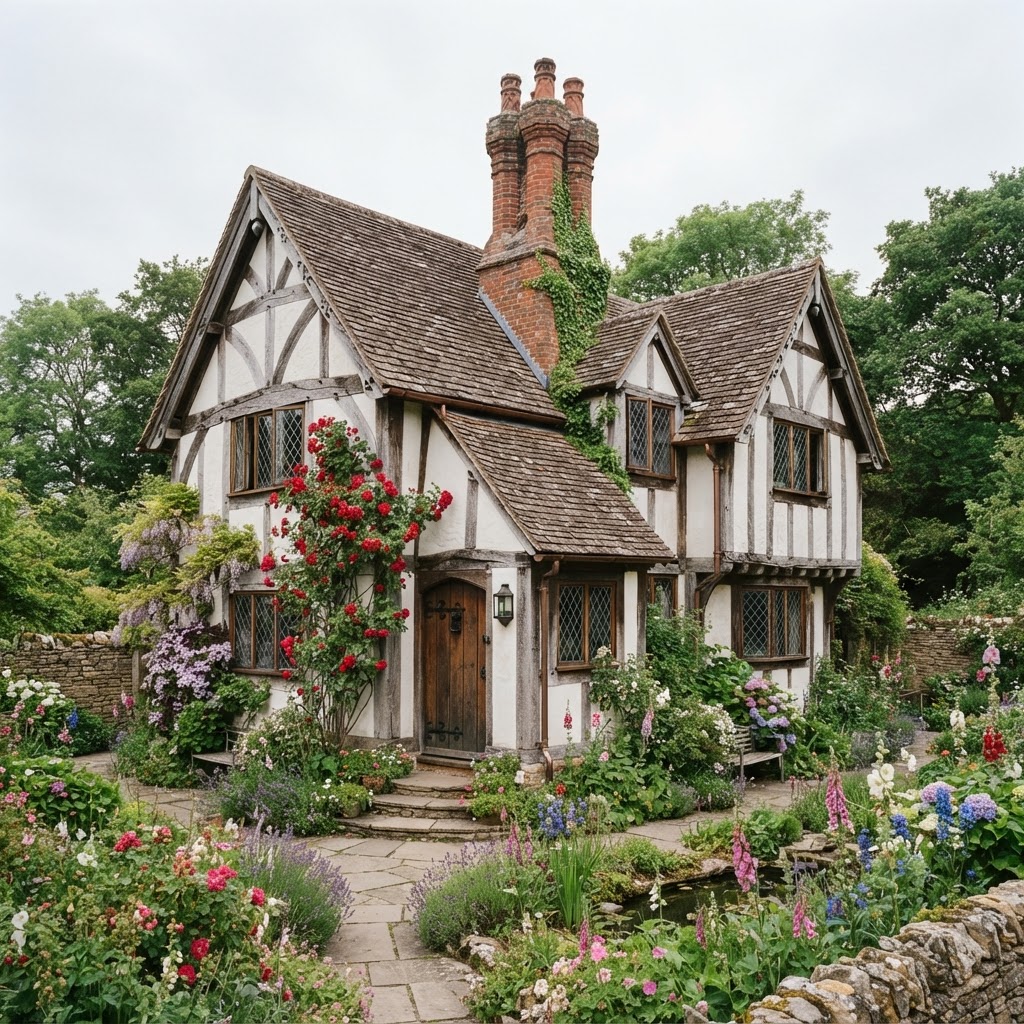
The English Tudor Revival cottage — half-timbered, steeply roofed, climbing with roses — is the house that romanticised the medieval English village for the modern world. Known affectionately (and sometimes dismissively) as "mock Tudor," it became, in the early 20th century, one of the most beloved domestic styles in Britain and, carried across the Atlantic, in America too.
According to [Wikipedia](https://en.wikipedia.org/wiki/Tudor_Revival_architecture), Tudor Revival architecture first manifested in domestic building in the United Kingdom in the latter half of the 19th century, based on a revival of aspects perceived as Tudor — though in reality it usually drew on the English vernacular architecture of the Middle Ages that had survived into the Tudor period.
**A romance of the past**
Tudor Revival was, at heart, nostalgic. In the Industrial Age, the half-timbered cottage — with its hand-hewn beams, its thatched or tiled roof, its leaded casement windows — represented an imagined "Merrie England" of craft, community, and pre-industrial calm. The style's cozier subset, known as Tudorbethan, was closely associated with the [Arts and Crafts movement](https://en.wikipedia.org/wiki/Arts_and_Crafts_movement), which championed exactly those values — honest materials, handwork, and the romance of the medieval maker.
**The anatomy of the style**
- **Decorative half-timbering** — dark-stained wood beams set against whitewashed or rendered plaster.
- A **steeply pitched gabled roof**, often with clay tiles or thatch.
- **Tall, prominent chimneys**, often brick, often ornamented.
- **Leaded diamond-pane casement windows**.
- **Climbing plants** — roses, wisteria, ivy — softening the timber frame.
**Why it charmed two continents**
The Tudor Revival offered the romance of the manor house at the scale of the cottage, and it spread fast — from the spec-built suburbs of interwar England to the leafy neighborhoods of 1920s America, where it became one of the period's most popular "storybook" styles. Done well, it is one of the most romantic domestic architectures ever produced; done badly, it descends into the "mock Tudor" of suburban cliché. The difference, as ever, is in the craft — real timber, real leaded glass, proportions drawn from the past rather than from a developer's pattern book.
**References:**
- Tudor Revival architecture: [Wikipedia](https://en.wikipedia.org/wiki/Tudor_Revival_architecture)
- Arts and Crafts movement: [Wikipedia](https://en.wikipedia.org/wiki/Arts_and_Crafts_movement)


Continue Reading