Home
The Trulli of Alberobello: Puglia's Iconic Conical Stone Houses
Whitewashed cones of dry-stacked limestone, capped with painted symbols — the extraordinary mortarless houses of a single Puglian town, now a UNESCO site.
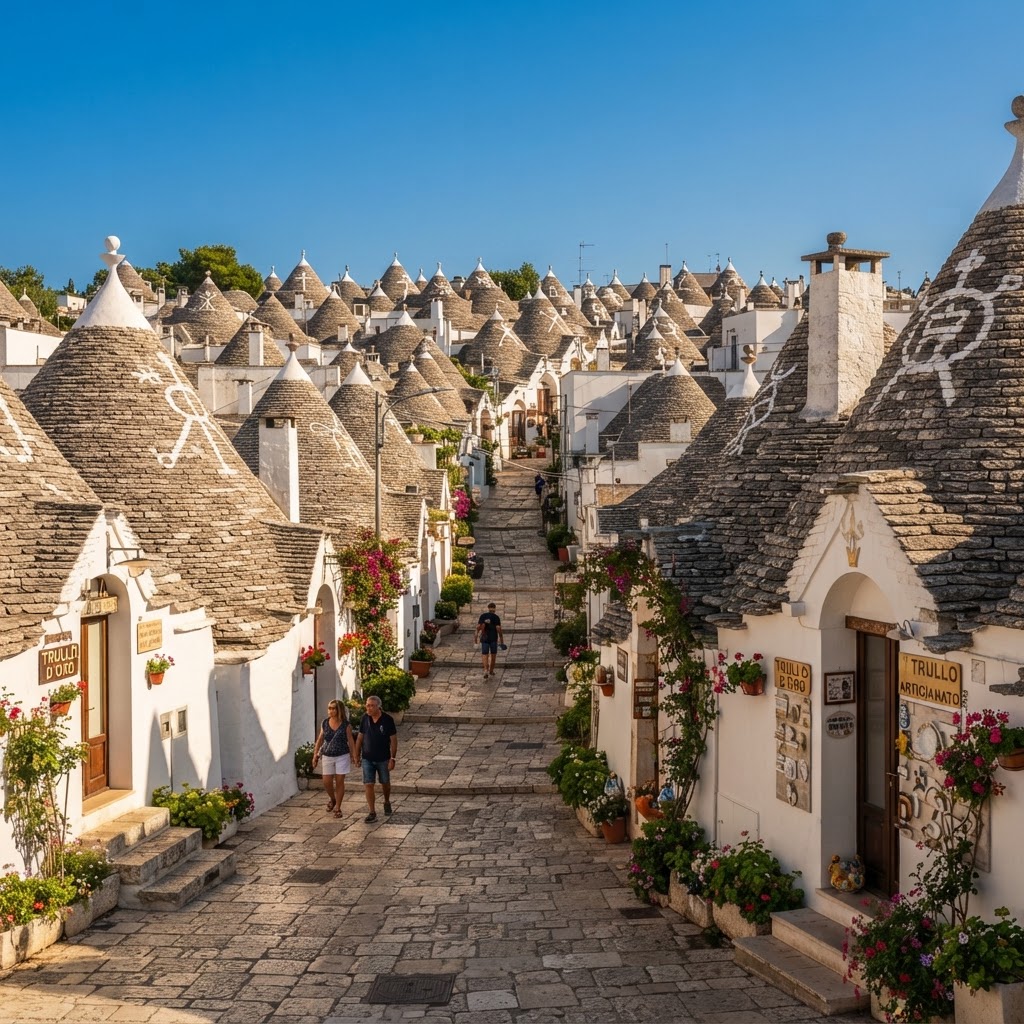
In a single town in the heel of Italy, the houses wear pointed white caps. The trulli of Alberobello — conical, dry-stone houses built entirely without mortar — are one of the most extraordinary vernacular architectures in the world, and since 1996 they have been a [UNESCO World Heritage Site](https://whc.unesco.org/en/list/787/).
According to [Wikipedia](https://en.wikipedia.org/wiki/Trullo), a trullo (plural, trulli) is a traditional Apulian dry-stone hut with a conical roof, its internal space covered by a dry-stone, corbelled vault.
**Built without mortar**
The trulli are feats of dry-stone construction — limestone boulders gathered from the surrounding fields, stacked by hand, without a drop of cement, into walls and conical roofs that have stood for centuries. The walls are double-skinned with a rubble core; the roof is a corbelled cone of limestone slabs, capped with a closing keystone and often crowned with a painted whitewashed symbol — a cross, a star, a heart — meant to bring good fortune to the house.
**Why the cones**
The form is brilliantly practical. The thick limestone walls keep the interior cool in the Puglian summer and warm in the mild winter, and the conical roof, built without mortar, can be dismantled and rebuilt — a useful trait in a region where, as UNESCO notes, the dry-stone technique reaches back thousands of years. The trulli of Alberobello represent, in UNESCO's words, a dry-stone building tradition several thousand years old, found across the Mediterranean.
**The two quarters**
Alberobello has two trulli districts — Aia Piccola and Rione Monti — where more than 1,600 trulli cluster along steep streets, their conical roofs forming a skyline like no other on earth. Many are still lived in; many more have become shops, restaurants, and guesthouses, and the town draws visitors from around the world who come to walk among the cones.
**Why it astonishes**
The trulli are a reminder that the most extraordinary architecture is often the most local — a building tradition born of the rocks in the field, the climate of the valley, and the ingenuity of the people who needed a roof. To stand inside a trullo, beneath its corbelled stone dome, is to stand inside one of the great, quiet inventions of domestic architecture.
**References:**
- Trullo: [Wikipedia](https://en.wikipedia.org/wiki/Trullo)
- The Trulli of Alberobello (UNESCO World Heritage Centre): [UNESCO](https://whc.unesco.org/en/list/787/)



Continue Reading