Travel
Newport, Rhode Island: Gilded Age Mansions & the Grandeur of America's Vanderbilt Summer
Where America's Gilded Age lives on — Newport's Bellevue Avenue mansions, from The Breakers to Marble House, alongside the colonial streets of a 1639 seaport and the sailing waters that hosted the America's Cup for over a century.
Newport, Rhode Island is where the Gilded Age lives on — a slender island city in Narragansett Bay where America's wealthiest families of the late nineteenth century built summer 'cottages' of staggering grandeur, where the America's Cup was contested for over a century, and where a colonial streetscape of clapboard houses still slopes down to one of the most beautiful harbors on the Eastern Seaboard. Founded in 1639, Newport was, for two distinct eras, the most fashionable resort in America.
The Gilded Age Mansions
Between 1870 and 1914, Newport's Bellevue Avenue became the most concentrated display of American wealth ever assembled. The great families — Vanderbilt, Astor, Belmont, Marble — commissioned the leading architects of the day to build summer houses that were, in truth, palaces.
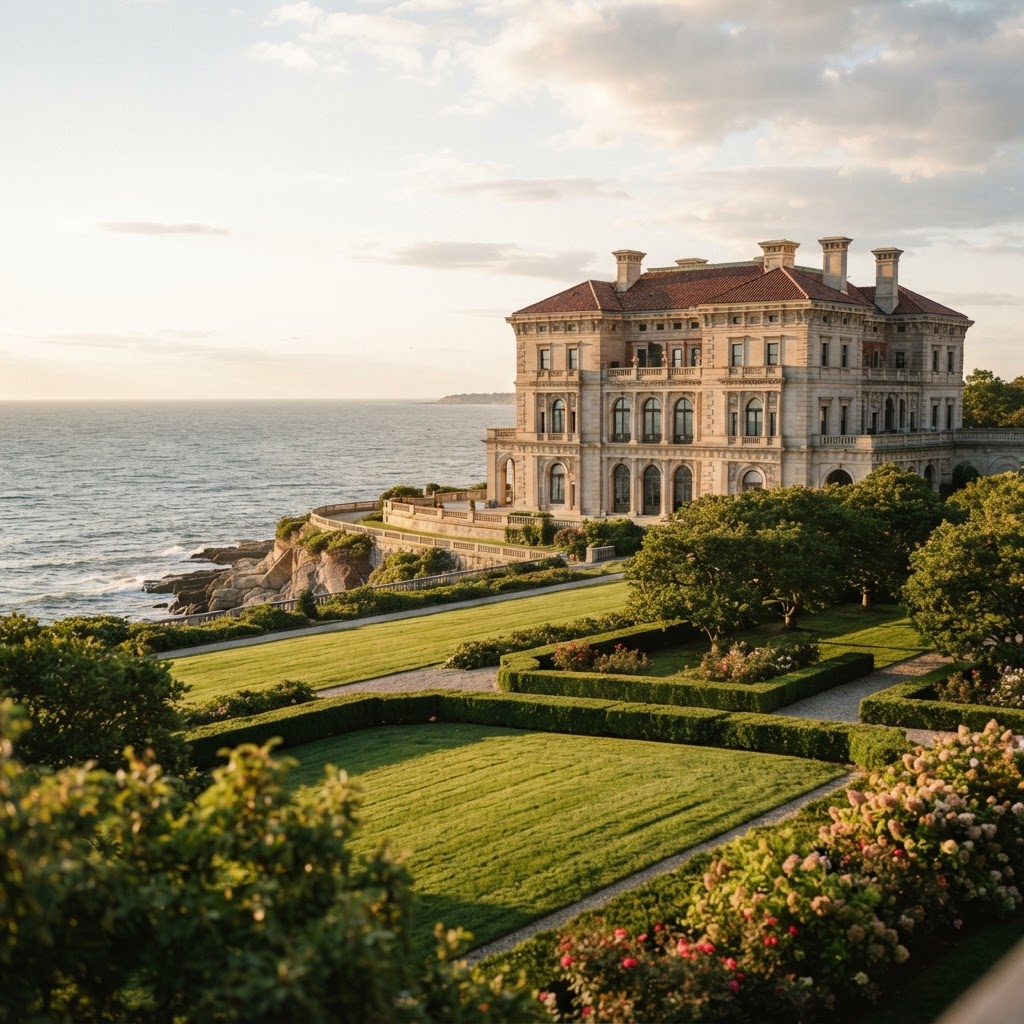
The greatest of them all is The Breakers, built between 1893 and 1895 for Cornelius Vanderbilt II, head of the New York Central Railroad. Designed by Richard Morris Hunt in the Italian Renaissance style and inspired by the palazzi of Turin and Genoa, it has 70 rooms across 62,500 square feet, with interiors by Jules Allard and Sons of Paris. The Great Hall, rising 50 feet beneath a ceiling of painted clouds, and the dining room with its Baccarat chandelier and walls of Algerian onyx, represent the pinnacle of American Beaux-Arts interiors. The house was built of fireproof steel and limestone after a 1892 fire destroyed its wooden predecessor.
Nearby stands Marble House (1888-1892), Alva Vanderbilt's marble 'temple to the arts' designed by Hunt at a cost of $11 million; The Elms (1899-1901), modeled on the Château d'Asnières outside Paris; Rosecliff (1898-1902), the Stanford White masterpiece used in the filming of The Great Gatsby; and Rough Point (1892), the oceanfront estate of tobacco heiress Doris Duke. These houses, collectively, form the greatest concentration of Gilded Age domestic architecture in the United States.
The Preservation Society
The survival of these houses is the work of the Preservation Society of Newport County, founded in 1945. The Society acquired its first property, Hunter House (a 1748 colonial), in 1946, and by the 1970s — as maintenance costs forced many families to sell or demolish — it had acquired The Breakers, The Elms, Marble House, and Rosecliff. Today the Society maintains eleven historic properties and welcomes over a million visitors annually.
The Colonial City
Long before the Gilded Age, Newport was one of the most important ports in colonial America, a center of the rum and slave trades and, more creditably, a haven of religious tolerance. Newport's Trinity Church (1726), designed by Richard Munday and modeled on Sir Christopher Wren's London churches, is one of the finest colonial-era houses of worship in America. The Touro Synagogue (1763), designed by Peter Harrison, is the oldest synagogue building in the United States and a National Historic Site — a monument to Newport's founding commitment to religious freedom.
The White Horse Tavern (1673) is, by most reckonings, the oldest operating tavern in America. The Cliff Walk, a 3.5-mile National Recreation Trail along the eastern shore, passes behind the mansions and offers the most dramatic juxtaposition of Gilded Age architecture and the open Atlantic anywhere in the country.
The America's Cup and the Yachting Capital
From 1870 until 1983, the America's Cup — the oldest trophy in international sport — was contested in the waters off Newport. The New York Yacht Club's Harbor Court facility, on the waterfront downtown, remains a center of American yachting. The Museum of Yachting and the International Yacht Restoration School, both on the waterfront, preserve the wooden-boat traditions that earned Newport the title 'Sailing Capital of the World.'
Reference Links:
- The Breakers (Preservation Society): newportmansions.org
- Discover Newport (Official): discovernewport.org
- Touro Synagogue (NPS): nps.gov/tosy
- Cliff Walk: cliffwalk.com
- White Horse Tavern: whitehorsetavern.com



Continue Reading