Travel
Matera, Italy: The Ancient Cave City of the Sassi & Europe's Most Extraordinary Rebirth
One of the oldest continuously inhabited cities on earth, Matera's cave-dwelling Sassi districts — carved into a limestone ravine for 9,000 years — went from ancient settlement to national shame to UNESCO World Heritage Site and 2019 European Capital of Culture in one of the great urban rebirths.
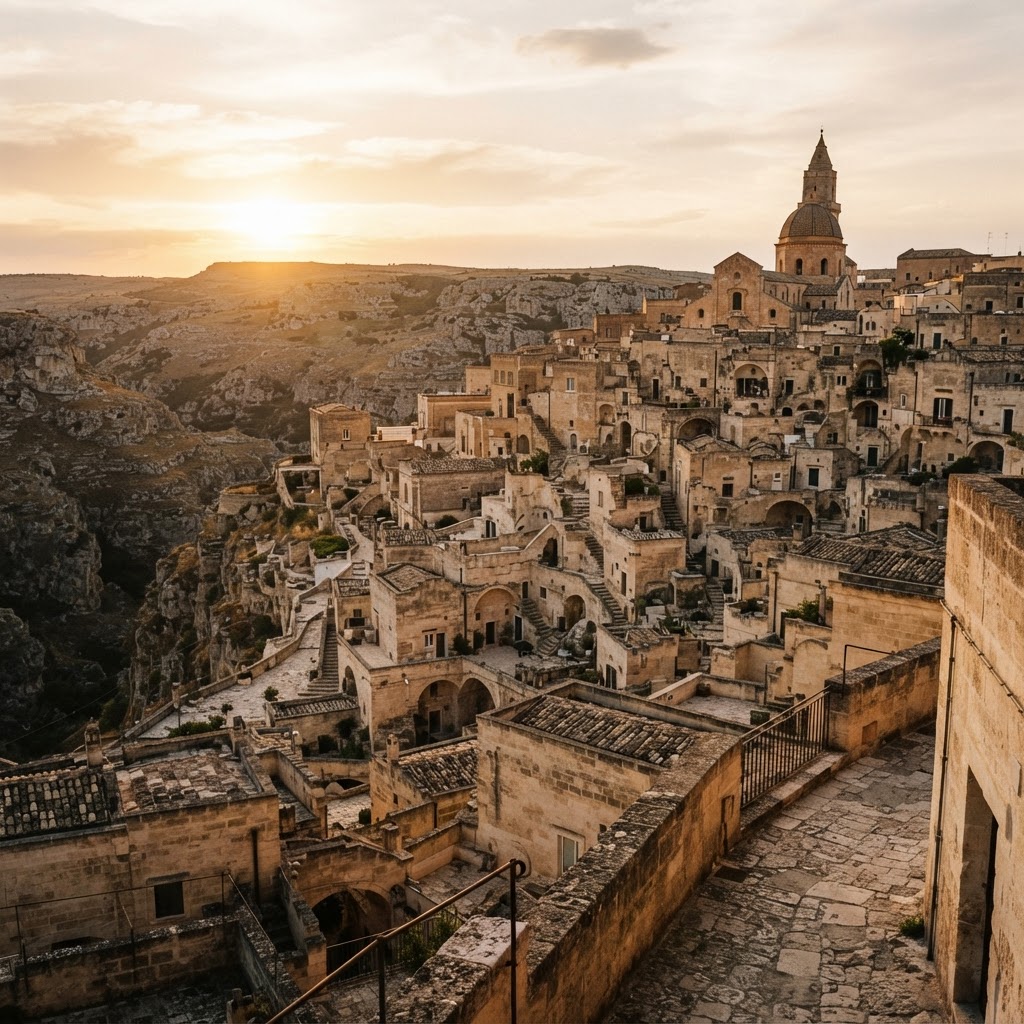
Matera, in the southern Italian region of Basilicata, is one of the oldest continuously inhabited cities in the world — a place where people have lived in cave dwellings carved into a limestone ravine for over nine thousand years. Its Sassi districts, a cascade of stone houses, churches, and streets built into and upon natural caves, were declared a UNESCO World Heritage Site in 1993, the first site so honored in southern Italy, and the city served as the European Capital of Culture in 2019. Matera's story — from ancient settlement to national shame to international icon — is one of the most extraordinary urban rebirths in modern history.
The Sassi
The Sassi di Matera are two ancient districts — Sasso Caveoso and Sasso Barisano — that descend the steep sides of a ravine (the Gravina) below the Civita, the city's original fortified nucleus. Together with the Park of the Rupestrian Churches on the opposite bank, they form a UNESCO property of 1,016 hectares containing more than a thousand cave dwellings and a large number of rock-cut churches and monasteries.
Human settlement here dates to the Palaeolithic period. From the 8th century onward, the natural caves were elaborated into houses, churches, and workshops — structures that are not built upon the rock but carved from it, so that the roof of one house is often the street or the floor of another. The result is a vertical city of honey-colored stone, a labyrinth where the boundary between the natural and the built is dissolved. A 13th-century Romanesque cathedral crowns the Civita between the two Sassi, and the 17th-century Piano district forms the later backbone of the city above.
Shame and Rebirth
For much of the twentieth century, the Sassi were a byword for poverty. By the 1950s, an estimated 15,000 people lived in the caves — often with their animals — in conditions of such overcrowding and disease that the Italian government, in 1952, passed a special law (Law 619) to evacuate the Sassi and resettle their inhabitants in new housing on the plateau above. The evacuation was completed by the late 1950s, and the Sassi were abandoned to decay.
The rebirth began slowly. In the 1980s, artists and pioneers began to reclaim the caves as homes and studios. The 1993 UNESCO inscription brought international attention, and Law 771/1986 — which delegated management of the historic area to the Municipality — created the framework for restoration. The opening of cave hotels (notably Sextantio Le Grotte della Civita) demonstrated that the Sassi could become a destination of genuine luxury. The 2019 European Capital of Culture designation, for which Matera defeated a field of Italian competitors, cemented its transformation.
What to See
The best way to experience Matera is on foot, descending into the Sassi from the Piano. In Sasso Caveoso, the cave dwellings remain largely in their original state — the Casa Grotta di Vico Solitario preserves a furnished cave home as it was lived in until 1958. In Sasso Barisano, many caves have been converted into restaurants, shops, and hotels. The rock-cut churches (chiese rupestri), decorated with Byzantine frescoes, are scattered through both districts and the Murgia across the ravine.
The views from the Belvedere di Murgia Timone, across the Gravina to the city, are among the most dramatic in Italy. The Palombaro Lungo, an enormous cistern beneath the city that once held the water supply, is open as a museum of the city's hydraulic ingenuity. And the 17th-century Church of Purgatory, with its skull-adorned facade, is a Memento Mori landmark.
Matera on Screen
Matera's otherworldly landscape has made it a favored location for biblical and historical cinema. Pier Paolo Pasolini filmed The Gospel According to St. Matthew here in 1964. Mel Gibson shot much of The Passion of the Christ here in 2004. And in 2021, Matera stood in for ancient Jerusalem in the James Bond film No Time to Die.
Reference Links:
- The Sassi of Matera (UNESCO): whc.unesco.org/en/list/670
- Matera, the Sassi (Italia.it): italia.it
- Matera European Capital of Culture 2019: matera-basilicata2019.it
- Casa Grotta di Vico Solitario: casagrottadicivosolitario.it



Continue Reading