Food & Drink
The World's Great Coffee Cultures: From Addis Ababa to Melbourne
Coffee is the world's most consumed beverage after water — and the rituals built around it, from the Ethiopian ceremony to the Viennese café to Melbourne's flat white culture, are among civilisation's most distinctive social technologies.
Coffea arabica originated in the forests of southwestern Ethiopia — in the Kaffa region, whose name may be the etymological root of 'coffee' — where it has grown wild for centuries. The beverage prepared from its roasted seeds has, over roughly 600 years of global spread, become the second most traded commodity in the world after oil, the daily ritual of an estimated 2 billion people, and the social infrastructure around which some of civilisation's most significant intellectual and cultural movements have organised themselves: the Enlightenment cafés of London, Paris, and Vienna; the Viennese Kaffeehäuser that hosted Freud, Trotsky, and Klimt; the third-wave coffee movement that reimagined quality coffee as a craft product comparable to wine.
**Ethiopia: The Origin**
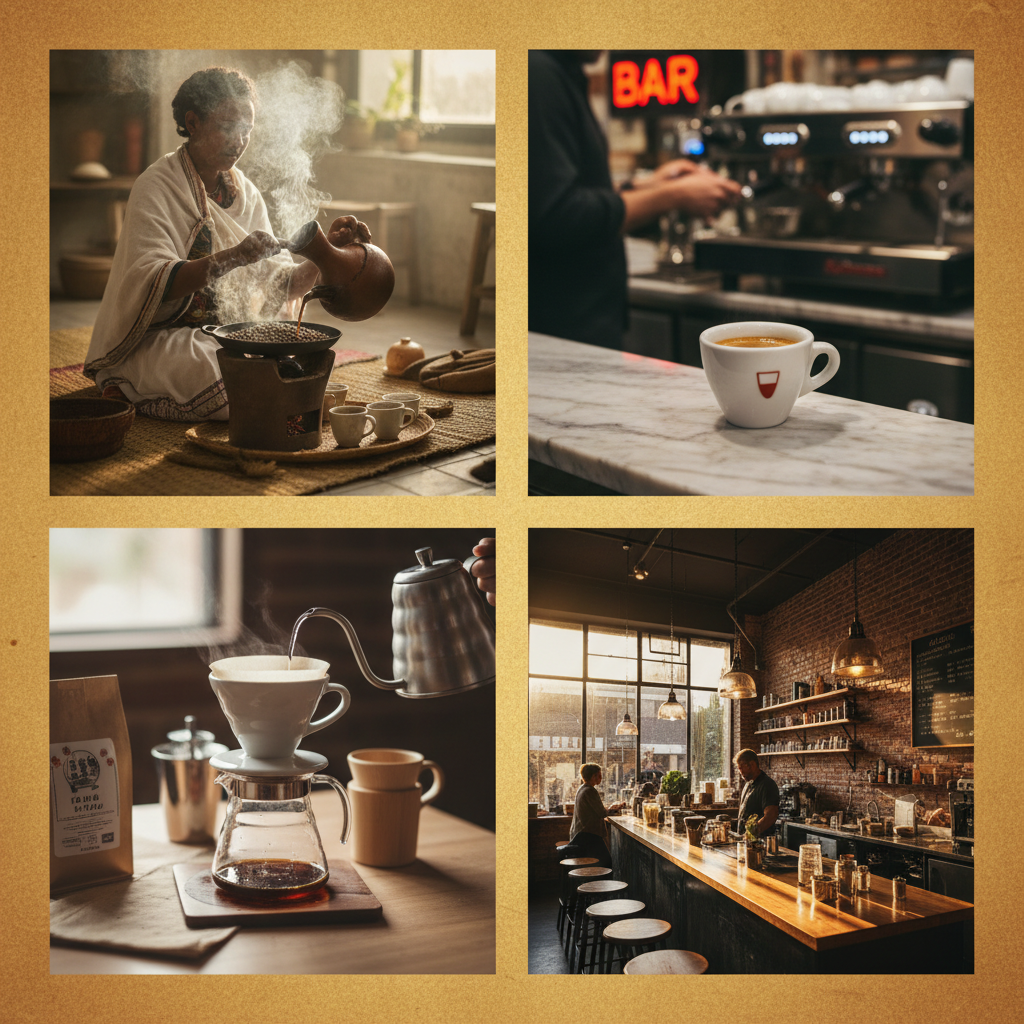
In Ethiopia, coffee is not a product but a ceremony — the Buna Tetu (coffee ceremony) is a social ritual of extraordinary duration and formality, performed by a woman in traditional dress who roasts raw green beans over charcoal before grinding them by hand and brewing them in a clay jebena pot. The coffee is served three times — the first round (Abol) is the strongest; the second (Tona) and third (Baraka, meaning 'blessing') progressively weaker. The ceremony may last two to three hours and is considered an expression of respect and hospitality. It is one of the most important social rituals in Ethiopian culture.
Ethiopia is still the world's fifth-largest coffee producer and the source of some of the most distinctive and geographically specific coffees available: Yirgacheffe (known for its bright citrus and floral notes — jasmine, bergamot, and lemon verbena are commonly identified), Sidamo, Harar (a dry-processed coffee of exceptional complexity with blueberry and wine notes), and Guji are the most celebrated origins. Reference: ethiopiancoffeeassociation.org
**Italy: The Espresso Culture**
Italy did not invent coffee, but it invented the espresso machine and the culture around it that has become the global template for coffee service. The espresso — a concentrated shot of coffee extracted under approximately 9 bars of pressure through finely ground, tamped coffee — was first served commercially in Milan in 1906, though the modern style of machine was perfected by Achille Gaggia in 1948 (gaggia.com).
Italian coffee culture is characterised by its brevity and its standing: the typical Italian coffee experience is consumed in seconds at the bar counter, without sitting, without a laptop, without extended social performance — an espresso taken between appointments, a macchiato in the mid-afternoon, a cappuccino only before noon (ordering a cappuccino after a meal in Italy marks you immediately as a tourist). The coffee itself is typically a dark-roasted blend of Arabica and Robusta — the latter adding body and crema. Sant'Eustachio il Caffè (santeustachioilcaffe.it) in Rome, founded 1938, and Caffè Florian (caffeflorian.com) in Venice, open since 1720, are the two most historically celebrated Italian coffee addresses.
**Vienna: The Kaffeehäuser Tradition**
The Viennese coffeehouse is a UNESCO Intangible Cultural Heritage — a distinctive social institution that emerged in the late 17th century (Vienna's first coffeehouse opened in 1683, according to legend using beans left behind by the retreating Ottoman army) and that reached its cultural zenith in the late 19th and early 20th centuries as the gathering place of Vienna's intellectual, artistic, and revolutionary communities.
The defining characteristics of the Viennese Kaffeehaus: you may stay as long as you like on a single order; you are brought a glass of water with your coffee; newspapers are provided on long wooden holders; there is no pressure to leave, ever. The atmosphere is simultaneously public and private — the sociologist describes it as 'a public room that feels like a private one.' Café Central (palaisevents.at/en/cafes/cafe-central), where Trotsky played chess in 1913; Café Hawelka (hawelka.at), opened 1939, beloved of artists and writers for decades; and Café Landtmann (landtmann.at), Freud's local, founded 1873 — these are the canonical addresses.
**Japan: Pour-Over Precision**
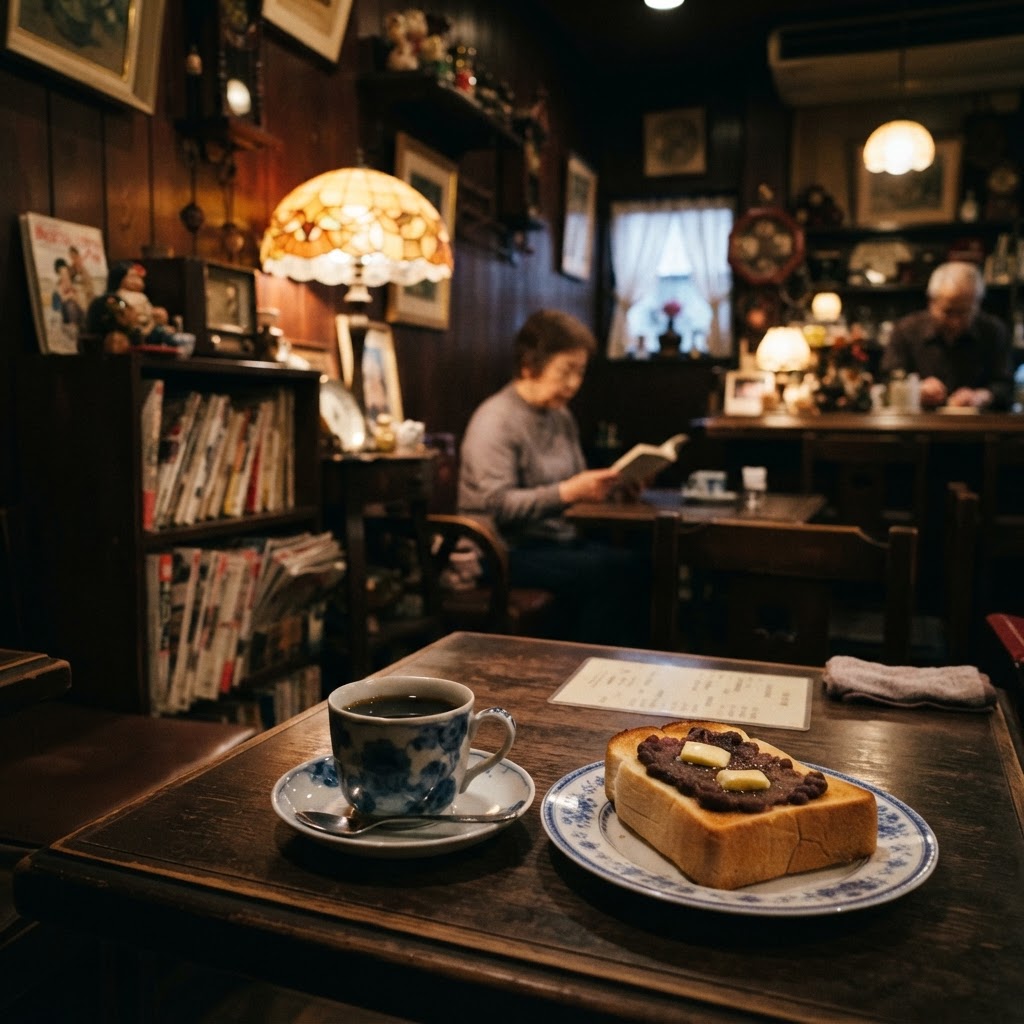
Japan has developed the most technically meticulous coffee culture in the world — the logical extension of the Japanese tendency toward craft perfection applied to a new medium. The kissaten (traditional Japanese coffee shop) culture — characterised by hand-poured drip coffee, exceptional beans, and a quietude bordering on ceremony — emerged in the post-war period and has experienced a significant revival in recent years as younger Japanese coffee enthusiasts have rediscovered it.
The V60 dripper, manufactured by Hario (hario.com) in Japan and now used globally as the standard for pour-over coffee, was developed from Japanese laboratory glassware. Blue Bottle Coffee (bluebottlecoffee.com) — founded in Oakland, California — opened its Japan operations in Tokyo's Kiyosumi-Shirakawa neighbourhood in 2015, a choice that reflected the neighbourhood's existing concentration of specialty coffee shops. The Tokyo coffee scene, centred on Kiyosumi-Shirakawa, Shimokitazawa, and Daikanyama, is now considered among the finest in the world.
**Melbourne: The Flat White Capital**
Melbourne's coffee culture — built on a large Italian immigrant community (post-WWII) that established espresso bar culture, combined with a subsequent wave of third-wave specialty coffee — is universally acknowledged as among the world's finest. The flat white (an Australian/New Zealand invention — the precise origin is disputed — of double espresso in a smaller vessel than a latte, with a higher coffee-to-milk ratio and microfoam rather than frothy milk) emerged from Melbourne's café culture in the 1980s and has become the default specialty coffee order globally. Proud Mary (proudmarycoffee.com), Seven Seeds (sevenseeds.com.au), and Patricia Coffee Brewers are the canonical Melbourne specialty coffee addresses.
**The Third Wave**
The 'third wave' of coffee — following the commodity-focused first wave and the espresso-chain-dominated second wave — is characterised by direct trade sourcing from specific farms, single-origin and micro-lot coffees, light roasting that preserves rather than masks origin flavour, and precise brewing methodology. Stumptown Coffee Roasters (stumptowncoffee.com), Intelligentsia (intelligentsiacoffee.com), and Counter Culture (counterculturecoffee.com) in the US; Hasbean (hasbean.co.uk) and Square Mile (squaremilecoffee.com) in the UK — these are the foundational third-wave roasters whose sourcing and roasting philosophies have transformed coffee from a commodity to a craft product in under three decades.



Continue Reading