Food & Drink
Turkish Coffee: The UNESCO Heritage Ritual of the Ottoman Empire
Turkish coffee is not merely a drink — it's a UNESCO Intangible Cultural Heritage, a 500-year-old ritual that combines special preparation techniques, communal traditions, and a place in the social fabric of Turkish life found nowhere else in the world.
Turkish coffee is not merely a drink. It's a UNESCO Intangible Cultural Heritage, a 500-year-old ritual that combines special preparation techniques, communal traditions, and a place in the social fabric of Turkish life found nowhere else in the world. Inscribed on the UNESCO Representative List of the Intangible Cultural Heritage of Humanity in 2013, Turkish coffee is celebrated in literature and song, plays a central role in ceremonies and holidays, and is regarded by the Turkish people as an indispensable part of their cultural heritage.
**The Arrival of Coffee in the Ottoman Empire**
The history of Turkish coffee begins in the 16th century, during the reign of Sultan Suleiman the Magnificent. According to legend, an Ottoman governor posted to Yemen — often identified as Özdemir Pasha — became fond of the coffee he found there and introduced it to the palace kitchen in Istanbul. The Sultan and his court were enchanted, and coffee soon spread beyond the palace to the general public.
The first coffee house in Istanbul opened in 1554, in the district of Tahtakale. These coffee houses became the intellectual and social centers of Ottoman life — places where people gathered to drink coffee, converse, share news, read books, and play backgammon. They were so important to the social fabric that they were sometimes called "the schools of the wise." The coffee house tradition spread from Istanbul across the Ottoman Empire and eventually to Europe, reaching London, Paris, and Venice in the 17th century, where it laid the foundation for the European café culture that endures today.
**The Preparation Ritual**
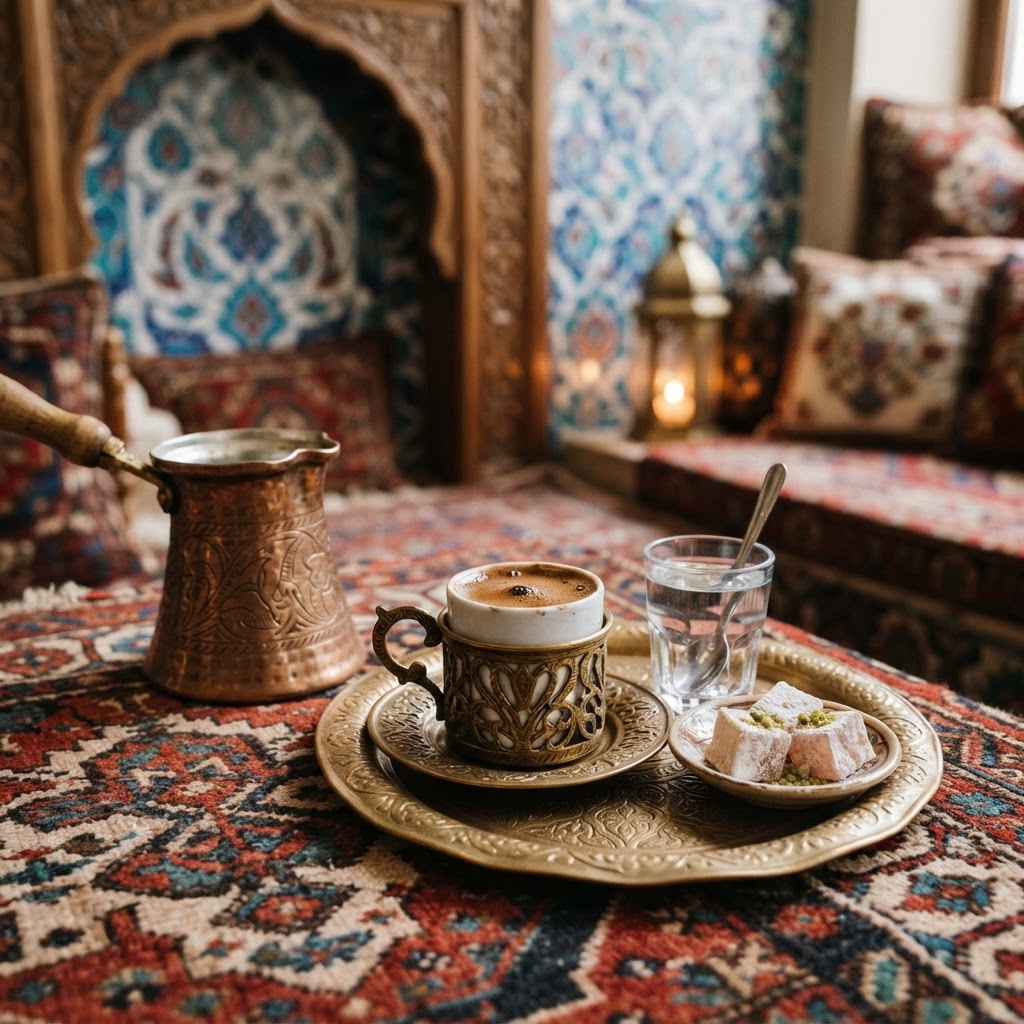
What makes Turkish coffee unique is not the bean — it's the preparation. Turkish coffee is made by grinding freshly roasted beans to an extremely fine powder, finer than espresso, almost like cocoa. The ground coffee, cold water, and sugar to taste are added to a *cezve*, a small long-handled copper pot with a wide base and narrow neck, and brewed slowly over a low flame.
The key to the method is the foam. As the coffee heats, a thick foam rises to the surface. The skilled coffee maker removes the cezve from the heat just before the coffee boils over, allows the foam to settle, and returns it to the heat — repeating the process two or three times to build a rich, dense foam. The coffee is then poured into a small cup, together with the grounds, which settle to the bottom. It's served with a glass of water, to cleanse the palate before the first sip, and often with a piece of Turkish delight.
The sweetness is determined during brewing, not afterward — sugar is added to the cezve before the coffee is cooked. The traditional levels are *sade* (unsweetened), *az şekerli* (slightly sweet), *orta şekerli* (medium sweet), and *çok şekerli* (very sweet). Adding sugar after the coffee is served is considered improper.
**The Social Rituals**
Turkish coffee permeates every level of social life. It is a symbol of hospitality, friendship, and refinement, and it plays a central role in ceremonies.
The most famous ritual is the coffee served during a marriage proposal. In the traditional Anatolian custom, the prospective groom and his family visit the bride's family, and the bride prepares and serves the coffee. If the bride is fond of the groom, she sweetens his coffee with sugar. If she is not, she salts it — and if the groom drinks the salty coffee without complaint, it's taken as a sign of his sincere affection and patience. This ritual, and the phrase "a cup of coffee can create a friendship that lasts for 40 years," capture the social weight the drink carries in Turkish culture.
Coffee also plays a role in resolving disputes. In Anatolian villages, when two people have fallen out, a "friendship coffee" is served to open a dialogue and end the resentment. And the grounds left in the empty cup — the *kahve falı* — are used for fortune telling, a ritual in which the cup is inverted onto the saucer and the patterns of the grounds are read to predict the future.
**The UNESCO Recognition**
In 2013, UNESCO inscribed Turkish coffee culture and tradition on its Representative List of the Intangible Cultural Heritage of Humanity, recognizing the unique ways in which the coffee is prepared and brewed, as well as its rich communal traditions, as an important part of Turkish cultural heritage. The inscription noted that Turkish coffee "combines special preparation and brewing techniques with a rich communal traditional culture," and that its knowledge and rituals are transmitted informally by family members through observation and participation.
**The Brunch Connection**
The intense, aromatic richness of Turkish coffee makes it a natural partner for a sweet mimosa brunch. A Peach Bellini Mimosa or a Strawberry Mimosa alongside a cup of Turkish coffee creates a contrast of bitter and sweet, hot and cold, that defines the best brunch pairings. For a more aromatic pairing, a Cardamom & Orange Blossom Mimosa echoes the spice notes of the coffee and the Ottoman tradition of flavoring it with cardamom.
**References**
- UNESCO: Turkish Coffee Culture and Tradition — https://ich.unesco.org/en/RL/turkish-coffee-culture-and-tradition-00644
- Wikipedia: Turkish Coffee — https://en.wikipedia.org/wiki/Turkish_coffee
- Perfect Daily Grind: A Guide to Turkish Coffee — https://www.perfectdailygrind.com/2019/10/a-guide-to-turkish-coffee/
- Culture Trip: The History of Turkish Coffee — https://theculturetrip.com/middle-east/turkey/articles/the-history-of-turkish-coffee/



Continue Reading