Food & Drink
The Japanese Kissaten: A Quiet Coffee Tradition Rooted in the Meiji Era
Before the espresso bar, before the third-wave roaster, there was the kissaten — the Japanese coffee house of stained glass and slow hand-drip, a place of such deliberate quiet that the brewing of a single cup can feel like a small ceremony.
Before the espresso bar, before the third-wave roaster, there was the kissaten — the Japanese coffee house of stained glass and slow hand-drip, a place of such deliberate quiet that the brewing of a single cup can feel like a small ceremony. To step into an old kissaten in Tokyo is to step out of the noise of the present and into a slower Japan, one in which the morning is not a thing to be hurried but a thing to be poured, carefully, through cloth and glass.
**The First Coffee House**
Coffee reached Japan through the Dutch trading posts of the Edo period, but it was in the Meiji era — that great opening of Japan to the world after 1868 — that coffee became a culture. The first true coffee house in Japan was the Kahiichakan (可否茶館), opened in 1888 in the Shimbashi district of Tokyo by Tsumura Eiichi, who wrote under the pen-name Tei Ei-kei and had studied at Yale University. Kahiichakan was modeled on the grand cafés of Europe, and it offered not just coffee but a library, billiards, and a meeting room — a salon for the newly Westernizing Japanese intelligentsia. It was short-lived, closing within a few years, but it established the kissaten as a place of culture rather than mere refreshment.
**What a Kissaten Is**
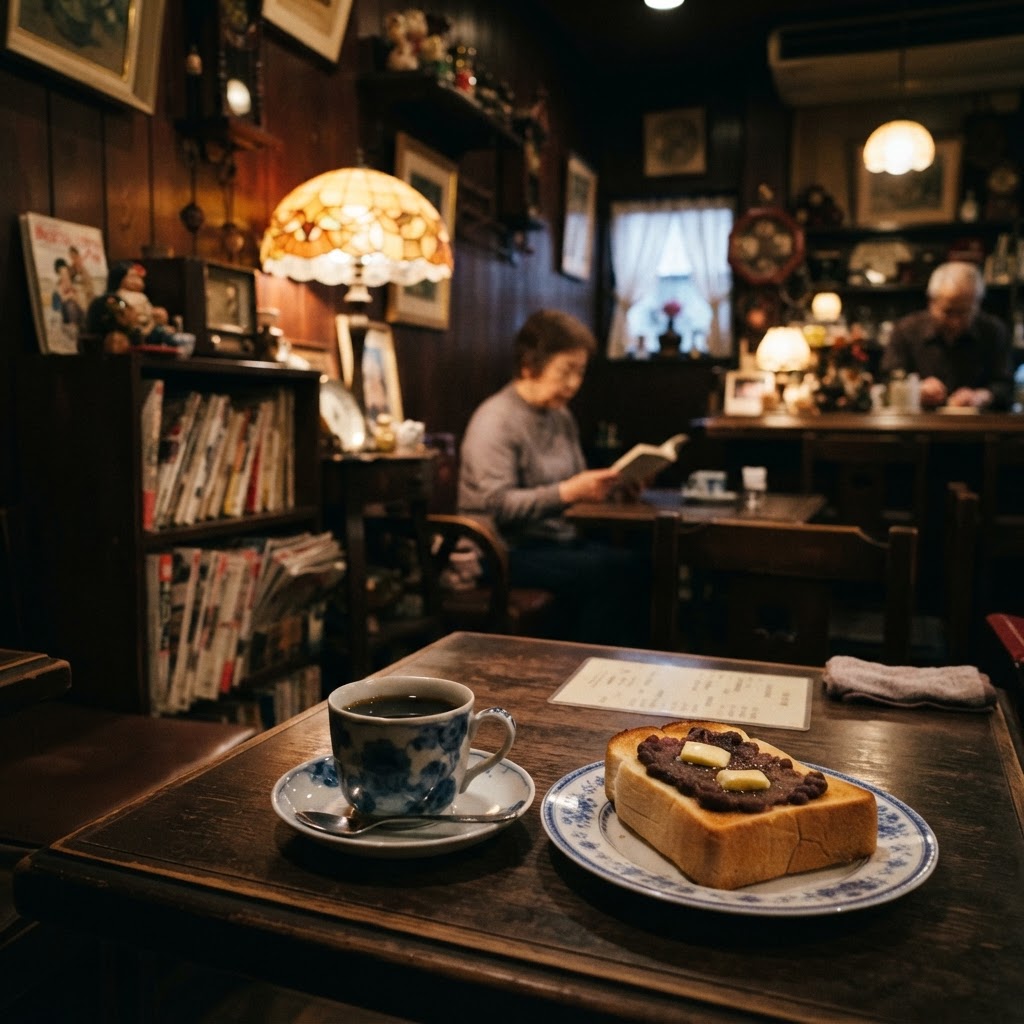
A kissaten (喫茶店), literally a "tea-drinking shop," is a traditional Japanese coffee house, distinct from the modern espresso café. The atmosphere is the point. The light is warm and low, often filtered through stained-glass lamps. The seating is in booths, sometimes upholstered in deep red velvet. The décor is Showa-era retro — dark wood, old magazines, framed prints, the accumulated texture of decades. The music, when there is music, is jazz or classical, played softly. And the coffee is made with extraordinary care: hand-dripped, one cup at a time, through a cloth or paper filter, or brewed in a glass siphon that hisses and gurgles over a flame. The result is a clean, delicate cup that rewards attention.
**The Morning Service**
The great daily ritual of the kissaten is the morning service, or "morning set." For the price of a single cup of coffee, ordered before eleven in the morning, the customer receives the coffee alongside a small breakfast — thick toast with butter and jam, a boiled egg, perhaps a small salad, sometimes a piece of kasutera sponge cake. The morning set originated in the cafés of Nagoya and spread across Japan in the postwar decades, becoming a daily institution for salarymen, students, and retirees. For a generation of Japanese who lived in cramped, thin-walled apartments, the kissaten was also a warm, quiet refuge — heated in winter, air-conditioned in summer — where one could read or study in comfort that home did not provide.
**Decline and Revival**
The kissaten has been in decline for decades. The number of operating kissaten in Japan fell steadily through the late twentieth and early twenty-first centuries, squeezed by the rise of the fast, cheap café chain — Starbucks entered Japan in 1996, and the Japanese chains Doutor and Pronto followed — and by the simple fact that the original proprietors aged out. But the decline has lately met a revival. A new generation of coffee obsessives, drawn to the slowness and the craft, has begun to preserve and reopen old kissaten, and the form is now cherished as a piece of living Japanese heritage rather than a relic. In a city of speed, the kissaten remains a place that asks you, gently, to slow down.
**The Brunch Connection**
The kissaten's morning set is, in everything but name, a brunch — a quiet meal of coffee, toast, and egg, taken slowly in a warm room. A brunch built on kissaten principles keeps the menu spare and the atmosphere deliberate: one carefully brewed cup, one piece of good toast, one small plate, and a single sparkling drink beside it. A Classic Champagne Mimosa, served cold and bright, contrasts beautifully with the deep, hand-dripped coffee; a Yuzu Honey Mimosa, with its Japanese citrus, would sit more naturally still. The lesson of the kissaten is that the morning rewards attention, and that a single cup, properly made, is enough.
**References**
- Wikipedia: Kissaten — https://en.wikipedia.org/wiki/Kissaten
- Wikipedia: Coffee — https://en.wikipedia.org/wiki/Coffee
- Japan House Los Angeles: The Story of Japan's Kissaten Cafés — https://www.japanhousela.com/articles/brewing-culture-kissaten-japanese-cafe-story-coffee-tea-shop-showa-retro-tei-eikei/


Continue Reading