Food & Drink
The World's Finest Oysters: A Connoisseur's Guide
To eat an oyster is to taste the ocean in its purest form — the terroir of the sea. From the deep, nutty Belon of Brittany to the buttery Kumamoto of the Pacific coast, the world's finest oysters offer a masterclass in flavour, place, and pleasure.
The Michelin Guide first awarded its stars to restaurants that served oysters. Champagne houses built their reputations on the pairing. And yet for many diners, oysters remain intimidating — unfamiliar in their raw, briny, almost oceanic intensity. This guide is for those who want to move beyond that hesitation and enter the world of serious oyster appreciation.
An oyster is a direct expression of the water in which it grows — a concept the French call 'merroir' (the sea equivalent of terroir). The salinity, temperature, mineral content, and plankton composition of any given stretch of coast produce oysters that taste entirely unlike those grown two bays over. It is one of the most place-specific foods on earth.
France dominates the world of fine oysters. Three regions produce the most celebrated varieties.
Brittany (Bretagne): Home to the legendary Belon — the only truly flat oyster (Ostrea edulis, European flat) still produced at scale. Belons are grown in the estuary of the Belon River in Finistère, where freshwater mixing creates an unusually complex, almost copper-metallic, deeply nutty flavour. They are divisive (many find them an acquired taste) but utterly extraordinary. The estate of the Belon river at Riec-sur-Belon (https://www.domaine-de-belon.com) is one of the few still producing genuine Belons to traditional standards.
Marennes-Oléron: The largest oyster-producing region in France, between the Charente estuary and the Île d'Oléron. The region's famous 'claires' — shallow green-bottomed fattening ponds — impart the distinctive green tint of the Fine de Claire and Spéciale de Claire oysters. The green comes from a diatom (Navicula ostrearia) that colonises the ponds and gives the oysters a complex, iodine-forward, slightly vegetal quality. Fine de Claire oysters are graded from 0 (largest) to 5 (smallest) and rated on their filling (fattening) period in the claires.
The Gillardeau: Technically from the Marennes-Oléron region but in a category of their own, Gillardeau oysters are a proprietary variety developed by the Gillardeau family since 1898 (https://www.gillardeau.fr/en/). Grown over four years — twice the standard period — they achieve an exceptional richness, sweetness, and meaty texture. Every Gillardeau shell is laser-engraved with a 'G' to prevent counterfeiting. They are among the most sought-after oysters in the world's finest restaurants.
Beyond France, a handful of other varieties deserve attention.
The Kumamoto (Crassostrea sikamea), originally from Amakusa, Japan, is now primarily cultivated in the Pacific Northwest of the United States and is beloved for its small cup, deep bowl, sweet flavour, and clean finish — a perfect introduction for oyster novices. Taylor Shellfish Farms (https://www.taylorshellfish.com) in Washington State produces superb Kumamotos.
The Irish Gigas, particularly those from Galway Bay and Connemara, are plump, creamy, and briny with exceptional shell weight. The Galway International Oyster & Seafood Festival (https://www.galwayoysterfestival.com), held annually in September, is the world's longest-running oyster festival and worth attending.
Australia's Sydney Rock Oyster (Saccostrea glomerata) is a unique native species grown primarily in New South Wales estuaries, with a sharp, mineralic brine and extraordinary longevity — they can survive for weeks out of water, unlike Pacific oysters.
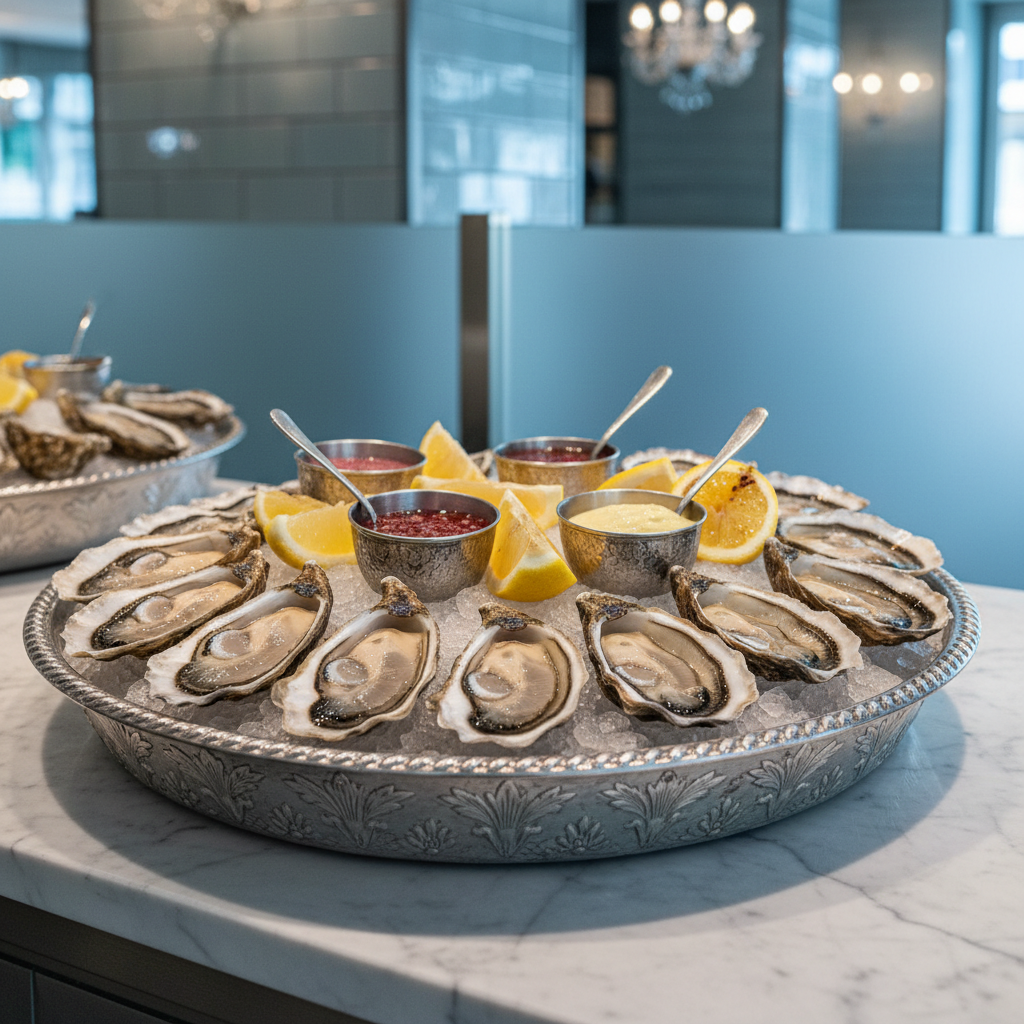
On eating oysters: tradition holds them raw with just a squeeze of lemon or a spoonful of classic mignonette (finely minced shallots in red wine vinegar). In France, a small brown bread slice with salted butter accompanies them. In the United States, cocktail sauce and horseradish are common. For the purist, the mignonette is the only acceptable accompaniment — anything more risks overwhelming the oyster's natural expression.
For pairing, oysters are one of the few foods that genuinely improve a glass of Champagne — the acidity of both amplifies the other's freshness. Muscadet Sèvre et Maine sur Lie (the classic Breton match), Chablis, and dry Fino Sherry are all superb alternatives. Avoid anything oaked or fruity — the wine should step back and let the oyster speak.
For sourcing premium oysters in the US, Hog Island Oyster Co. (https://hogislandoysters.com) in California and Island Creek Oysters (https://islandcreekoysters.com) in Massachusetts both ship nationwide and maintain exemplary quality and traceability standards.



Continue Reading