Food & Drink
The White Truffle of Alba: Italy's Most Precious Ingredient
The tuber magnatum pico — the white truffle of the Piedmont — is the world's most expensive food by weight. Everything you need to know about finding, cooking, and eating one.
Somewhere in the oak and hazel forests of the Langhe hills south of Turin, between October and January, a dog's nose touches the earth and begins to dig. Beneath the surface — attached to the roots of the tree above, in a symbiotic relationship that took decades to establish and that no human science has yet successfully replicated — lies a lump of pale, dirt-encrusted fungus roughly the size of a golf ball. It weighs perhaps 2 ⅞ oz. At current market prices, it is worth approximately $400.
This is the white truffle of Alba: *Tuber magnatum pico*, the most expensive food ingredient in the world by weight, and the one whose flavor is most completely impossible to describe to someone who has never experienced it.
**The Science of the Aroma**
The white truffle's extraordinary aroma — unmistakable, penetrating, simultaneously earthy and garlicky and animal and oceanic and something else entirely that has no name in any language — is produced by a complex of volatile sulfur compounds, among them dimethyl sulfide, bis(methylthio)methane, and androstenol (the same compound produced by human and pig pheromones, which is why pigs were the original truffle-hunting animals before dogs proved more controllable and less eager to eat the find).
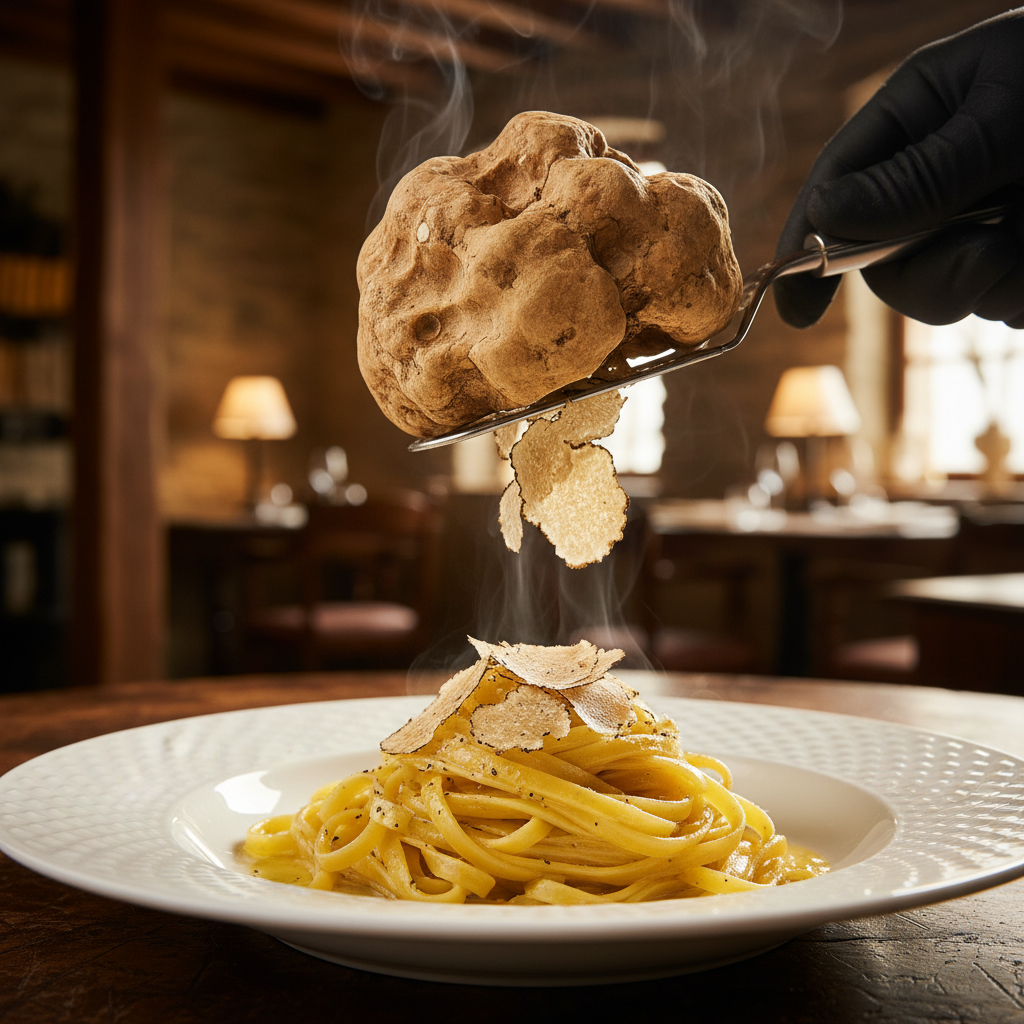
The aroma is entirely heat-volatile — white truffle must never be cooked. Unlike black truffle (tuber melanosporum), which develops flavor when gently warmed, white truffle's entire value is destroyed by heat. Every molecule of the aroma exists only in the raw, freshly shaved state. This is why the only proper way to serve white truffle is shaved paper-thin over a hot, simple dish — the heat releases the aromas upward as the paper-thin shavings land on the warm surface, creating a brief, intense aromatic bloom that is the entire point.
**The Season and the Market**
The white truffle season runs from early October through late January, with the peak at the Alba Truffle Fair (fieradeltartufo.org), held every weekend in October and November in the small Piedmontese city of Alba. The fair is the world's most important truffle market — international buyers, chefs, and enthusiasts converge from across the world, and the fragrance of the fresh truffles on display is overwhelming in the most wonderful possible way.
Prices fluctuate dramatically based on annual yield, which is dictated by the preceding summer's rainfall. An average season price for high-quality specimens is $3,000–$5,000 per kilogram. In exceptional years (2021's drought produced scarcity that pushed prices past $10,000/kg), a single extraordinary specimen may sell for $50,000 at auction.
**The Classical Preparations**
The white truffle's most celebrated vehicle is tajarin — the egg-rich Piedmontese pasta, thinner than tagliatelle, butter-sauced with nothing more than the finest local butter and a shower of Parmigiano-Reggiano. The pasta is hot, simple, rich — the truffle is shaved at the table, directly over the bowl. Every element exists to amplify the truffle and nothing more.
Other classical pairings: fonduta (Piedmontese fondue made with Fontina d'Aosta cheese, egg yolks, and butter) with white truffle shaved over the top; perfectly soft-scrambled eggs with truffle; risotto al tartufo bianco made with Carnaroli rice and Parmesan, topped tableside. The rule is consistent: simple, rich, warm, and never containing any other competing flavors.
**Where to Eat White Truffle in Piedmont**
Piazza Duomo (piazzaduomoalba.it) in Alba, three Michelin stars under chef Enrico Crippa, is the definitive white truffle dining experience in the world. The autumn tasting menu is constructed entirely around the truffle in its seasonal peak — each course a different expression of the ingredient's possibilities. Reserve six months in advance. Dinner from €350 per person before wine.
Vistamare at the Hotel Barchetta in Bellagio offers white truffle in a different context — shaved over Lake Como perch. La Ciau del Tornavento (laciaudeltornavento.it) in Treiso, overlooking the Langhe hills, serves the most atmospheric truffle lunch in the region alongside one of the finest cellars of Barolo and Barbaresco in Italy.
**Bringing White Truffle Home**
Fresh white truffle can be transported internationally (it is not subject to CITES restrictions, unlike black Périgord truffle in some contexts). The window is short — a fresh white truffle is at peak quality for 5–7 days after harvest — so timing is everything.
Store fresh truffle wrapped in dry paper towels (changed daily) in a sealed glass jar in the refrigerator. The paper absorbs moisture and prevents rot. Do not store in rice — the popular folk advice actually desiccates the truffle and the rice absorbs the precious aroma. Store eggs in a sealed container alongside or near the truffle — they will absorb the aroma through their shells, producing the finest scrambled eggs of your life.
**The Wine Pairing**
White truffle's natural home is Piedmont, and its wines are the natural companions: Barolo and Barbaresco (both from the Nebbiolo grape) have a tar, rose, and earth character that resonates perfectly with the truffle's underground aromatic. Among whites, a mature Burgundy Grand Cru — specifically a Meursault or Puligny-Montrachet with several years of bottle age — harmonizes with the truffle's hazelnut notes in a way that younger whites cannot.



Continue Reading