Food & Drink
Wagyu & Omakase: Japan's Most Extraordinary Dining Experience
Japanese omakase dining — where the chef decides everything — paired with A5 Wagyu beef is the pinnacle of the world's most refined food culture. Here is how to understand, access, and fully experience it.
Japan has the most sophisticated food culture in the world. This is not a controversial statement — it is the conclusion reached by every serious food scholar, every Michelin inspector, every chef who has spent time in the country — but it is worth stating plainly as a foundation for understanding what omakase dining and A5 Wagyu represent: not merely excellent food, but a civilization-level expression of what happens when a culture decides to apply the same philosophical seriousness to the preparation and consumption of food that it applies to everything else.
**Understanding Omakase**
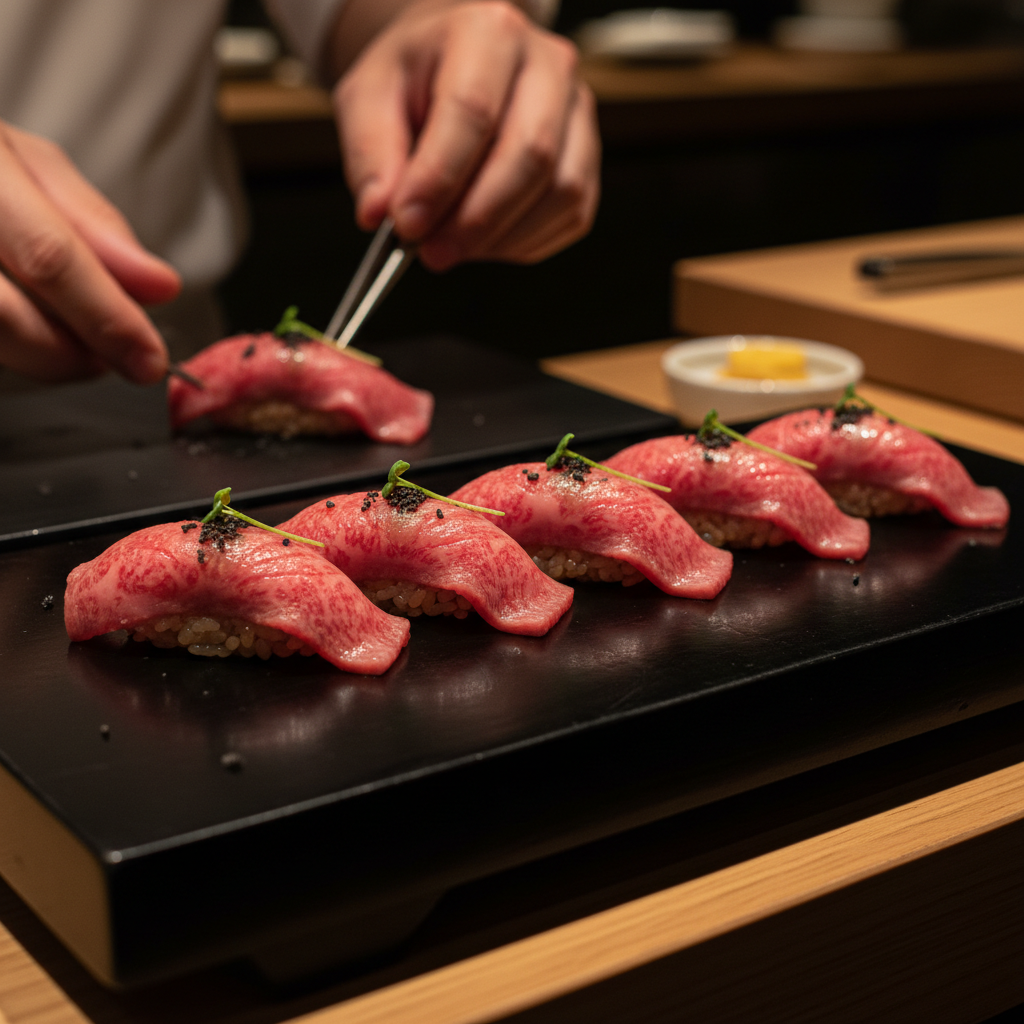
Omakase (お任せ) translates literally as 'I leave it to you' — an instruction to the chef to serve whatever they judge to be at its peak that day, in whatever order and quantity they deem optimal. It is the opposite of the Western à la carte model, which places all decision-making power with the diner.
At a proper omakase restaurant — typically a counter of 6–12 seats facing an open kitchen or a sushi bar where the chef works directly in front of the diners — the experience is one of complete surrender to the chef's knowledge and seasonal awareness. The chef has purchased the ingredients that morning from the specific suppliers they have worked with for years (or decades). They know exactly what is at peak today and how to present it. The diner's role is to receive, attend, and appreciate.
This format produces the highest concentration of Michelin stars per capita of any dining city in the world. Tokyo alone holds more Michelin stars than any other city — more than Paris, more than New York, more than London. And the heart of that achievement is the omakase tradition.
**A5 Wagyu: Understanding Japan's Finest Beef**
Wagyu (和牛) means simply 'Japanese cow' — but in practice it refers to four specific breeds (Japanese Black, Japanese Brown, Japanese Shorthorn, and Japanese Polled) selected and developed over centuries for their extraordinary capacity to accumulate intramuscular fat, the marbling that gives Wagyu its defining quality.
Japanese beef is graded on two scales: Yield Grade (A, B, or C, with A being the highest) and Quality Grade (1–5, with 5 being the highest). A5 — the designation printed on menus in the finest restaurants worldwide — represents the apex: maximum yield with quality score of 5 across all four criteria (marbling, color and brightness, firmness and texture, and color and quality of fat).
The fat itself is the point — the intramuscular fat (shimofuri) of A5 Wagyu has a melting point of approximately 77°F (77°F), meaning it begins to dissolve at body temperature. This is why a single slice of A5 Wagyu placed on the tongue literally melts — a physical sensation unlike any other meat experience.
*Kobe Beef* is A5 Tajima-gyu (a sub-strain of Japanese Black) from the Hyogo Prefecture, certified by the Kobe Beef Marketing and Distribution Promotion Association. Only cattle meeting extraordinary criteria — born, raised, and slaughtered in Hyogo Prefecture, meeting the top-grade specifications — may be certified Kobe. Only approximately 3,000 cattle per year qualify. All Kobe Beef is Wagyu; not all Wagyu is Kobe Beef.
*Matsusaka Beef* from Mie Prefecture and *Omi Beef* from Shiga Prefecture are considered by many connoisseurs to rival or surpass Kobe in flavor complexity and fat quality — both command comparable prices ($500+ per kg retail) and are more difficult to find outside Japan.
**The Great Tokyo Omakase Addresses**
*Saito* (by introduction only) in Minami-Aoyama is considered by many Japanese food authorities to be the finest sushi restaurant in the world. Chef Sho Saito trained under the legendary Jiro Ono of Sukiyabashi Jiro for over a decade. No website, no public reservation system — accessible only through established relationships with the Japanese hospitality world.
*Sushi Yoshitake* (3 Michelin stars, ginza-yoshitake.com) in Ginza is the most reliably bookable of Tokyo's top-tier sushi omakase experiences for international visitors. Chef Masahiro Yoshitake's shari (sushi rice) is considered by specialists to be the finest in the city — the temperature, vinegar ratio, and rice variety selection change by season.
*Aragawa* (aragawa.co.jp) in Shimbashi is Japan's most celebrated Wagyu restaurant — a restaurant so legendary that a single dinner for two regularly exceeds $1,000. The Wagyu sirloin, charcoal-grilled over Binchōtan and served with absolutely no accompaniment that might distract from the meat, is considered the definitive expression of the ingredient.
*Kawamura* (kawamura-ginza.com) in Ginza serves Wagyu in the shabu-shabu and sukiyaki formats — paper-thin slices of A5 Matsusaka or Kobe swirled briefly through dashi broth or cooked in a sweet soy-sugar broth, respectively. Both preparations show the fat's extraordinary melt-in-mouth quality more vividly than grilling.
**The Sake and Whisky Pairing**
At a Japanese omakase, water or Japanese green tea is the traditional accompaniment to sushi — the delicacy of raw fish calls for nothing that imposes flavor. With Wagyu, the pairing of choice is Junmai Daiginjo sake — the highest grade of premium sake, made from rice polished to at least 50% of its original size — which has a clean, floral, almost ethereal quality that complements the fat's richness without competing with it.
For Western pairings: a mature red Burgundy (Chambolle-Musigny Village or above) with its fine tannins and earthiness complements A5 Wagyu with extraordinary elegance. Alternatively, a 12-year Yamazaki single malt from Suntory (suntory.com/yamazaki) — Japan's most decorated whisky — drunk neat and alternated with bites of Wagyu, creates one of the most sophisticated alcohol-and-food pairings available anywhere in the world.

Continue Reading