Travel
Vienna: Imperial Palaces, the Musikverein & the Art of the Viennese Café
Vienna is the city that has never really left the 19th century — and doesn't intend to. The Habsburg imperial capital remains one of Europe's most beautiful, most cultured, and most comfortable cities, with a café culture, a music tradition, and a quality of urban life that no other European capital quite matches.
Vienna has never quite left the 19th century — and shows no intention of doing so. The Habsburg imperial capital, which for six centuries presided over an empire stretching from the Carpathians to the Adriatic, retains a grandeur of civic architecture, a depth of cultural life, and a quality of daily existence — expressed most perfectly in its extraordinary café culture — that no other European capital quite replicates.
The Ringstrasse boulevard, constructed on the orders of Emperor Franz Joseph I between 1858 and 1865, is one of the great achievements of European urban planning: a 5km ring of imperial institutions — the State Opera, the Kunsthistorisches Museum, the Natural History Museum, Parliament, the Burgtheater, and the University — designed by the finest architects of the era in a cavalcade of historicist styles that constitutes an open-air museum of 19th-century architectural ambition.
Where to Stay: Vienna's Palace Hotels
Hotel Imperial (marriott.com/hotels/travel/viemz-hotel-imperial-a-luxury-collection-hotel-vienna) on the Ringstrasse is the defining address of imperial Vienna — a converted ducal palace (the Duke of Württemberg's Vienna residence) that opened as a hotel in 1873 for the Vienna World's Fair. Every European royal family has stayed here; the Royal Suite was used by the Austrian Emperor Franz Joseph for state functions. The hotel's Imperial Torte — a dense chocolate marzipan cake — is one of Vienna's iconic confections. Suites from $1,200/night.
Hotel Sacher Wien (sacher.com) behind the State Opera is the most storied address in Vienna — home of the original Sachertorte (a two-layer chocolate cake with apricot jam in a dark chocolate glaze, invented by Franz Sacher for Prince Metternich in 1832), a Red Bar of legendary intimacy, and a guest list spanning 165 years of European royalty, composers, and heads of state. Suites from $900/night.
Palais Coburg Residenz (palais-coburg.com) is the most architecturally extraordinary hotel in Vienna — a converted Biedermeier ducal palace whose wine cellar, housing over 60,000 bottles in conditions unchanged since the 19th century, is considered one of the finest private wine collections in the world. The seven suites and six residences are furnished with Habsburg period pieces. Suites from $1,800/night.
The Viennese Café: A UNESCO Cultural Heritage
The Viennese Kaffeehauskultur was inscribed by UNESCO on its Representative List of Intangible Cultural Heritage in 2011. The coffeehouse tradition — where patrons may nurse a single Melange (espresso with frothed milk, served in a glass with a small chocolate and a glass of water) for an entire afternoon while reading the complimentary newspapers, playing chess, or simply observing the world — is not a tourist affectation but a genuine institution, practiced daily by Viennese of all ages.
Café Hawelka (hawelka.at) in the first district, run by the same family since 1939, is the original Bohemian coffeehouse — dark, smoke-stained, legendary. Café Central (palaisevents.at/en/cafes/cafe-central) in the Palais Ferstel has the most spectacular room — a vaulted Moorish interior — and is the café where Trotsky played chess and Freud reportedly had his morning coffee. Café Schwarzenberg on the Ringstrasse was Vienna's first coffeehouse (1861) and remains among its most distinguished.
The Wiener Schnitzel: Vienna's Great Dish
The Wiener Schnitzel — a thin veal cutlet (Kalbsschnitzel) pounded until translucent, coated in breadcrumbs, and fried in clarified butter until golden and puffed — is Vienna's defining dish and one of the great preparations of European cooking. By Austrian law, a Wiener Schnitzel must be made from veal; 'Schnitzel Wiener Art' is the pork version. Figlmüller Wollzeile (figlmueller.at) — established 1905 — is the institution against which all others are measured: their Schnitzel overhangs the plate by 2 in on each side and has been the city's most beloved lunch for over a century.
The Musikverein and Vienna Philharmonic
The Musikverein (musikverein.at) — home of the Vienna Philharmonic — is the finest concert hall in the world by virtually universal consensus among musicians, conductors, and acousticians. Its Großer Saal (Golden Hall), constructed in 1870, has a resonance and warmth that no modern concert hall has been able to replicate. The Vienna New Year's Concert, broadcast to 90 countries annually, takes place here. Standard concert tickets sell out months in advance; standing room (Stehplatz) tickets for the Großer Saal are released 45 minutes before each performance and represent extraordinary value — €5–8 for music of the highest order in the world's most beautiful hall.
The Belvedere and Schönbrunn
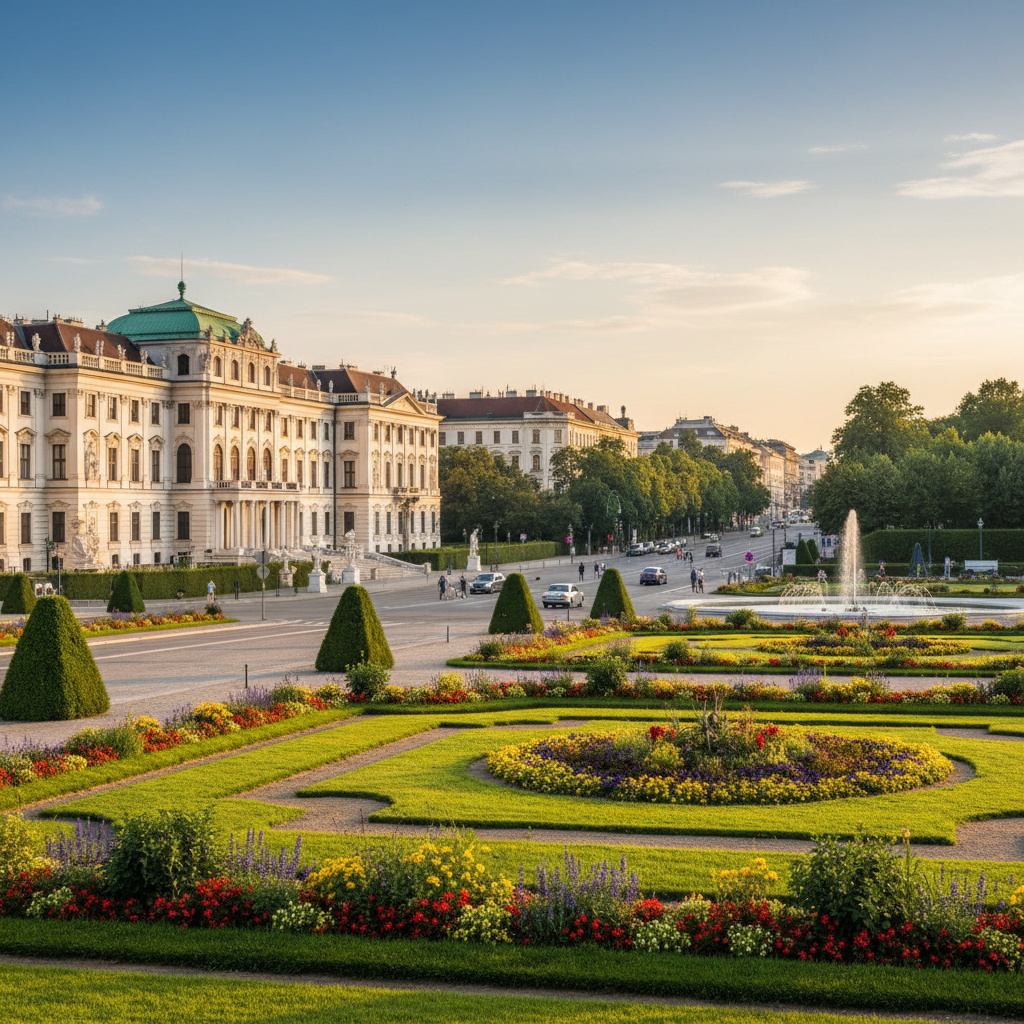
The Belvedere (belvedere.at) complex — Upper and Lower Belvedere palaces with their formal Baroque gardens — houses Austria's greatest collection of art, including Klimt's The Kiss and Judith, Schiele's Self-Portrait with Physalis, and Kokoschka's major works. It is the essential art museum of Vienna. Schönbrunn Palace (schoenbrunn.at), the imperial summer residence with 1,441 rooms and the oldest zoo in the world (1752), requires a full day.
Getting There
Vienna International Airport (VIE) is one of Europe's most connected hubs, with direct service from all major North American, Middle Eastern, and Asian cities. The City Airport Train (CAT) reaches Wien Mitte station in 16 minutes, connecting to the city's extensive U-Bahn (subway) network.
Continue Reading