Food & Drink
The Truffle Hunt: Italy's Most Extraordinary Gastronomic Ritual
At dawn in the forests of Piedmont and Umbria, hunters and their dogs move quietly through the oaks and hazels in search of the world's most expensive ingredient. This is the life of the truffle, from earth to table.
Tuber magnatum pico — the White Truffle of Alba, the tartufo bianco — grows underground in the root systems of oak, hazel, poplar, and beech trees in a specific arc of northern and central Italy: the Langhe hills of Piedmont, the forests of Tuscany, Umbria, and the Marche. It cannot be cultivated. It cannot be farmed. It cannot be found without a trained dog. It is harvested for approximately ten weeks each year, from mid-October to mid-December. At peak season, it sells for €3,000–€7,000 per kilogram. In exceptional years, a single specimen of unusual size may be auctioned for sums that make international headlines: a 1.5-kg white truffle sold at the World Truffle Auction in Alba in November 2023 for €105,000.
No other ingredient in world gastronomy combines rarity, unduplicatable flavour, and this degree of dependence on specific ecological conditions. The white truffle is the most extreme expression of terroir in food — the product of a specific relationship between specific tree species, specific soil fungal networks, specific microclimate, and specific wild microbiology that has evolved over millennia and that no human intervention has yet been able to simulate.
**The Two Great Truffles**
The White Truffle of Alba (Tuber magnatum) and the Black Truffle of Périgord/Norcia (Tuber melanosporum) are the two prized species, though the Italian truffle world recognises dozens of species with culinary use.
The white truffle is used exclusively raw: shaved paper-thin with a mandoline directly over hot pasta, risotto, eggs, or crostini immediately before serving. Heat destroys its volatile aromatics within seconds — which is why no white truffle oil (all of which use synthetic 2,4-dithiapentane rather than actual truffle) comes close to the real ingredient. The smell of a great white truffle at peak maturity — musky, garlicky, honey-like, with overtones of aged cheese and forest floor — is one of the most distinctive and compelling aromas in gastronomy.
The Black Truffle of Périgord (also called Norcia or Spoleto truffle in Italy) is more tolerant of heat and is used both raw and cooked — sliced into sauces, folded into butter, layered under the skin of roasting birds. Its flavour is earthier, more chocolatey, and more consistently usable across a broader range of preparations. The Périgord harvest (tartuffe noire) typically runs December to March; the Italian harvest from Norcia and Spoleto overlaps significantly. Reference: ufficiodeltartufo.it
The Summer Truffle (Tuber aestivum) — harvested May through August — offers a milder, nuttier flavour at a fraction of the cost of its winter counterparts, and is increasingly used by chefs seeking a year-round truffle presence on the menu.
**The Hunt**
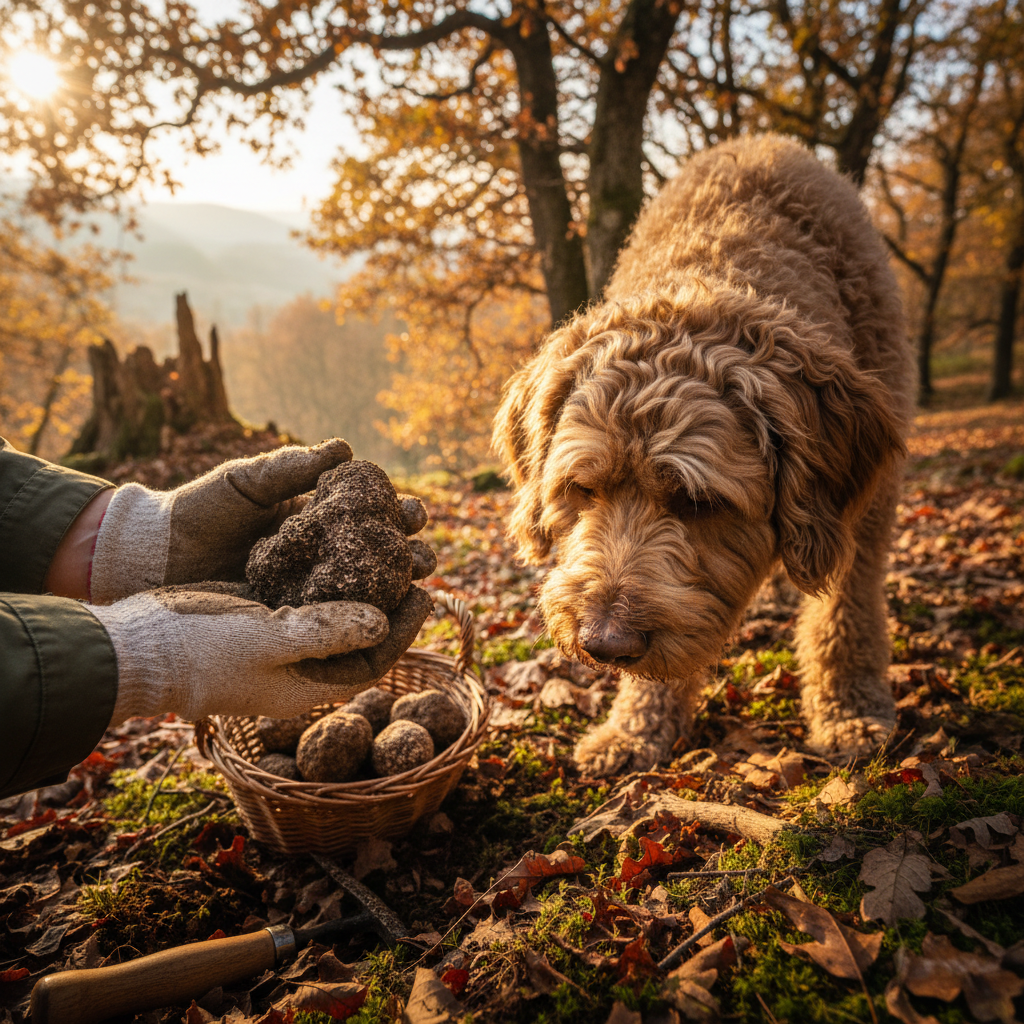
Truffle hunting in Italy is a licensed, family-transmitted tradition. Trifolao (truffle hunters) in Piedmont typically begin before dawn, working their dogs — most commonly Lagotto Romagnolo, a breed specifically developed for truffle hunting — through the forest on foot, covering 8–15km of terrain in a single morning. A great trifolao will have hunted the same forests for 30+ years, with knowledge of specific trees and root systems passed down through generations.
The dogs are trained from puppyhood to associate the truffle's specific scent (produced by the dimethyl sulfide and bis(methylthio)methane compounds in the mature fungus) with reward. A well-trained Lagotto can detect a ripe truffle up to 6 metres underground and will indicate the spot by scratching, at which point the hunter uses a small pick (vanghetto) to unearth the specimen without damage.
**Experiencing It**
The Alba White Truffle Fair (fieradeltartufo.org) runs October through November each year, centred on the Cortile della Maddalena in Alba — the world's most important truffle market. The annual World Truffle Auction, traditionally held on the second Sunday of November, raises funds for international charities and attracts bidders from Asia, the US, and the Middle East.
For hands-on truffle hunting experiences, the Savini Tartufi estate in Tuscany (savinitartufi.it) offers morning hunts with professional trifolao and their dogs, followed by a truffle lunch. In Piedmont, the hotels of the Langhe — Relais San Maurizio (relaissanmaurizio.it) and Castello di Govone (castellodigovone.it) — organise hunts for guests during the October–December season.
**At the Table**
For white truffle in Alba during peak season, Piazza Duomo (piazzaduomoalba.it) — three Michelin stars, awarded three times 'Best Restaurant in Italy' — is the ultimate expression: chef Enrico Crippa's white truffle menu, available October–December, is among the greatest seasonal tasting experiences in Europe. Osteria dell'Arco and Il Centro di Priocca in the Langhe offer more accessible Piedmontese dining with outstanding local truffle service.



Continue Reading