Food & Drink
The Texas BBQ Pilgrimage: Brisket, Smoke, and the Lone Star Tradition
In the meat markets of central Texas, German and Czech immigrants created a barbecue tradition built on one principle: the meat speaks for itself. Today, the lines form before dawn, and the brisket sells out by noon.
Texas barbecue is not a single tradition but a regional cuisine with distinct styles, the most celebrated of which is Central Texas barbecue. This style, which has come to define Texas BBQ in the national and international imagination, is characterised by simple preparation — meat rubbed with nothing more than salt and pepper, smoked low and slow over post oak wood — and by its origins in the meat markets of central Texas, where German and Czech immigrants settled in the 19th century and established the tradition of smoking meat as a way to preserve it. The result is a barbecue tradition that is uniquely Texan: unsweetened, un-sauced (sauce is offered on the side, if at all), and focused entirely on the quality of the meat and the mastery of the fire (texasmonthly.com).
The defining fuel of Central Texas barbecue is post oak — a species of white oak native to the Texas Hill Country and the southern Great Plains. Post oak is a dense, slow-burning hardwood that produces a clean, mild smoke with a slightly sweet, nutty character that complements beef without overwhelming it. Unlike the hickory used in Southern barbecue or the mesquite used in West Texas, post oak burns evenly and produces a consistent temperature, making it ideal for the long, slow smoking that brisket requires. The preference for post oak is not merely cultural but practical: it grows in abundance in central Texas, it burns hotter and longer than most other local woods, and its smoke has a milder, sweeter character than the assertive smoke of hickory or mesquite. A Central Texas pitmaster will use nothing else, and many will tell you that the post oak is as important to the flavour of the brisket as the beef itself.
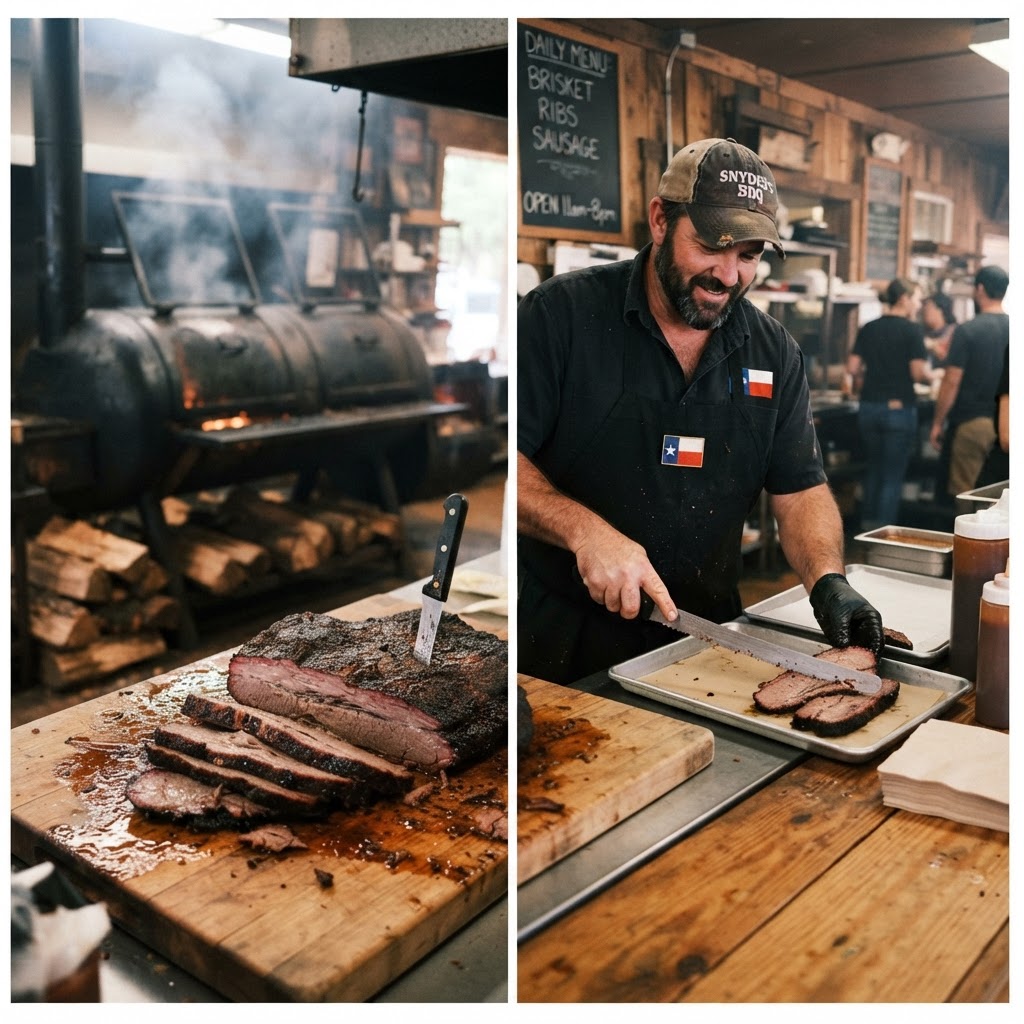
The brisket — the king of Texas barbecue — is a cut that exemplifies the transformative power of smoke and time. Brisket is a tough, fatty cut from the breast of the cow, composed of two distinct muscles: the flat (the leaner, thicker portion) and the point (the fattier, more marbled portion), connected by a layer of fat. Left to itself, brisket is nearly inedible — tough, chewy, and unappealing. But when rubbed with a simple mixture of coarse salt and black pepper (the 'Dalmatian rub,' as it is known in the trade), smoked at a low temperature (typically 225-275°F / 107-275°F) for 12 to 18 hours, and rested properly, the brisket undergoes a remarkable transformation. The collagen in the connective tissue breaks down into gelatin, making the meat tender and succulent. The fat renders, basting the meat from within and keeping it moist. The smoke penetrates the meat, creating the characteristic 'smoke ring' — a pink layer just beneath the surface that is the hallmark of properly smoked brisket. And the salt-and-pepper crust, known as the 'bark,' develops a deep, savoury, slightly bitter character that contrasts with the rich, sweet, unctuous meat beneath.
The meat market tradition is the foundation of Central Texas barbecue. In the late 19th and early 20th centuries, German and Czech immigrants settled in towns across central Texas — Lockhart, Taylor, Luling, Elgin, Bastrop — and established meat markets that served the local farming and ranching communities. These markets butchered cattle and pigs, and they smoked the meat as a way to preserve it before the advent of refrigeration. The smoked meat was sold by the pound, sliced to order, and served on butcher paper with crackers, pickles, onions, and cheese — a tradition that continues in many of the most celebrated Texas BBQ joints today. Kreuz Market in Lockhart, founded in 1900, is perhaps the most iconic of these meat markets, and its insistence on serving barbecue without sauce — a policy maintained to this day — reflects the German tradition of letting the quality of the smoked meat speak for itself (kreuzmarket.com).
The pantheon of Central Texas barbecue includes several legendary establishments. Louie Mueller Barbecue in Taylor, founded in 1949, is one of the most respected barbecue joints in Texas, known for its massive brick pits, its deeply smoky brisket, and its James Beard Award for America's Classics in 2006. Smitty's Market in Lockhart, which split from Kreuz Market in 1999 following a family dispute, occupies the original Kreuz building and maintains the traditional practice of smoking meat over open pits directly on the floor of the dining room. Franklin Barbecue in Austin, opened by Aaron Franklin in 2009, became the most famous barbecue joint in America, with lines that form before dawn and brisket that sells out by early afternoon. Franklin, who won the James Beard Award for Best Chef: Southwest in 2015, is credited with popularising the craft barbecue movement and demonstrating that a single pitmaster, with exceptional skill and attention to detail, could produce barbecue that rivals or surpasses the output of the historic meat markets. Snow's BBQ in Lexington, a small operation that is open only on Saturdays, has been ranked the best barbecue in Texas by Texas Monthly — a distinction that carries extraordinary weight in a state where barbecue is a matter of passionate, near-religious conviction (franklinbbq.com).
Texas Monthly, the state's premier magazine, publishes a definitive 'Top 50 Barbecue Joints in Texas' list that is updated every few years and is treated by Texans with the seriousness that Michelin stars are treated in France. The list, compiled by a team of barbecue experts who travel the state anonymously, ranks joints based on the quality of the brisket, the sausage, the ribs, and the overall experience. The 2021 list, the most recent comprehensive update at the time of writing, named Goldee's Barbecue in Fort Worth as the number one barbecue joint in Texas, reflecting the dynamism of the Texas barbecue scene and the emergence of a new generation of pitmasters who are building on the traditions of the meat markets while bringing their own innovations and perspectives (texasmonthly.com).
The experience of eating Central Texas barbecue is unlike any other dining experience. You enter through the smoke — the smell of post oak and rendering fat hangs in the air around the building, often visible as a haze that drifts across the parking lot. You line up, often for an hour or more, and when you reach the counter, you order by the pound — a half pound of brisket (both lean from the flat and moist from the point), a few links of sausage (the coarse-ground, beef-and-pork links that are a hallmark of German-Texan barbecue), perhaps some pork ribs or beef ribs. The meat is sliced to order, weighed on a scale, and placed on a sheet of butcher paper. You carry your tray — meat, white bread (for making sandwiches or sopping up juice), pickles, onions, jalapeños, and perhaps a side of potato salad or beans — to a table, and you eat with your hands, with plastic forks and knives, with the smoke and the noise and the heat of the pit room all around you. There is no pretension, no plating, no garnish. There is only the meat — hot, smoky, tender, and extraordinary.
What makes Texas barbecue so significant in the world of food and drink is its demonstration that the most extraordinary culinary experiences often come from the simplest preparations, applied with extraordinary skill and patience. Salt, pepper, post oak smoke, and 18 hours of patient attention — this is the entire formula. There is no marinade, no injection, no complex rub, no sauce to hide behind. The quality of the brisket depends entirely on the quality of the beef, the mastery of the fire, and the judgment of the pitmaster, who must read the meat by sight and touch, adjusting the temperature, managing the smoke, and knowing — through years of experience and an almost instinctive feel — when the brisket is done. It is a craft that cannot be automated, shortcut, or faked, and it is practiced by a community of pitmasters who are, in their own way, as dedicated and as skilled as any chef in any fine dining restaurant in the world.
For those planning a pilgrimage, Texas Monthly's Top 50 Barbecue list is the essential guide (texasmonthly.com). Franklin Barbecue in Austin provides hours and ordering information, including the reality that the line forms early and the meat sells out (franklinbbq.com). The Texas Barbecue Trail, which connects the historic meat markets of Lockhart, Luling, Taylor, and Elgin, is approximately 60 miles south of Austin and can be driven in a day (texasbarbletetrail.com).


Continue Reading