Fashion
The Spanish Mantilla and Peineta: Black Lace, Catholic Devotion, and the Protocol of the Spanish Court
The mantilla, a lace veil worn over a tall ornamental comb, came into use in sixteenth-century Spain and was elevated by Queen Isabella II in the nineteenth century. It remains the formal headwear of Spanish Holy Week, royal audiences, and state weddings.
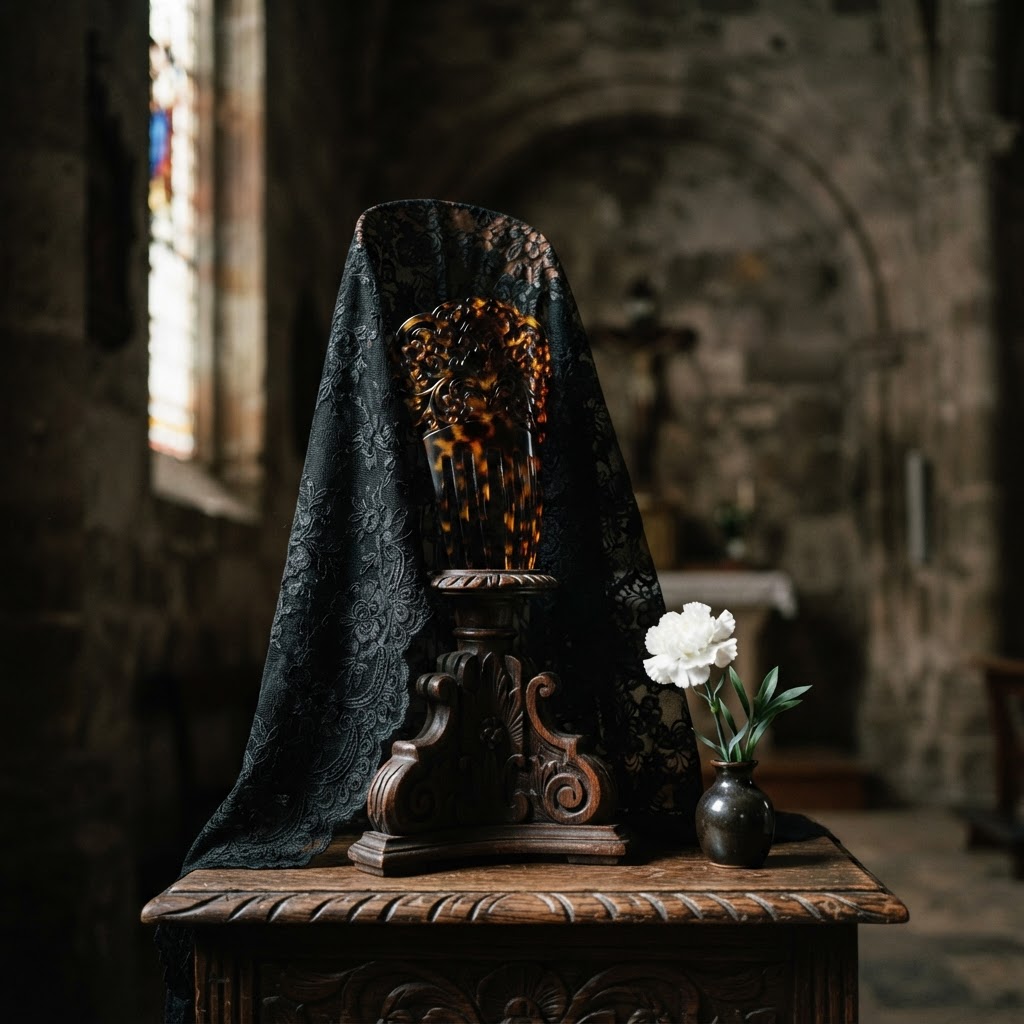
Toward the end of the sixteenth century, in the warmer regions of Spain, a lightweight ornamental lace veil came into use as an adaptation of the ancient Christian practice of women covering the head during prayer. The garment was called the mantilla, and it would become, over the following four centuries, the most recognizable symbol of Spanish feminine elegance. Worn over a high ornamental comb called the peineta, the mantilla is still the formal headwear of Spanish Holy Week processions, royal audiences with the Pope, and state weddings. Its history is a study in how a religious practice becomes a national costume.
The Early Veil: Velazquez and Goya
The earliest mantillas were simple veils of silk or tulle, draped over the head and shoulders. They appear in the portraits of Diego Velázquez in the seventeenth century and Francisco Goya in the eighteenth, where the black lace veil is already a recognizable element of Spanish female dress. The garment's deepest roots, however, are older than Spain itself: the practice of women veiling the head during worship descends from Roman veiling rituals, and the fine lace traditions that characterize the mature mantilla owe much to the Moorish textile culture that shaped the Iberian Peninsula for nearly eight hundred years. The mantilla is, in this sense, a Spanish synthesis of Roman, Moorish, and Christian inheritance.
Queen Isabella II and the Golden Age of the Mantilla
The mantilla reached its greatest prominence in the nineteenth century under Queen Isabella II of Spain, who actively encouraged its use at court. The Queen's patronage made the black lace mantilla, worn over an elaborately carved tortoiseshell peineta, the formal attire of the Spanish court and aristocracy. The peineta itself — a large convex comb, usually of tortoiseshell, that holds the mantilla aloft and adds height to the wearer — originated in the nineteenth century as a specifically Spanish ornament. After Isabella II's abdication in 1870, the mantilla's everyday use diminished, and by 1900 it had become largely limited to church services, bullfights, Holy Week processions, and weddings, where it remains today.
The Protocol of Color: White for Queens, Black for the Rest
The mantilla is governed by a precise protocol of color. A black mantilla is the traditional choice for Holy Week, for attendance at a bullfight, and for an audience with the Pope. A white mantilla is reserved, under a tradition called the privilège du blanc, for the Queen of Spain and a small number of other Catholic queens and consorts, who alone may wear white when received by the Pope. The lace itself is finest when it is hand-made Chantilly or blonde lace, the latter a silk bobbin lace produced in the traditional workshops of Spain. A well-made mantilla, properly draped over a tall peineta, frames the face and adds a sculptural quality to the silhouette that no other headwear achieves.
Practical Guidance: Wearing a Mantilla
The mantilla is worn over a peineta placed near the crown of the head, with the comb's prongs anchoring the veil and lifting it to create height. The lace falls over the shoulders to roughly the elbow. For Holy Week and solemn occasions, black is correct; for a church wedding, white. The peineta should be of genuine tortoiseshell or a high-quality synthetic, and the mantilla should be secured with discreet pins. The garment is properly worn with a fitted dress — never trousers — and with the hair pulled back. A mantilla is not casual wear; it is an occasion garment, and treating it as such is part of its meaning.
Related Reading
The mantilla is one of several garments in our journal whose meaning is inseparable from religious and cultural tradition — our pieces on [French girl style](/lifestyle/french-girl-style-guide-effortless-parisian-chic) and the [art of the silk scarf](/lifestyle/the-art-of-the-silk-scarf) explore how headwear and draping carry cultural weight.
Reference Links
- Mantilla (16th century Spain, Queen Isabella II, peineta, privilège du blanc): [Wikipedia](https://en.wikipedia.org/wiki/Mantilla)
- Fashion History: The Mantilla (Spanish lace, peineta, origins): [Royal Style Watch](https://stylewatch.substack.com/p/fashion-history-the-mantilla)
- Mantilla and Peineta: Spanish Lace Tradition and How to Wear It (19th century, royal protocol): [Zevira](https://www.zevira.net/en/information/articles/mantilla-peineta-spanish-tradition)
- A Stitch in Time: The Mantilla (origins, Spanish lace): [The Conservation Center](https://www.theconservationcenter.com/articles/2015/11/16/mantilla)



Continue Reading