Fashion
The Japanese Kimono's Modern Renaissance: From Edo-Period Silk to the Streets of Kyoto
The kimono reached its highest form during the Edo period, when samurai women and kabuki actors set the fashions of an entire nation. Then it nearly disappeared. Here is how a new generation of designers and wearers has brought the kimono back to the street.
During the Edo period (1603–1868), Japan was closed to most foreign trade, and within that closed, stable society the kimono reached its most elaborate form. The garment — whose name simply means "the thing worn" — became a canvas for the textile arts of a prosperous, status-conscious culture. Samurai women wore richly embroidered silks that signaled their rank; kabuki actors and courtesans set the fashions that the merchant class eagerly copied. Then, in the late nineteenth century, Japan opened to the West, adopted Western dress, and the kimono nearly vanished from daily life. Its return to the street is one of the more remarkable stories in modern fashion.
The Edo Inheritance
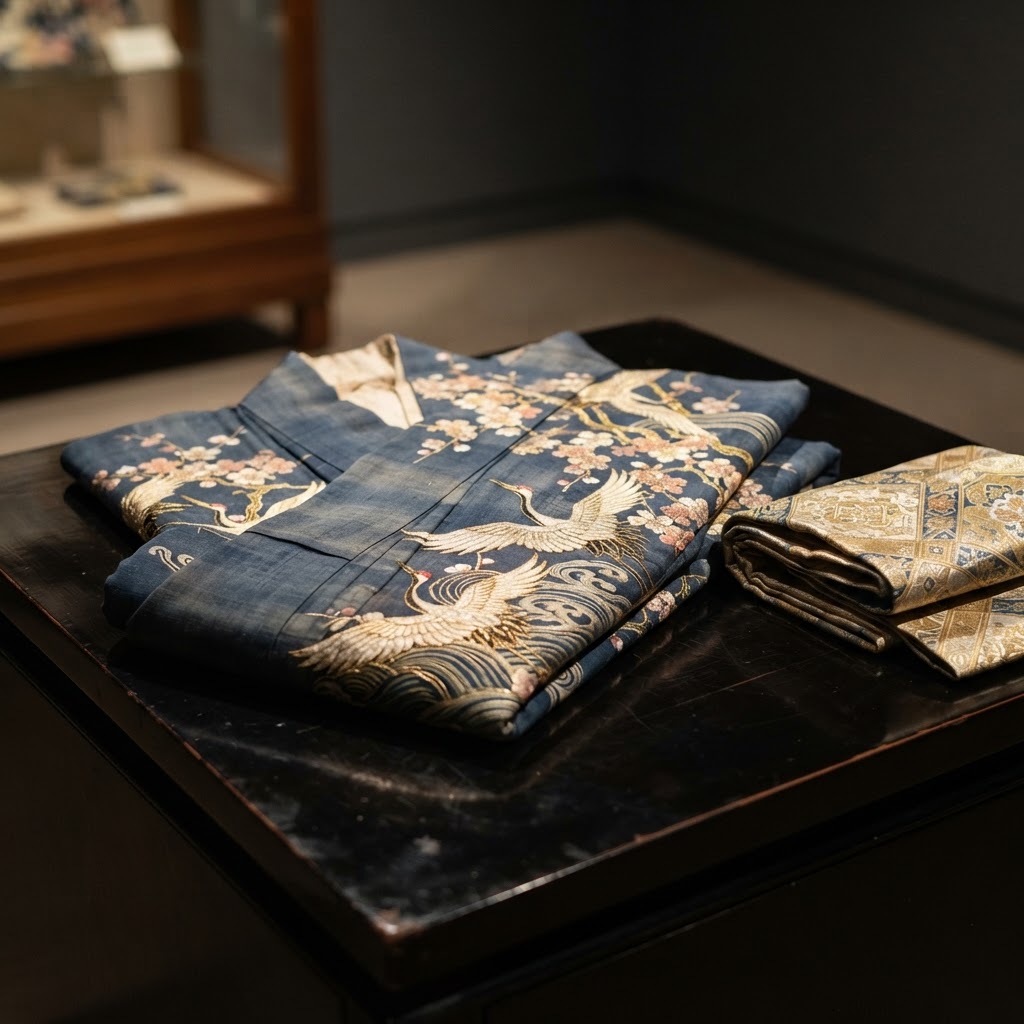
The kimono as we know it is descended from the kosode, a T-shaped, straight-seamed robe with wide sleeves, worn wrapped left over right and secured with an obi sash. During the Edo period, a new dyeing process called kanoko shibori was developed, and detailed patterns grew in popularity. The silks were decorated with auspicious motifs — cranes for longevity, tortoises for endurance, plum blossoms for resilience. A kimono worn by a samurai woman was an elaborate ensemble, regulated by rank and occasion, and a bride's kimono was embroidered with symbols of a long and happy marriage. The garment was, in this period, a complete language of status, season, and intention.
The Decline: Meiji and the Western Shift
After Japan was forced to open its borders to foreign trade in the 1850s, the new Meiji era (1868–1912) concentrated on building a modern, industrialized state. Western clothing was adopted as a sign of modernity, and the kimono became rigid, formal attire worn only at weddings, funerals, and tea ceremonies. By the mid-twentieth century, the kimono had retreated almost entirely from daily Japanese life. A handwoven formal kimono, when made by the finest makers, could cost thousands of pounds and was reverently handed down through generations, but it was a museum piece rather than a living garment.
The Modern Renaissance
Since the 1990s, a quiet revival has gathered pace. A younger generation of Japanese, fueled by magazines, blogs, and online communities, began to relearn how to wear the kimono, and second-hand kimono could be found in Tokyo and Kyoto for a few thousand yen. Designers began to cut kimono in lighter, contemporary fabrics and to style them with Western shoes and accessories, treating the garment as a living piece of clothing rather than a costume. As the textile historian Anna Jackson told the BBC, the kimono is "not just an icon or a traditional garment" — it is a dynamic garment whose use has ebbed and flowed with the tides of history. A new breed of kimono designer, particularly in Kyoto, has succeeded in putting the garment back on the street rather than on a pedestal.
The Western Fashion Conversation
The kimono's influence on Western fashion is older than its modern revival. In the early twentieth century, designers such as Paul Poiret and Madeleine Vionnet drew on the kimono's straight-cut, unstructured silhouette to liberate Western women's clothing from the corset. The kimono's influence is visible in the Art Nouveau and Art Deco garments of the 1910s and 1920s, and it continues to echo through contemporary runway collections. The kimono is, in this sense, a garment that has shaped global fashion twice: once in the 1910s, through its silhouette, and again today, through its revival as living dress.
Practical Guidance: Wearing and Caring for a Kimono
A first kimono should be a casual komon (small-pattern) or a vintage piece, worn with a simplified hanhaba obi. The wrap is always left over right — the reverse is reserved for dressing the dead. A nagajuban, or under-kimono, is worn beneath. The obi is tied at the back, and the entire ensemble is held in place with koshihimo sashes and an obi-ita. Silk kimono are dry-cleaned by specialists; cotton and linen yukata, the summer kimono, can be hand-washed. The garment is stored folded along its seams in washi paper, never hung, to preserve the silk.
Related Reading
The kimono's journey from traditional dress to global runway mirrors other living textile traditions — our guides to [Tokyo street style](/lifestyle/tokyo-street-style-worlds-most-daring-fashion-city) and [Italian craftsmanship](/lifestyle/italian-craftsmanship-fashion-brands-worth-knowing) explore how heritage and modernity meet in contemporary fashion.
Reference Links
- Kimono: from status symbol to high fashion (Edo period, Meiji decline, modern revival): [BBC Culture](https://www.bbc.com/culture/article/20200305-the-japanese-kimono-status-symbol-to-high-fashion)
- Japanese Kimono (Edo period, kosode, auspicious motifs): [Minneapolis Institute of Art](https://new.artsmia.org/programs/teachers-and-students/teaching-the-arts/artwork-in-focus/japanese-kimono)
- Kimono Style: Edo Traditions to Modern Design (Paul Poiret, Western fashion): [The Metropolitan Museum of Art](https://www.metmuseum.org/met-publications/kimono-style)
- The History of Kimonos (Edo period, kosode, shibori): [KimonoKoi](https://kimonokoi.com/blogs/news/the-history-of-kimonos)



Continue Reading