Fashion
The Scottish Tartan and the Kilt: How Sir Walter Scott and an 1822 Royal Visit Invented a Nation's Dress
In August 1822, King George IV became the first reigning British monarch to visit Scotland in nearly 170 years. Sir Walter Scott staged a pageant of clan tartans and Highland dress that fixed, almost overnight, the image of Scotland the world still holds today.
In August 1822, King George IV arrived in Edinburgh, becoming the first reigning British monarch to set foot in Scotland in nearly 170 years. The visit was stage-managed by the novelist Sir Walter Scott, who saw in the occasion a chance to revive what he considered the fading culture of the Scottish Highlands. Scott insisted that the clan chiefs who greeted the King wear their clan tartans and full Highland dress, and he organized a great "Gathering of the Gael" that draped the higher classes of Edinburgh in plaid. The pageant fixed, almost overnight, the image of Scotland the world has held ever since: a nation of tartan, kilts, and clan identity. Whether that image reflects an unbroken ancient tradition is a more complicated question.
The Fabric Before the Romance
Tartan as a textile is far older than the clan system that now defines it. The earliest surviving Scottish specimen, the Glen Affric tartan, has been carbon-dated to the sixteenth century, and a fragment found at Falkirk dates to roughly the third century AD. Tartan is not unique to Scotland — early specimens have been found in China, Egypt, and elsewhere in Europe — but only in Scotland did it reach the status of a cultural symbol. Before the early nineteenth century, Scots wore tartan based on what they liked, could afford, or what was locally available. The naming of civilian tartans by clan began only in the late eighteenth century, when the weaving firm Wilsons of Bannockburn started naming their patterns after towns, regions, and notable people. In 1815, the Highland Society of London asked the clan chiefs to submit specimens of their traditional tartans, and the chiefs, many of whom had no such tradition, were forced to invent or select patterns on the spot.
The 1822 Pageant and the Invention of Tradition
Scott's 1822 pageant is the moment at which tartan and the kilt became a formalized national dress. The King himself appeared in a kilt of Royal Stewart tartan, and the Edinburgh streets filled with tartan-clad clan chiefs and Highland soldiers. The event was, in the words of historians, an act of "invented tradition" — the term later coined by the historian Hugh Trevor-Roper, who argued in his famous essay The Invention of Tradition that the clan tartan system, as a fixed pattern assigned to a specific surname, was largely a creation of the early nineteenth century rather than an ancient inheritance. The claim is contested, but the broad outlines are well established: before 1800, tartan was a regional fabric; after 1822, it was a symbol of clan and nation.
The Kilt Itself
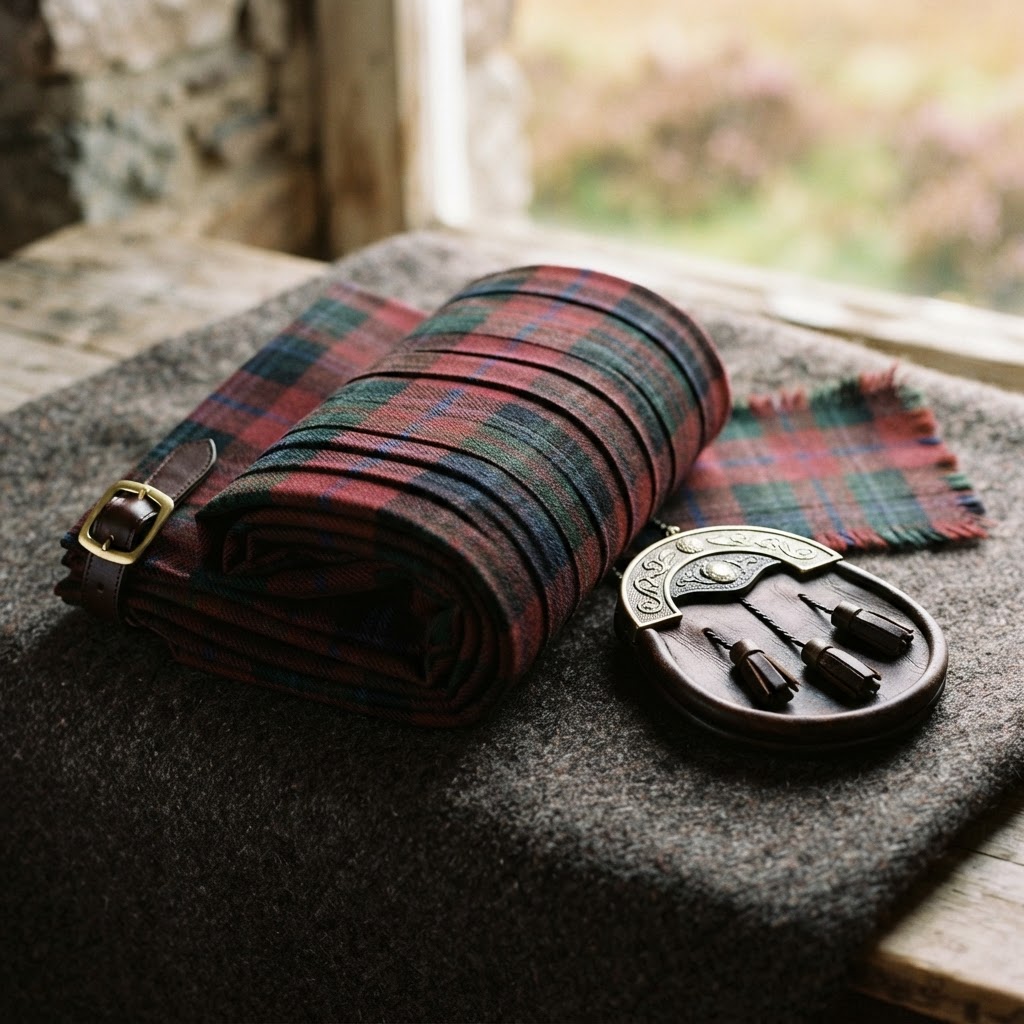
The modern small kilt, or feileadh beag, is itself a relatively recent garment. The older Highland dress was the belted plaid, a single large length of tartan gathered and belted around the waist with the upper portion draped over the shoulder. The small kilt — a pleated skirt of tartan with the upper portion separated — emerged in the early eighteenth century, and its popularization is sometimes credited to an English Quaker industrialist named Thomas Rawlinson, who had it made for his Scottish workers in the 1720s so they could move more freely in the forge. Whether Rawlinson truly invented it is debated, but the small kilt is, by the standards of national dress, a young garment. After the Jacobite rising of 1745, the Dress Act of 1746 prohibited the wearing of Highland dress by men and boys in the Highlands, a ban that lasted 35 years and was largely obsolete by about 1770. The repeal in 1782, followed by the 1822 pageant, turned the kilt from a suppressed garment into a celebratory one.
Practical Guidance: Choosing and Wearing a Kilt
A proper kilt is woven in worsted wool, in a clan or district tartan, and pleated to the sett (so the pattern continues across the back) or to the line. It is worn high on the waist, with a leather sporran at the front, kilt hose in a complementary color, and ghillie brogues laced around the ankle. A kilt should be made to measure; an off-the-rack kilt rarely falls correctly. The tartan one chooses may reflect clan affiliation, regional origin, or simply personal taste, and there is no authority that strictly governs who may wear which pattern. A well-made kilt, like a well-made suit, lasts a lifetime.
Related Reading
The story of a working garment elevated into national costume echoes elsewhere in our journal — our guide to the [trench coat](/lifestyle/the-trench-coat-fashions-most-enduring-garment) traces a similar path from military function to civilian fashion.
Reference Links
- The History of Tartan (Glen Affric, Wilsons of Bannockburn, 1815, 1822 George IV): [Scottish Tartans Authority](https://www.scottishtartansauthority.com/the-history-of-tartan)
- Scottish Tartan and Kilts (1822 visit, Sir Walter Scott, clan tartans): [VisitScotland](https://www.visitscotland.com/things-to-do/research-your-ancestry/clans/kilts-tartan)
- Sir Walter Scott and George IV's Visit to Scotland (1822, Gathering of the Gael): [USA Kilts](https://www.usakilts.com/blog/sir-walter-scott-and-george-ivs-visit-to-scotland.html)
- The Invention of Tradition (Hugh Trevor-Roper, Highland myth): [Columbia University (PDF)](http://www.columbia.edu/itc/journalism/stille/Politics%20Fall%202007/readings%20weeks%206-7/Trevor-Roper,%20The%20Highland%20Tradition.pdf)



Continue Reading