Home
The Santa Fe Adobe: New Mexico's Centuries-Old Pueblo Revival Tradition
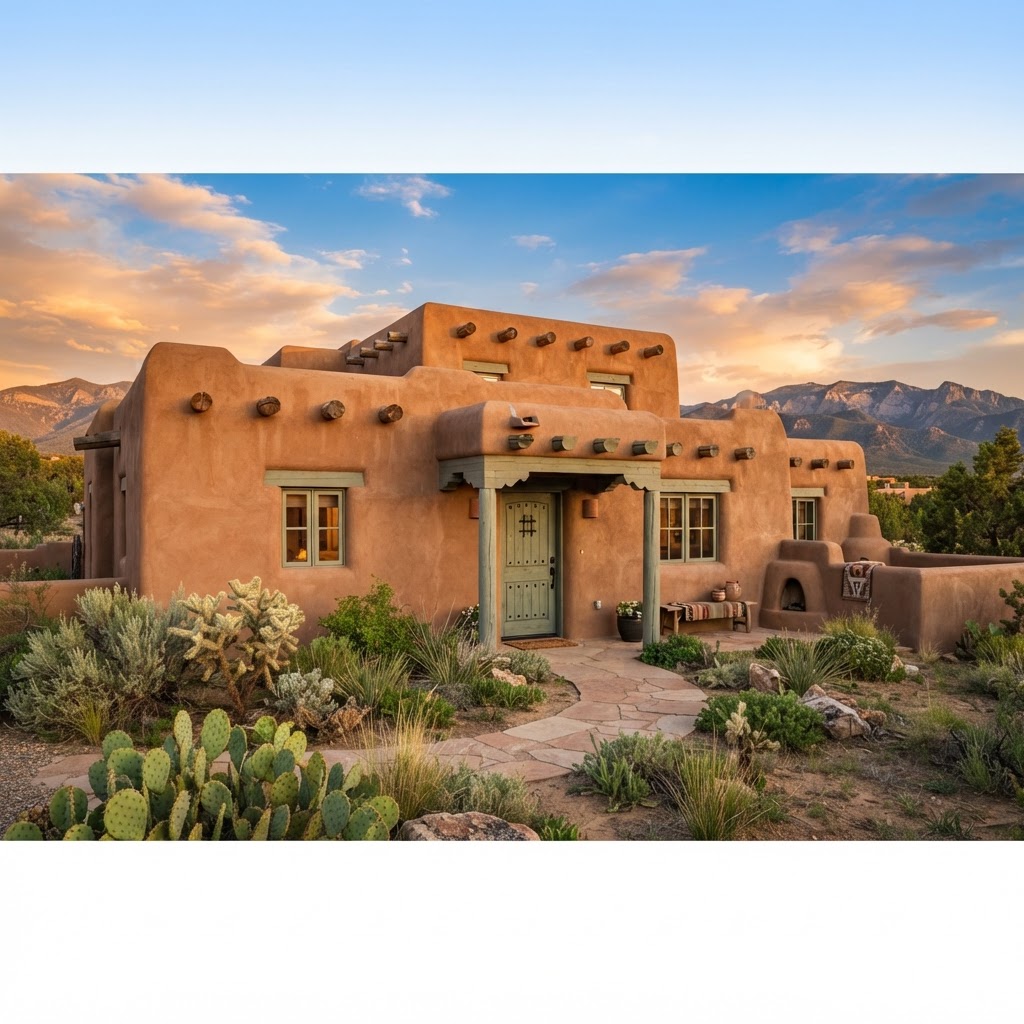
Thick earthen walls, rounded corners, and vigas beams — the sun-baked architecture of New Mexico, and a design language older than the United States.
Drive into Santa Fe and the light changes, the color changes, and the houses change — into soft, rounded, earth-toned walls with flat roofs and exposed wooden beams, a vernacular architecture older than the country around it. This is the adobe tradition of New Mexico, refined into what is now called [Pueblo Revival architecture](https://en.wikipedia.org/wiki/Pueblo_Revival_architecture).
**Built from the earth beneath them**
True adobe is sun-baked brick made of sand, clay, straw, and water — literally the dirt of the site, formed and dried in the high-desert sun. The Pueblo peoples built with it for centuries, hand-molding walls in low bands and letting each course dry before adding the next. The thick walls that resulted were brilliant passive climate machines, absorbing the day's heat and releasing it slowly through the cold desert night.
The Spanish who arrived in the 16th and 17th centuries adopted the method and added their own elements — vigas (exposed roof beams), latillas (cross-poles), and the characteristic flat roofs — and the fusion became the architectural language of New Mexico.
**The Pueblo Revival**
In the early 20th century, Santa Fe consciously chose this vernacular as its civic style. Pueblo Revival architecture imitates the appearance of traditional adobe Pueblo architecture — thick, slightly battered walls, rounded corners, flat roofs with projecting vigas, and deep-set windows — even when the structure beneath is modern. As the [Santa Fe tourism site](https://www.santafe.org/visiting-santa-fe/about-santa-fe/santa-fe-architecture/) recounts, the Pueblo Indians built their homes using wood, stone, and puddled adobe, a laborious method of molding walls by hand.
**The elements of the style**
- **Thick, rounded earthen walls**, often slightly tapered (battered) toward the top.
- **Flat roofs** with exposed wooden **vigas** and **latillas**.
- **Rounded corners** and soft, hand-formed edges.
- **Earth tones** — the natural straw-and-clay palette of adobe, sometimes whitewashed.
- **Deep-set windows** and **wooden doors** in sage greens and weathered blues.
**Why it still inspires**
The Santa Fe adobe is a masterclass in building from and for a place. The walls are the ground; the beams are the local trees; the forms answer a specific sun, a specific wind, a specific altitude. In an era of placeless architecture, that rootedness is the lesson — and the warmth of a hand-molded adobe wall at sunset is one of the great sensory pleasures of American design.
**References:**
- Pueblo Revival architecture: [Wikipedia](https://en.wikipedia.org/wiki/Pueblo_Revival_architecture)
- Santa Fe architecture: [Santa Fe](https://www.santafe.org/visiting-santa-fe/about-santa-fe/santa-fe-architecture/)
Continue Reading