Fashion
The Pearl: The World's Most Timeless Gem and How to Wear It
The pearl is the world's oldest gem, and the only one created by a living creature. From Kokichi Mikimoto's 1893 cultured pearl breakthrough to the Akoya, South Sea, and Tahitian varieties, here is the complete guide.
The pearl is the world's oldest gem — and the only one created by a living creature. Unlike diamonds, rubies, and sapphires, which must be cut and polished from rough stone, the pearl emerges from the oyster complete, luminous, and ready to wear. It has been prized for over 4,000 years, and its story encompasses ancient mythology, royal adornment, and one of the most remarkable breakthroughs in the history of jewellery.
The Cultured Pearl Revolution
For most of human history, pearls were among the rarest and most valuable materials on earth. Natural pearls were harvested by pearl divers who descended to the seabed without breathing apparatus, and a single gem-quality pearl might require the opening of thousands of oysters. The discovery of the pearl by a diver was a matter of chance, and the supply was so limited that pearls were worth more than diamonds by weight.
This changed in 1893, when a Japanese pearl farmer named Kokichi Mikimoto (1858–1954) successfully created the world's first cultured pearl. Mikimoto, who had begun experimenting with pearl cultivation in 1888 using the Akoya pearl oyster (Pinctada fucata), patented his process in 1896 and cultured the first fully spherical pearl in 1905. His work — which involved the surgical insertion of a nucleus into the oyster to stimulate the production of nacre (the iridescent substance that forms the pearl) — revolutionised the industry, making pearls accessible to a far wider audience while preserving their essential beauty.
Mikimoto's company, MIKIMOTO, founded in 1893, remains one of the world's most prestigious pearl jewellers. The 'father of cultured pearls' opened his first boutique in Tokyo's Ginza district in 1906 and expanded internationally, including a landmark store on Fifth Avenue in New York.
The Types of Pearls
There are four principal types of cultured pearls, each with its own characteristics:
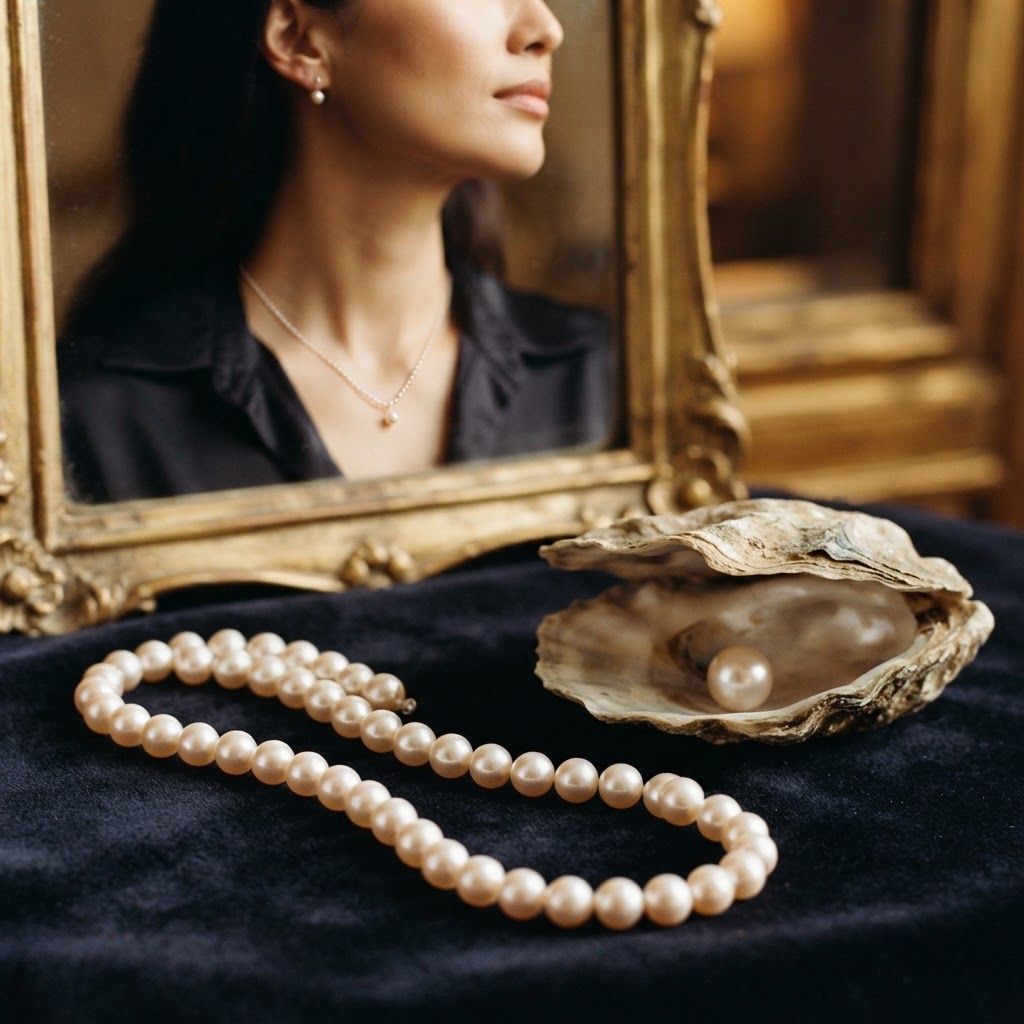
**Akoya pearls** — Cultivated primarily in Japan from the Akoya oyster, these are the classic white, round pearls most associated with pearl strands. They typically range from 5mm to 10mm in diameter, with exceptional lustre — the sharp, mirror-like reflection that is the primary measure of a pearl's quality. Akoya pearls were the first to be cultured by Mikimoto.
**South Sea pearls** — The largest and most valuable of all cultured pearls, grown in the Pinctada maxima oyster in the warm waters of Australia, the Philippines, and Indonesia. South Sea pearls range from 9mm to over 20mm and are prized for their satiny lustre and thick nacre. White South Sea pearls (from Australia) and golden South Sea pearls (from the Philippines and Indonesia) are the most coveted.
**Tahitian pearls** — Cultivated in French Polynesia (primarily Tahiti) from the Pinctada margaritifera oyster, these are the naturally dark pearls that range in colour from charcoal grey to deep black, with overtones of peacock green, aubergine, and silver. Despite being known as 'black pearls,' most Tahitian pearls are shades of grey, green, or blue.
**Freshwater pearls** — Cultivated in freshwater mussels (Hyriopsis cumingi) primarily in China, freshwater pearls come in a wide range of shapes, sizes, and natural colours (white, peach, lavender). They are the most affordable cultured pearls and have improved dramatically in quality over the past two decades.
How to Choose and Wear Pearls
The quality of a pearl is assessed by five factors: **lustre** (the sharpness and brightness of the reflection on the surface), **surface quality** (the absence of blemishes), **shape** (round being the most valued for Akoya), **colour** (a matter of personal preference and skin tone), and **size** (larger pearls are rarer and more valuable).
A classic strand of Akoya pearls — graduated or uniform, 18 inches (princess length) — is the single most versatile pearl investment. For a more contemporary look, South Sea pearl studs or a single Tahitian pearl pendant make an elegant statement. The most important principle: buy the best quality you can afford in a smaller size, rather than a larger pearl with poor lustre.
Reference Links:
- MIKIMOTO Official: mikimotoamerica.com
- Mikimoto Brand Story: mikimotoamerica.com/us_en/brand-story
- GIA — Pearl Guide: gia.edu/pearl
- Pearl Paradise: pearlparadise.com
- American Pearl: americanpearl.com
- Lang Antiques — Mikimoto: langantiques.com/university/mikimoto-kokichi
- BioOne — History of Cultured Pearl Industry: bioone.org/journals/zoological-science



Continue Reading