Home
The Moroccan Riad: The Inward-Facing Courtyard House of Marrakech
Behind a blank wall on a Marrakech alley lies a garden, a fountain, and a house that turns its back on the street to face itself.
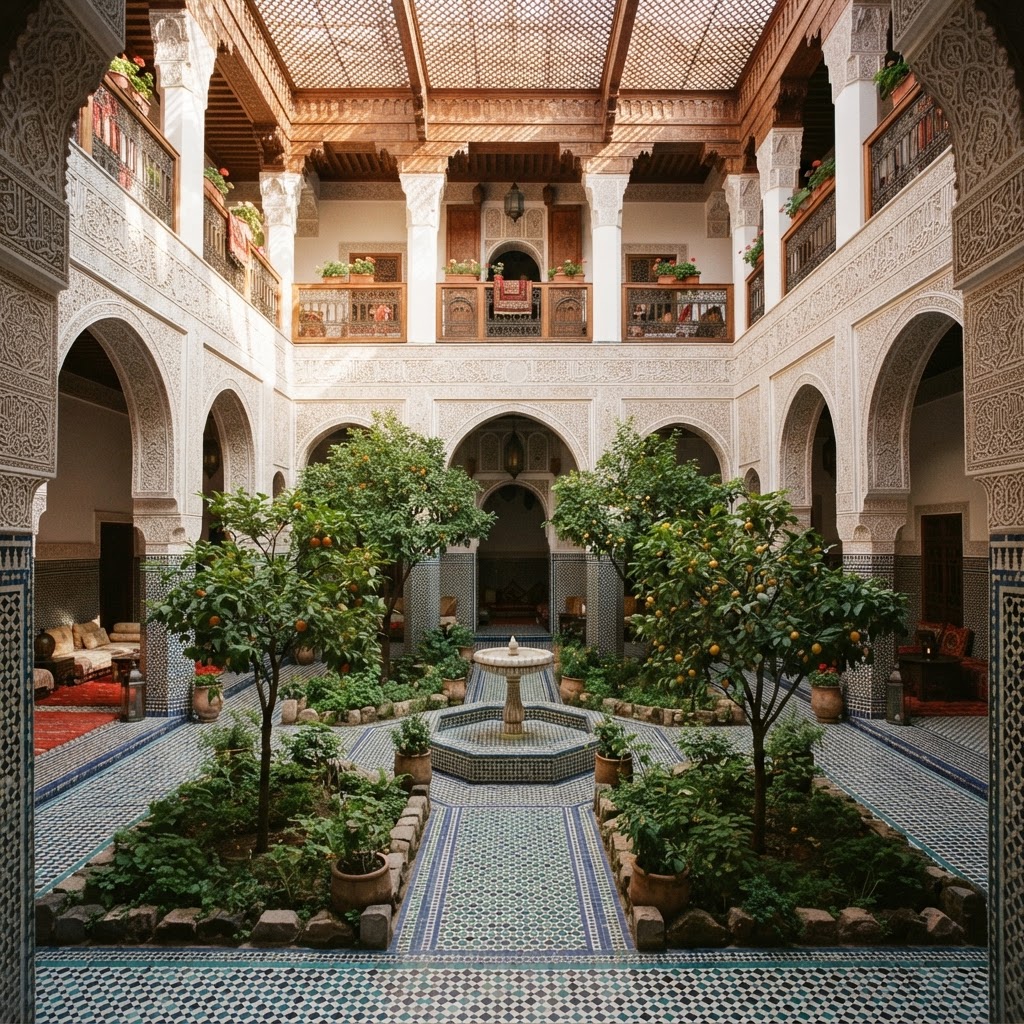
In Marrakech, the grandest houses reveal nothing from the street. A plain, windowless wall, a heavy door, an alley — and then you step through, and the world opens into a cool, tiled courtyard, a four-part garden around a central fountain, with rooms arranged on every side. This is the riad, the inward-facing courtyard house that is one of the great domestic forms of the Islamic world.
According to [Wikipedia](https://en.wikipedia.org/wiki/Riad_(architecture)), the riad is one of two main types of traditional Moroccan house — often two or more stories arranged around an interior symmetrical garden centered on a fountain.
**A house that faces itself**
The riad turns its back on the street by design. In a hot, dense city, the courtyard is the climate strategy: it shades, it cools through evaporation from the fountain and the planted beds, and it gives privacy in a culture that prizes it. The rooms open onto the courtyard, not the street, so the whole house orients inward — a private world of greenery, water, and carved plaster.
**A thousand years of refinement**
The form has ancient roots. As Wikipedia notes, riad architecture has roots in Mediterranean and Middle Eastern courtyard houses, and the earliest known true riad garden in Morocco was found in the Almoravid palace built in Marrakesh in the early 12th century. Over the centuries of the Almoravid, Almohad, Marinid, and Nasrid dynasties, the model was refined into the standard we still recognize — the four-part *chahar bagh* garden, the central fountain, the peristyle gallery, the zellige tile, and the carved cedar screens.
**The elements of the riad**
- A **central symmetrical courtyard**, often divided into four garden beds (the *chahar bagh*).
- A **fountain at the center**, cooling the air and anchoring the composition.
- **Horseshoe arches** and a peristyle gallery around the courtyard.
- **Zellige tilework**, carved plaster, and cedar *mashrabiya* screens.
- **Rooms opening onto the courtyard**, with few or no street-facing windows.
**Why it still teaches**
The riad is a lesson in the power of the inward turn — the idea that the most beautiful room in a house can be the one no one on the street ever sees. For any home in a dense or noisy setting, the riad's example is clear: make a courtyard, however small, and let the house gather around it.
**References:**
- Riad (architecture): [Wikipedia](https://en.wikipedia.org/wiki/Riad_(architecture))
- A brief history of Moroccan riads: [Marrakech Riads](https://marrakech-riads.com/en/a-brief-history-of-moroccan-riads/)



Continue Reading