Home
The Icelandic Turf House: The Grass-Roofed Viking Cottage of the North
With walls and roofs blanketed in living green turf, the Icelandic turf house is the great vernacular house of the North — a 1,000-year-old answer to a treeless, volcanic, wind-scoured landscape.
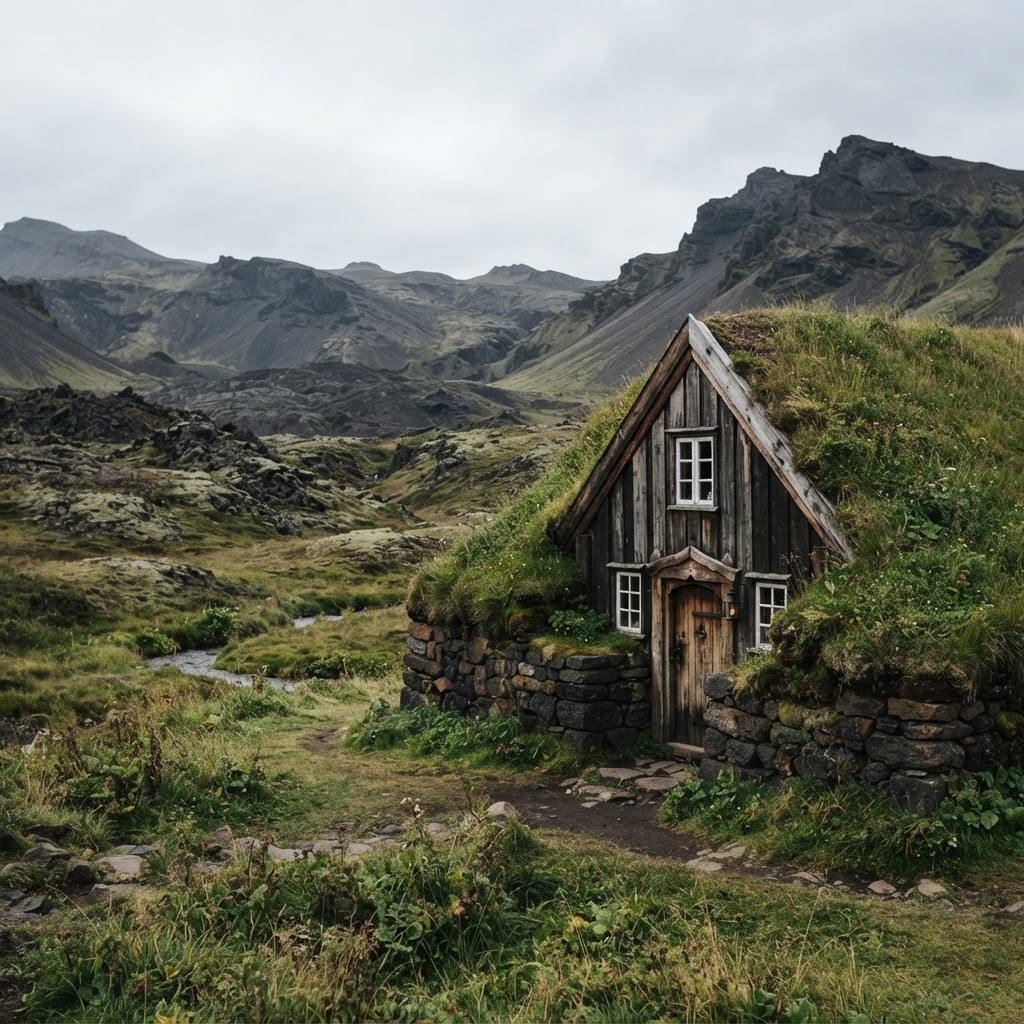
On a windswept Icelandic plain, a low house with walls and a roof of living green turf seems to grow out of the earth itself. This is the Icelandic turf house — the great vernacular house of the North, built of timber and turf for more than a thousand years, and one of the most beautiful and ingenious answers to a hostile climate that any culture has produced.
According to [Wikipedia](https://en.wikipedia.org/wiki/Icelandic_turf_house), Icelandic turf houses are timber structures with turf walls and a turf cover for the roof, constructed since Iceland was settled in the ninth century.
**A house born of scarcity**
When Norse settlers arrived in Iceland in the ninth century, they found a land with almost no trees — only low birch — but an abundance of suitable turf. They were already familiar with turf roofs from Norway, and they adapted the Viking longhouse (*langhús*) to their new, harsher home. Turf offered superior insulation against the cold and wind, and it was the one material they had in abundance. Over the centuries, as the birch forests vanished, turf houses evolved into complexes of smaller rooms linked by tunnels — a way to conserve heat and minimize the use of wood.
**The elements of the turf house**
- A **flat-stone foundation** supporting a wooden frame.
- **Walls of stacked turf blocks**, often in a herringbone pattern.
- A **turf roof**, blanketed in living grass.
- A **wooden doorway**, often the only external wood and often decorative.
- Small **windows, mostly without glass** until modern times.
- A **central hall** with a great fire.
**The burstabær**
The turf house evolved over a thousand years. In the late eighteenth century, a new style emerged — the *burstabær*, with wooden gable ends (*gaflar*) rising above the turf walls. This is the most commonly depicted version of the Icelandic turf house, and many survived well into the twentieth century before being replaced by corrugated iron and concrete. The best-preserved examples, like the cluster at Glaumbær, are now museums.
**Why the turf house matters now**
As the [Guide to Iceland](https://guidetoiceland.is/history-culture/the-ultimate-guide-to-turf-houses-in-iceland) documents, the turf house is increasingly studied as a model of sustainable, climate-responsive building — a house made almost entirely of local, renewable material, with extraordinary insulation, that blends so completely into its landscape that it seems to be part of it. The turf house is the ultimate lesson in building with what the land gives you, and it looks, in its green, grassy way, like something from a fairy tale.
**References:**
- Icelandic turf house: [Wikipedia](https://en.wikipedia.org/wiki/Icelandic_turf_house)
- The Ultimate Guide to Turf Houses in Iceland: [Guide to Iceland](https://guidetoiceland.is/history-culture/the-ultimate-guide-to-turf-houses-in-iceland)



Continue Reading