Home
The Craftsman Bungalow: How the Arts and Crafts Movement Built America's Coziest Homes
Low roofs, deep porches, and honest woodwork — the little house that put the Arts and Crafts movement within reach of the American middle class.
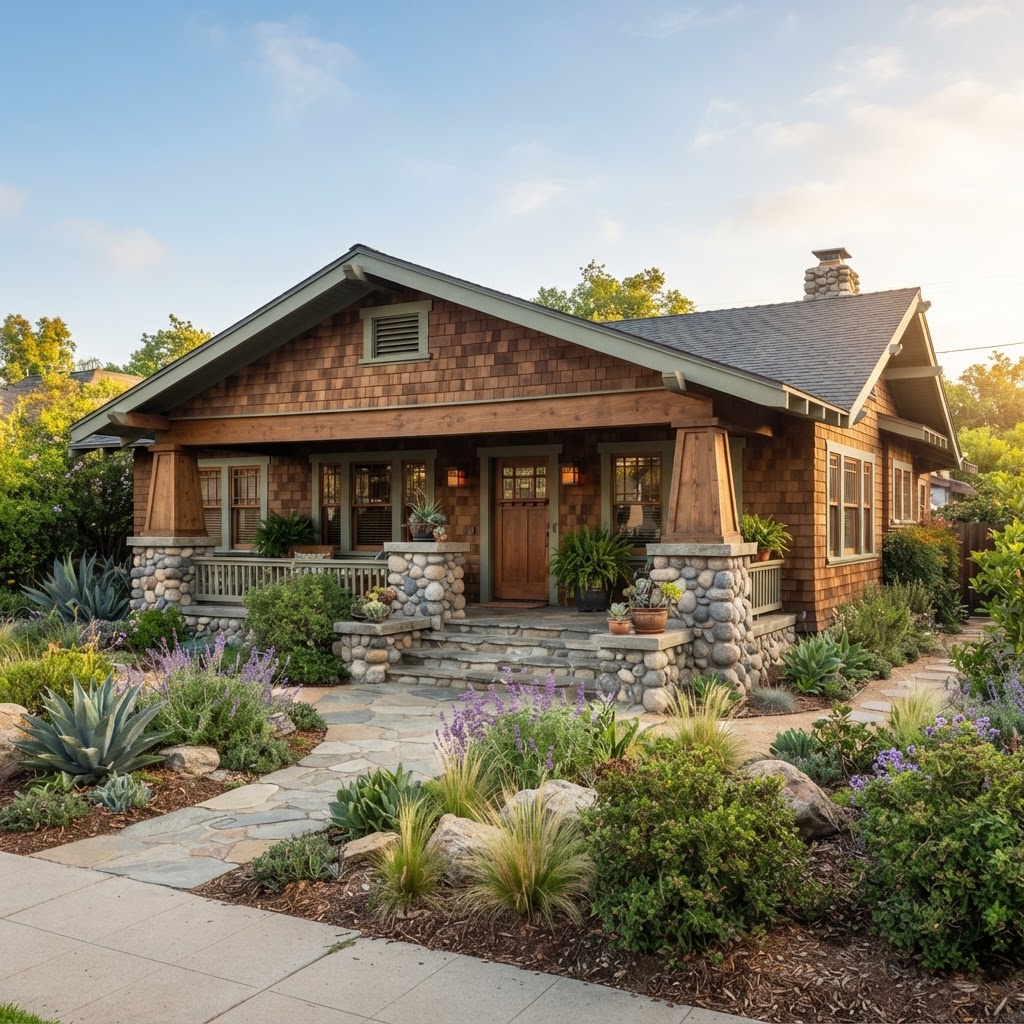
If one house came closer than any other to defining the American ideal of home in the early 20th century, it is the Craftsman bungalow. Low, broad, sheltering — a deep porch beneath a low-pitched roof, tapered columns rising from a stone base, exposed rafters and honest woodwork — the Craftsman bungalow was the Arts and Crafts movement made livable, affordable, and unmistakably American.
According to [Wikipedia](https://en.wikipedia.org/wiki/American_Craftsman), the American Craftsman style was an American offshoot of the British Arts and Crafts movement, and the term "Craftsman" was taken from furniture-maker Gustav Stickley, whose magazine *The Craftsman* was first published in 1901.
**A movement of honest making**
The Arts and Crafts movement had begun in Britain as a protest against the shoddy, mass-produced goods of the Industrial Revolution — a call to return to handwork, natural materials, and the dignity of the maker. When those ideas crossed the Atlantic, they found an eager audience among a rising American middle class who wanted homes that were beautiful, simple, and built to last.
Stickley was the movement's great popularizer. Through *The Craftsman* magazine and his furniture, he championed a vision of the modest, well-built home — built-in bookcases, pegged oak floors, generous fireplaces, and woodwork that celebrated the grain rather than hiding it. The style, scaled down, became the California bungalow, which spread across the country from roughly 1905 to 1930.
**The anatomy of a Craftsman bungalow**
- A **low-pitched gabled roof** with wide, unenclosed eaves and exposed rafter tails.
- **Tapered, squared porch columns**, often on stone or brick bases.
- A **deep, sheltering front porch** that extends the living space outdoors.
- **Natural materials** — cedar shingles, river rock, oak, Douglas fir.
- **Built-in furniture** and woodwork that is honest, hand-finished, and structural.
**Why we still love it**
The Craftsman bungalow endures because it is warm, human-scaled, and beautifully made. It is a house that asks to be touched — the grain of the wood, the weight of the front door, the cool of a stone porch column in summer. In an age of flat-pack furniture and disposable finishes, that tactility reads as a kind of luxury, and a quiet one.
**References:**
- American Craftsman style: [Wikipedia](https://en.wikipedia.org/wiki/American_Craftsman)
- Arts and Crafts movement: [Wikipedia](https://en.wikipedia.org/wiki/Arts_and_Crafts_movement)



Continue Reading