Food & Drink
Tennessee Whiskey and the Sacred Lincoln County Process
What makes Tennessee whiskey different from bourbon? One thing: the Lincoln County Process, a slow filtration through sugar maple charcoal that smooths the spirit and defines an entire category of American whiskey.
Tennessee whiskey is defined by a single step that distinguishes it from all other American whiskeys: the Lincoln County Process. This process, named after Lincoln County, Tennessee — where Jack Daniel's was originally located before county boundary changes placed it in what is now Moore County — involves filtering the freshly distilled spirit through a thick bed of sugar maple charcoal before it goes into the barrel for aging. This charcoal mellowing, as it is known in the industry, removes impurities, rounds off harsh edges, and imparts a distinctive smoothness that has become the hallmark of Tennessee whiskey. The Lincoln County Process is so essential to the identity of Tennessee whiskey that it is now codified in Tennessee state law (en.wikipedia.org/wiki/Lincoln_County_Process).
The legal definition of Tennessee whiskey was established on May 13, 2013, when the governor of Tennessee signed House Bill 1084, requiring that any product labelled 'Tennessee whiskey' must be filtered through maple charcoal prior to aging, in addition to meeting all the existing federal requirements for bourbon. The law requires that the whiskey be produced in Tennessee, made from at least 51 percent corn, aged in new charred oak barrels, distilled to no more than 80 percent alcohol by volume, and entered into the barrel at no more than 62.5 percent alcohol by volume. The Lincoln County Process — the maple charcoal filtration step — is the additional requirement that makes Tennessee whiskey distinct from bourbon. One producer, Benjamin Prichard's, was granted a specific exemption from the law, as their production methods predated the legislation and did not include charcoal mellowing (thewhiskeywash.com).
The Lincoln County Process begins with the selection and burning of sugar maple trees. The trees are harvested, cut into billets, and stacked in a specific configuration known as a rick. The rick is set alight and allowed to burn under controlled conditions, with the fire being closely monitored and managed to produce charcoal of the right density and porosity. The resulting charcoal is then ground and placed in large vats — at Jack Daniel's, these vats are approximately 10 feet deep and hold approximately 13 feet of charcoal — through which the newly distilled, clear whiskey (known as 'white dog' or 'new make') is filtered drop by drop. The process is slow: at Jack Daniel's, the whiskey takes approximately three to five days to percolate through the charcoal bed. During this time, the charcoal absorbs impurities, including certain heavy compounds that contribute to harshness, and the spirit emerges clearer, smoother, and more refined.
The history of Tennessee whiskey is intertwined with the history of the American South. The earliest Tennessee distillers were farmers of Scotch-Irish and German descent who settled in the hills and hollows of middle and east Tennessee, bringing with them the tradition of distilling grain spirits. The distinctive feature of Tennessee distilling — charcoal mellowing — is believed to have been developed in the early 19th century, though its exact origin is debated. Some accounts attribute it to Alfred Eaton, a distiller in Lincoln County who is said to have begun filtering his whiskey through charcoal in the 1820s. Others trace the practice to earlier, possibly indigenous or African traditions of water purification through charcoal. Regardless of its origin, the process was well established by the time Jack Daniel began learning to distil as a boy in the 1850s, under the tutelage of a Lutheran minister named Dan Call and Call's enslaved distiller, Nathan 'Nearest' Green, who is now recognised as the first African American master distiller on record in the United States.
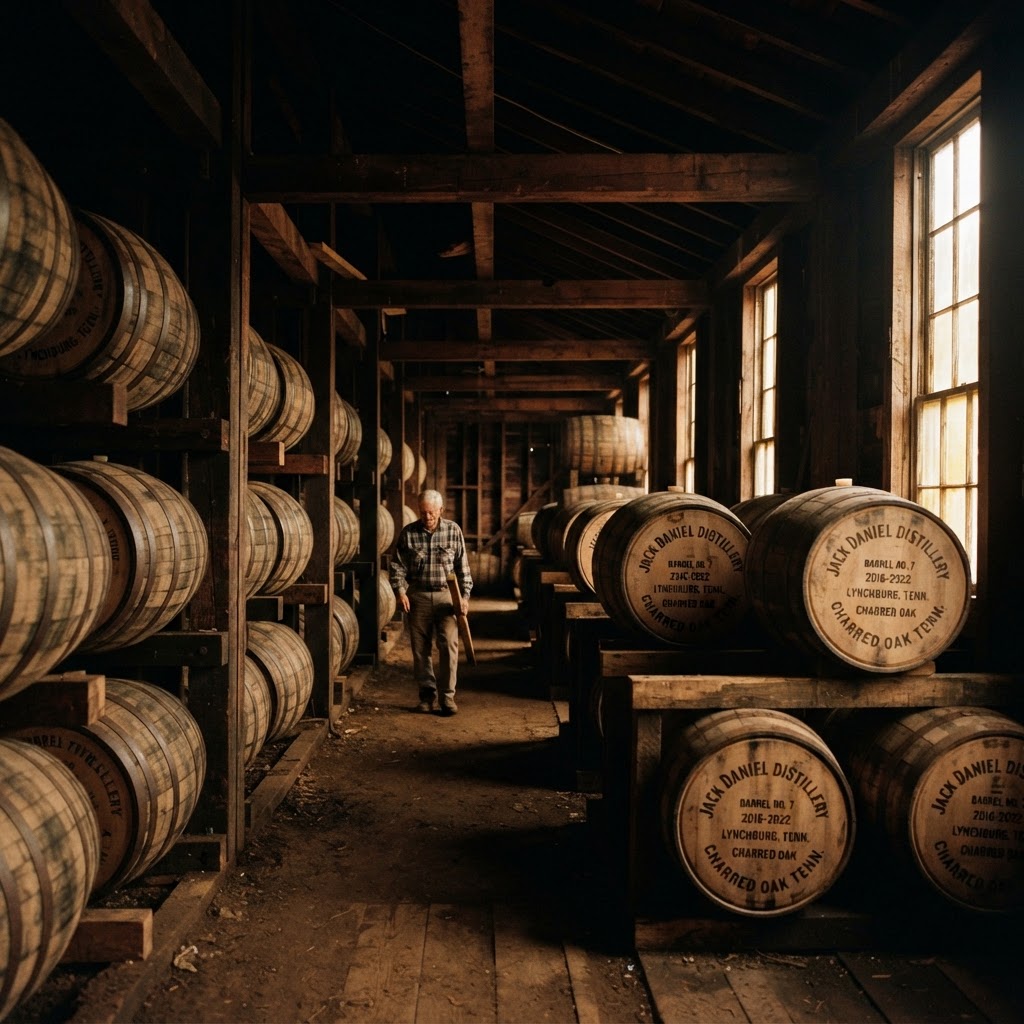
Jack Daniel registered his distillery in 1866, making it the oldest registered distillery in the United States. The Jack Daniel's Distillery, located in Lynchburg, Tennessee (population approximately 6,300, in a county — Moore — that remains dry to this day, meaning that the distillery's primary product cannot be legally sold in the town where it is made), is one of the most visited tourist attractions in Tennessee, drawing over 300,000 visitors annually. The distillery offers tours that take visitors through every step of the production process, from the cave spring that provides the iron-free water used in every bottle, through the grain milling, fermentation, distillation, charcoal mellowing, and barrel filling, to the aging warehouses where the whiskey rests in new charred American white oak barrels for a minimum of four years (jackdaniels.com).
The Jack Daniel's portfolio includes several expressions. Old No. 7, the brand's flagship, is aged approximately four to five years and is the world's best-selling American whiskey. Jack Daniel's Single Barrel is aged in the warmest part of the barrel houses, where greater temperature variation drives more interaction between the whiskey and the wood, producing a bolder, more intense flavour profile. Gentleman Jack is charcoal mellowed twice — once before barrel aging, like all Jack Daniel's, and again after aging — producing a particularly smooth, refined character. Jack Daniel's also produces Tennessee Rye, made from a mash of 70 percent rye grain, which undergoes the same Lincoln County Process as the brand's corn-based whiskeys.
Beyond Jack Daniel's, Tennessee whiskey is produced by several other distilleries. George Dickel, located in Tullahoma, Tennessee, is the other major historic Tennessee whiskey producer, founded in 1870 and known for its use of chilled charcoal filtration — a variation on the Lincoln County Process in which the whiskey is chilled before filtration, which the company believes produces a smoother result. Benjamin Prichard's, in Kelso, Tennessee, is the only producer legally exempt from the Lincoln County Process requirement, and produces its whiskey using traditional methods without charcoal mellowing. Nelson's Green Brier Distillery, revived in 2011 from a historic Nashville distillery that operated from 1885 until Prohibition, uses the Lincoln County Process for its Tennessee whiskeys. And in recent years, a new generation of craft distilleries has emerged across the state, contributing to a Tennessee whiskey renaissance that extends far beyond the two historic giants.
What makes Tennessee whiskey so significant in the world of spirits is the way a single, distinctive production step — the Lincoln County Process — creates a character that is recognisably different from bourbon, even though the two share the same fundamental ingredients and aging requirements. The charcoal mellowing does not fundamentally change the chemistry of the whiskey, but it refines it — removing certain compounds, smoothing certain edges, and allowing the character of the grain, the barrel, and the time to express themselves with a clarity that un-mellowed bourbon does not quite achieve. It is a tradition born of practical ingenuity in the hills of Tennessee, refined over 150 years, and now enshrined in law — a uniquely American contribution to the world of spirits, born of the same frontier self-reliance and agricultural tradition that produced bourbon, but distinguished by a single, deliberate, patient step that transforms the spirit into something unmistakably, unmistakably Tennessee.
For those seeking to learn more or plan a visit, the Jack Daniel's Distillery provides tour information and history (jackdaniels.com). The Tennessee Whiskey Trail, maintained by the Tennessee Distillers Guild, connects over 30 distilleries across the state (tnwhiskeytrail.com). The George Dickel Distillery offers tours and information on its chilled charcoal process (georgedickel.com).
Continue Reading