Entertaining
The Tasting Menu at Home: How to Serve a Multi-Course Dinner Like a Restaurant
The tasting menu is the format that defines the world's great restaurants. Replicating it at home is one of the most ambitious and most rewarding forms of entertaining — and the key is pacing.
The tasting menu — a sequence of small, carefully composed courses designed to be experienced in order rather than chosen from — is the format that defines the world's great restaurants. From eleven-course evenings at Michelin three-star kitchens to the minimalist kaiseki of Kyoto, the principle is constant: smaller plates, more courses, a deliberate progression from light to rich, from savoury to sweet, orchestrated in pacing and sequence.
Replicating this at home is one of the most ambitious and most rewarding forms of entertaining. It demands more preparation than a single main course, but it produces an experience that feels categorically different — closer to a performance, with the host as chef, server, and curator. The key is pacing: each course should be small enough that the cumulative meal remains balanced, and the intervals between courses long enough for conversation but short enough to maintain momentum.
**Choosing Your Courses**
A home tasting menu typically runs five to seven courses — enough to feel like an event, manageable enough for one cook. The classic progression moves from light to rich and from cold to hot:
1. Amuse-bouche — a single bite, often cold, that sets the tone
2. First course — light and bright, often seafood or vegetables
3. Soup or intermediate course — a palate refresher
4. Main course — the most substantial plate, often protein with sauce
5. Pre-dessert or cheese course — a small transition
6. Dessert — the sweet conclusion
7. Mignardises — petits fours served with coffee or tea
**Pacing the Meal**
Professional kitchens serve a new course roughly every 15–25 minutes, depending on the conversation and the course. Culinary Crush (culinarycrush.biz) advises cooking multiple courses simultaneously to ensure the meal is paced like a real restaurant — course four and five, for example, may need to be plated at the same time. The Splendid Table (splendidtable.org) recommends that the conversation, not the clock, should dictate pacing — rushing the meal defeats the purpose of the format.
**Plating and Portion**
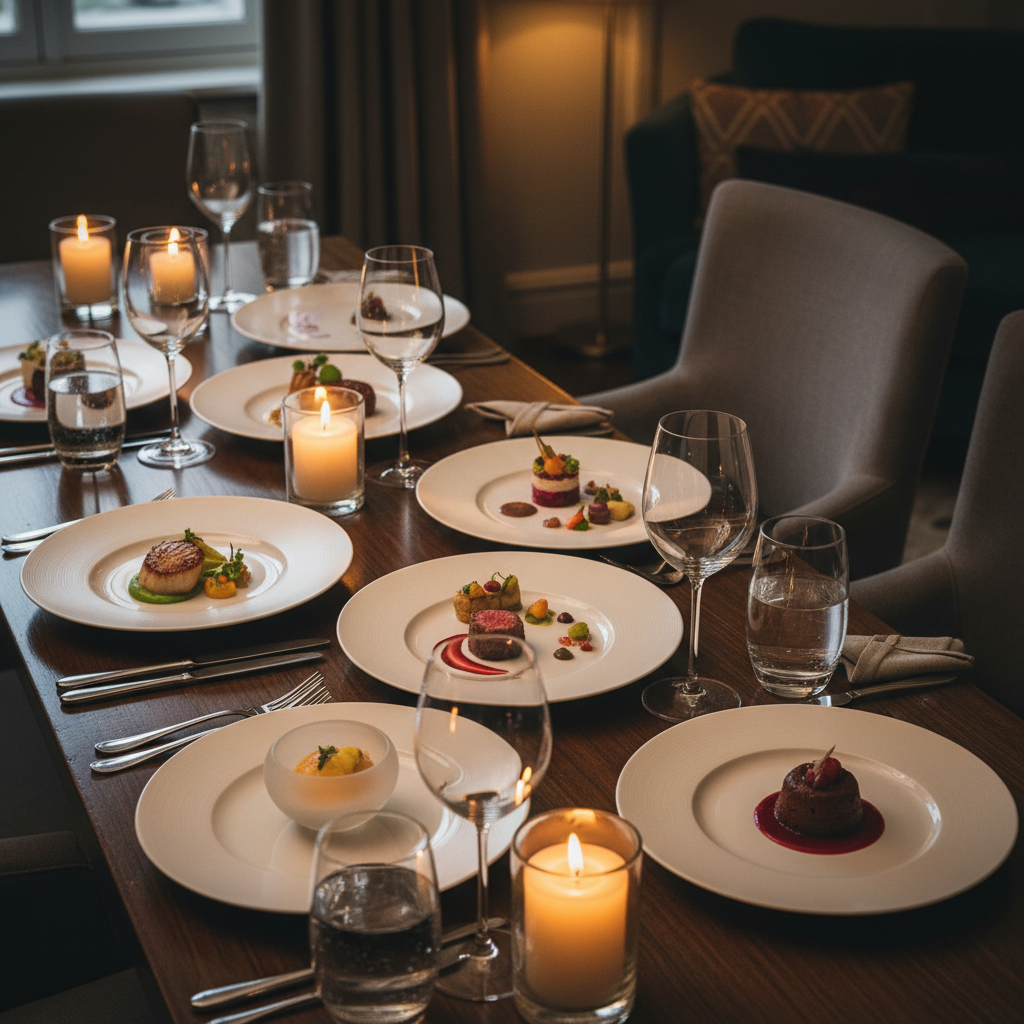
The cardinal sin of the home tasting menu is over-portioning. Each course should be roughly half the size of a normal appetiser — three or four bites is ideal. The cumulative effect of seven small courses should equal a normal dinner, not exceed it. Invest in neutral plates (white is the restaurant standard) that let the food be the focus, and garnish with intention — a single herb leaf, a precise drizzle of sauce, a few crystals of flaky salt.
**Reference Links:**
- How to host a tasting menu dinner at home: Culinary Crush (culinarycrush.biz/all/hosting-a-tasting-menu-at-home)
- The art of dinner conversation and pacing: The Splendid Table (splendidtable.org)
**Pro Tips:**
Mise en place is non-negotiable — every component prepared and portioned before guests arrive. Pre-plate as much as possible. And always taste a final seasoning before service — a course that needs salt at home will need it more at the table.



Continue Reading