Entertaining
The Korean BBQ Party: The Tabletop Grill at the Heart of Korean Social Life
Korean barbecue — gogi-gui — is the great communal dining tradition of Korea, a meal built around a tabletop grill where guests cook marinated bulgogi and galbi, wrap them in lettuce with ssamjang, and eat in a constant round of grilling, dipping, and soju.
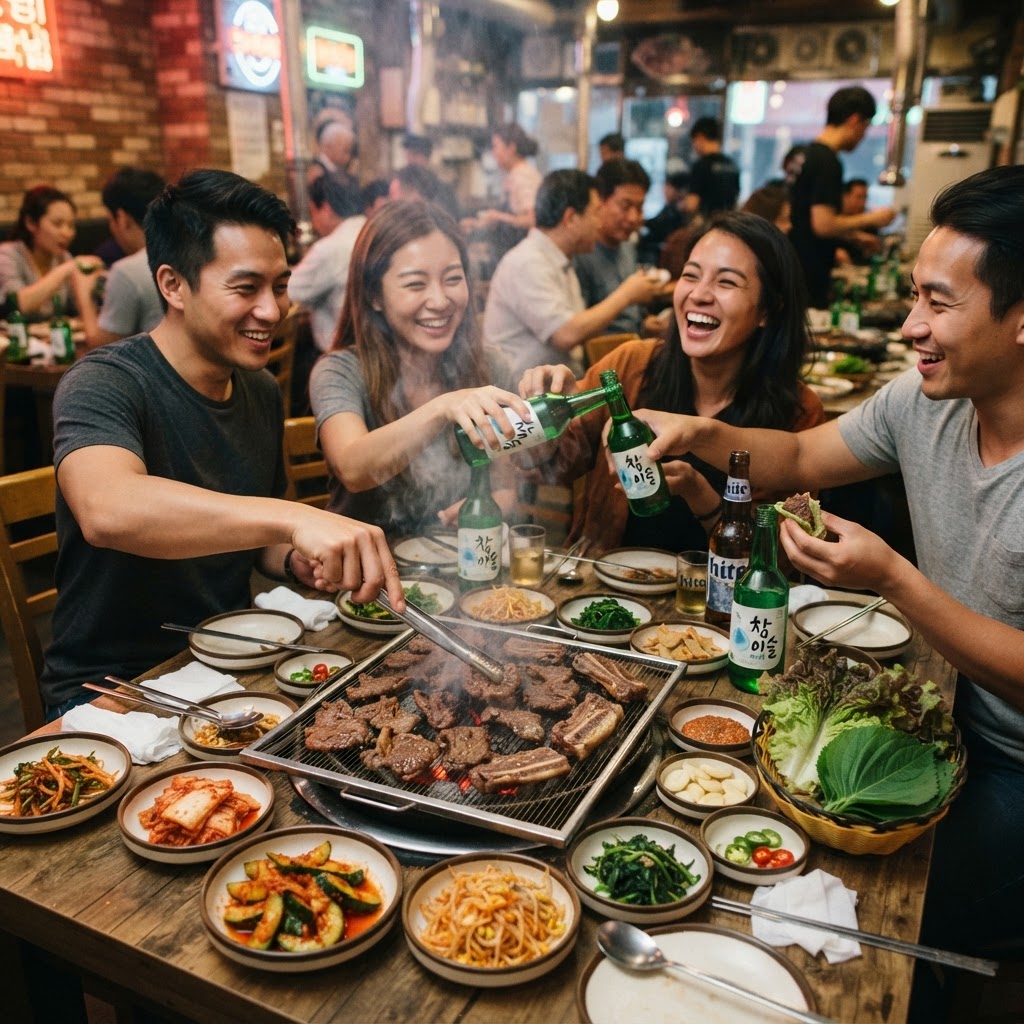
If you want to understand the social life of Korea, go to a Korean barbecue. The Korean barbecue — gogi-gui, 'meat roast' — is the great communal dining tradition of Korea, a meal built around a grill set into the center of the table, where the guests cook their own marinated meats, wrap them in lettuce, and eat them in a constant round of grilling, dipping, drinking, and talking. It is one of the most convivial entertaining traditions in the world, and its meaning is in the gathering itself.
**Origins**
As Wikipedia records, bulgogi — the marinated, thin-sliced beef that is the heart of Korean barbecue — has roots reaching back centuries on the Korean peninsula. The dish's name is a combination of two Korean words: bul, 'fire,' and gogi, 'meat.' The earliest ancestor is thought to be maekjeok, a dish of skewered and grilled meat from the Goguryeo era (37 BCE-668 CE), which evolved during the Goryeo dynasty (918-1392) and the Joseon dynasty into the marinated, grilled beef known today as bulgogi. The modern form of Korean barbecue — the tabletop grill, the banchan, the lettuce wraps — developed as beef became more widely available in the 20th century, and it has since become one of the most popular and most exported dining traditions of Korea.
**The Grill**
At the heart of Korean barbecue is the tabletop grill — a charcoal or gas burner set into the table, over which the guests cook their own meat. The classic cuts are bulgogi — thinly sliced beef marinated in soy sauce, sugar, sesame oil, garlic, and pear — and galbi, the marinated beef short ribs cut across the bone. Pork is central to the tradition: samgyeopsal, the thick slices of uncured pork belly grilled until crisp; dwaeji galbi, pork ribs; and the spicy pork. The meats are grilled at the table by the diners themselves, cut with scissors into bite-sized pieces, and eaten as they come off the grill, hot and sizzling.
**The Banchan**
Korean barbecue is defined as much by its accompaniments as by its meat. The table is set with banchan — the small side dishes that fill the surface: kimchi (fermented cabbage), kongnamul (seasoned bean sprouts), japchae (glass noodles), pickled radish (mu), and the fresh lettuce leaves for wrapping. The grilled meat is wrapped in a lettuce leaf with a dab of ssamjang (the fermented soybean and chili paste), a slice of raw garlic, a sliver of green chili, and a dab of kimchi, and eaten in a single bite — the ssam, the wrap, that is the essential gesture of the meal. The table is kept full, the banchan refilled without limit, and the meal is accompanied by soju, the clear spirit, or by makgeolli, the cloudy rice wine.
**How to Host One**
To host a Korean barbecue party, you need a tabletop grill (portable butane or charcoal), thinly sliced marinated beef (bulgogi) and pork belly (samgyeopsal), and a full array of banchan. Set the table with lettuce leaves, ssamjang, raw garlic and green chilies sliced thin, and the banchan dishes. Pour soju or beer. Let the guests grill the meat themselves at the table, cut it with scissors, and build their own wraps. The genius of Korean barbecue is that the cooking is the conversation — no one is stuck in the kitchen, and the meal unfolds around the heat of the grill.
**Why It Matters**
Korean barbecue is the great communal dining tradition of Korea — a meal in which the cooking, the wrapping, the drinking, and the talking are one continuous act, and in which the table, not the kitchen, is the center of the gathering. To host one is to understand that in Korea, the best meal is the one everyone makes together.
**References**
- Wikipedia: Bulgogi — https://en.wikipedia.org/wiki/Bulgogi
- Wikipedia: Korean barbecue — https://en.wikipedia.org/wiki/Korean_barbecue
- Wikipedia: Banchan (Korean side dishes) — https://en.wikipedia.org/wiki/Banchan



Continue Reading