Travel
The Swiss Alps: Zermatt, St. Moritz & the Art of the Alpine Winter
The Swiss Alps in winter operate at a frequency that no other mountain destination quite matches. The infrastructure has been built over 150 years of continuous refinement: the trains run on ice, the ski lifts open on time, and the hotels know exactly who you are.
The Swiss Alps in winter operate at a frequency that no other mountain destination quite matches. The infrastructure has been built over 150 years of continuous refinement: the Jungfrau Railway reached the Jungfraujoch (3,454 metres) in 1912 and has run punctually every day since; the Zermatt ski area's lift network is the most extensive and most consistently reliable in the Alps; and the hotels — particularly in Zermatt and St. Moritz — have been perfecting alpine hospitality since the British mountaineers of the Alpine Club first arrived in the 1860s and created the modern ski and mountaineering holiday by accident.
Switzerland is expensive. This is not a budget destination at any level. It is, however, the destination where the money spent on hospitality delivers the most consistent return — the Swiss service ethic, the quality of the food, the reliability of the transport, and the sheer beauty of the landscape make it the most dependable luxury travel investment in Europe.
Zermatt & the Matterhorn
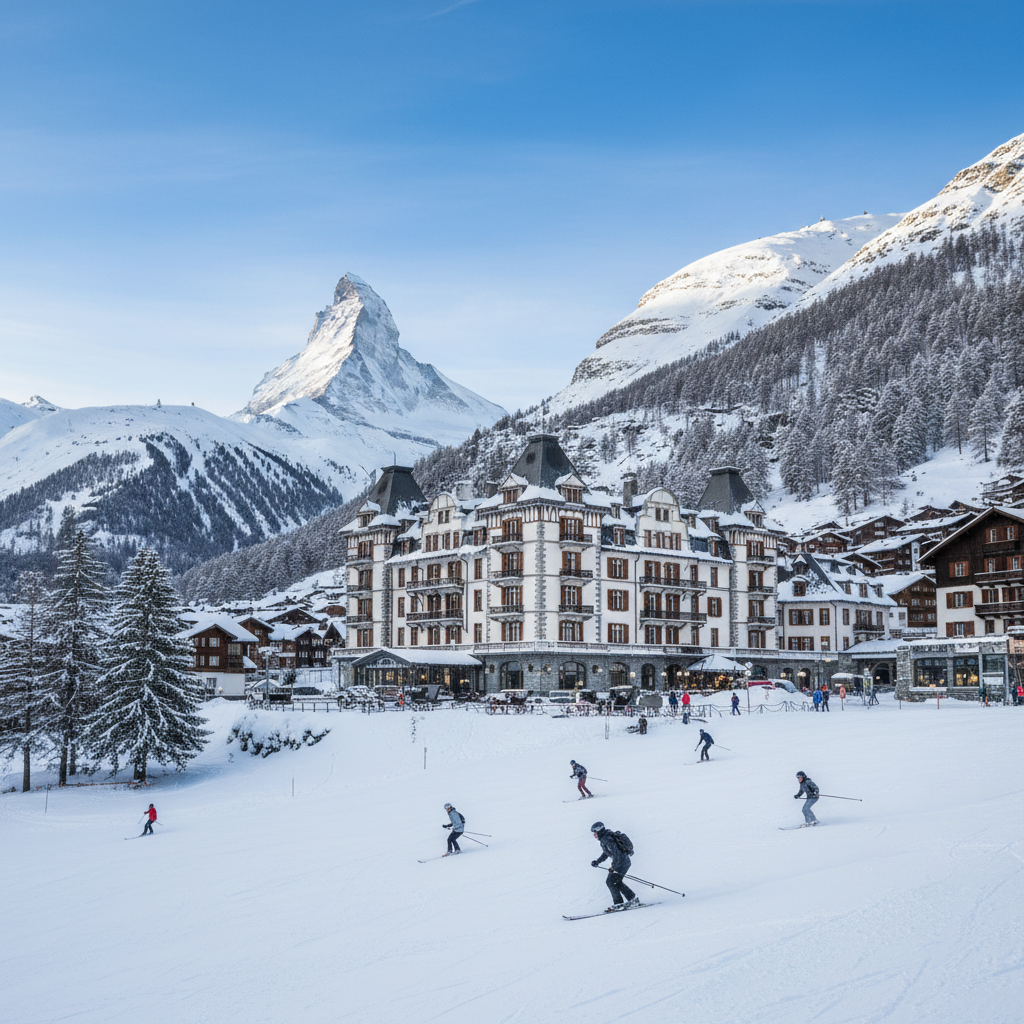
Zermatt (zermatt.ch/en) is car-free — all motor vehicles are banned; arrivals come by Matterhorn Gotthard Bahn train from Visp or Täsch — which preserves the village's extraordinary Alpine character and keeps the air clean. The Matterhorn (4,478 metres) is the most photographed mountain in the world and one of the few that is as dramatic and as photogenic in person as in every image: a perfect pyramid of rock and ice, visible from almost every point in the village.
The Omnia (the-omnia.com) is the finest hotel in Zermatt — a modernist stone-and-wood design built into the rock above the village, accessed by a tunnel elevator from the village centre. The 30 rooms and suites face the Matterhorn directly; the spa and breakfast room have views over the village rooftops to the peak. Suites from CHF 1,500/night.
For the historic grand hotel experience, the Monte Rosa Hotel (monterosakurier.ch) is where Edward Whymper stayed before making the first ascent of the Matterhorn on July 14, 1865 — the most famous moment in mountaineering history.
St. Moritz: The Original Ski Resort
St. Moritz (stmoritz.com) invented the winter tourism season — the hotelier Johannes Badrutt bet four English summer guests in 1864 that they would be warm enough to return in winter, and if they weren't, he would pay their travel costs. They returned; they loved it; and the Swiss winter holiday was born. St. Moritz has been the most glamorous ski destination in the world ever since, and the clientele — royalty, celebrities, old-money families who have been coming for generations — reflects that primacy.
Badrutt's Palace Hotel (badruttspalace.com) is the defining St. Moritz address — opened by Hans Badrutt (Johannes's son) in 1896, and still run by the family. The King's Club, in the hotel's basement, is the longest-running ski resort nightclub in the Alps. The Palace Grill is the reference point for St. Moritz dining. Suites from CHF 2,000/night.
The Kulm Hotel St. Moritz (kulmhotel-stmoritz.ch) — opened in 1856 and the first hotel in St. Moritz — hosts the Cresta Run (the world's oldest and most exclusive tobogganing club, founded 1884), which starts from behind the hotel and drops 1,212 metres to Celerina in 50 to 60 seconds.
The Glacier Express: The World's Slowest Express Train
The Glacier Express (glacierexpress.ch/en) from Zermatt to St. Moritz (or vice versa) takes 8 hours to cover 291km — earning its ironic 'slowest express train' designation — through a sequence of valleys, viaducts, and mountain passes that represents the most scenic rail journey in Europe. The panorama windows of the first-class cars frame the landscape with the deliberateness of a cinema screen; the four-course lunch served on board uses Swiss regional produce.
Getting There
Geneva Airport (GVA) and Zurich Airport (ZRH) are the main gateways, both served by direct flights from all major North American and global cities. Switzerland's rail network (sbb.ch/en) connects both airports to Zermatt (3 hours from Geneva, 3.5 hours from Zurich) and St. Moritz (4.5 hours from Zurich) with seamless connections.
Reference Links:
- The Omnia Zermatt: the-omnia.com
- Badrutt's Palace St. Moritz: badruttspalace.com
- Glacier Express: glacierexpress.ch/en
- Zermatt tourism: zermatt.ch/en
- Switzerland Tourism: myswitzerland.com



Continue Reading