Food & Drink
Sparkling Shiraz: Australia's Uniquely Festive Red Bubbly
Deep crimson, boldly tannic, and alive with fine bubbles — Sparkling Shiraz is Australia's most singular wine. Born in the 19th century as 'Sparkling Burgundy,' it has evolved into a celebrated festive classic that pairs brilliantly with everything from Christmas turkey to dark chocolate.
There is no wine quite like Sparkling Shiraz. Pour a glass and you are confronted with something that seems to defy every assumption about sparkling wine: a saturated, deep magenta-ruby pour crowned with a persistent red mousse, carrying the full-bodied weight of a serious red wine yet lifted and refreshed by a lively thread of fine bubbles. It is bold, it is visceral, and it is unapologetically Australian.
Unlike the lighter, often sweeter Italian Lambruscos that share the category of "sparkling red," Australian Sparkling Shiraz is made like a heavy still red wine from ripe Shiraz grapes, retaining bold tannins and oak-aged complexity that are then balanced by the finesse of traditional-method effervescence. The result is a wine of striking paradox — velvety and plush on the palate, yet cutting through its own richness with every bubble.
**A Brief History: From 'Sparkling Burgundy' to Australian Icon**
The story of Sparkling Shiraz begins in the late 19th century, when Australian winemakers, inspired by the great reds of Burgundy, set out to create a sparkling version of their own robust Shiraz. The first recorded production of what was then called "Sparkling Burgundy" in Australia dates to 1881, produced by the Victorian Champagne Company — a short-lived but pioneering partnership between a Melbourne doctor and French winemaker Auguste D'Argent.
The style truly took shape in 1893, when French winemaker Edmond Mazure, working at Auldana in Adelaide, South Australia, created a sparkling Shiraz using the traditional méthode champenoise, with secondary fermentation taking place in the bottle. (Some sources date Mazure's creation to 1895.) Before the enforcement of French appellation d'origine contrôlée laws, which reserved the name "Burgundy" for wines produced in that French region, the Australian style freely carried the moniker "Sparkling Burgundy" — a nod to the inspiration behind it.
Around the same time, Hans Irvine in Victoria's Great Western region also began producing Sparkling Burgundy with his winemaker Charles Pierlot, who won awards for his sparkling wines. When legendary winemaker Colin Preece took over at Great Western in 1932, his rich, evocative, and long-lived sparkling reds of the 1930s and 1940s inspired a generation of producers and cemented the style's place in Australian wine culture. Seppelt, another historic producer, became synonymous with the style and helped keep it alive through decades when it fell out of fashion with the broader wine-drinking public.
Today, Sparkling Shiraz has been described as "uniquely Australian" — a wine style that exists nowhere else in the world in quite the same form. After a period of relative obscurity, it has experienced a resurgence, with both historic producers and modern winemakers embracing its singular character for festive occasions and everyday enjoyment alike.
**The Flavor Profile & Characteristics**
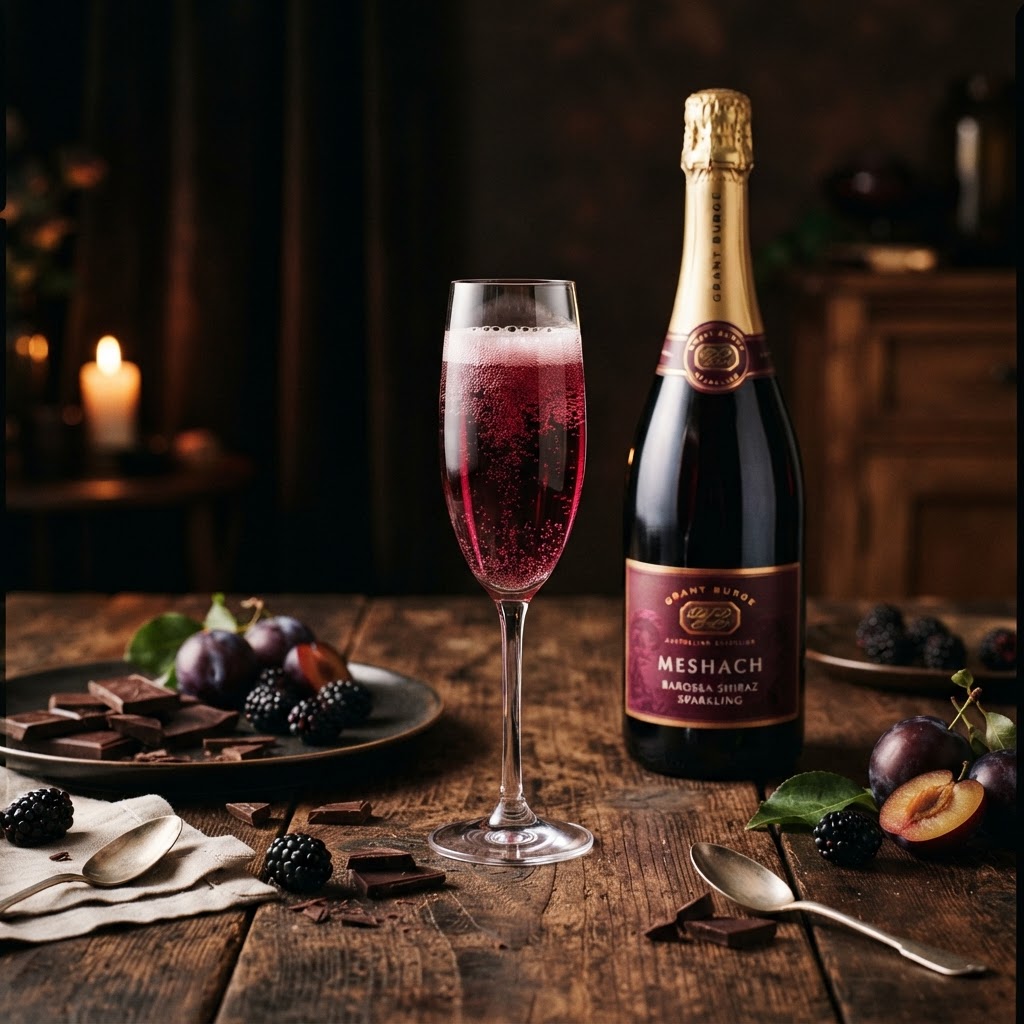
**Appearance:** Saturated, deep magenta or ruby-purple with a persistent red mousse — the bead is fine and lasting, and the color is unlike any other sparkling wine in the world.
**Taste:** Concentrated flavors of plum, blackberry, and cherry mingle with dark chocolate, licorice, and the signature black pepper spice of Shiraz. Depending on the producer and oak regimen, you may also find notes of dark forest fruits, Christmas cake spice, vanilla, and cocoa.
**Texture:** Velvety and plush. The bubbles cut right through the heavy richness of the red fruit to refresh the palate — this is the genius of the style, turning what would be a heavy wine into something surprisingly lively and moreish.
**Sweetness:** Varies from off-dry, with a touch of residual sugar that enhances the fruit's apparent ripeness, to completely dry and savoury. Most commercially available examples sit in the off-dry to medium-dry range, though premium traditional-method bottlings tend toward a drier, more complex profile.
**Popular Bottles to Try**
If you are new to the style, these bottles offer an excellent introduction, ranging from accessible and fruit-forward to complex and age-worthy:
**The Chook Sparkling Shiraz:** A highly accessible, full-bodied choice blending multi-vintage fruit from McLaren Vale and Langhorne Creek. It showcases notes of dark berries, warm spices, and a touch of caramel popcorn — an approachable and generous introduction to the style.
**Bleasdale "The Red Brute" Sparkling Shiraz:** A rich, velvety South Australian classic from the historic Langhorne Creek region, bursting with ripe cherries, chocolate, and peppery spice. Bleasdale, founded in 1850, is one of Australia's oldest wineries and a benchmark producer of the style.
**Mollydooker "Miss Molly" Sparkling Shiraz:** Known for its deep ruby color, intense blackcurrant tones, and a creamy vanilla-cocoa finish. Mollydooker's wines are celebrated for their generosity and intensity, and the Miss Molly is a decadent, fruit-driven expression.
**Peter Lehmann "The Black Queen" Sparkling Shiraz:** A premium, traditional-method option aged on yeast lees for several years to develop serious complexity. This rich, deep purple-red wine is full of spicy dark fruit flavours with notes of cinnamon, dark chocolate, and Christmas cake spice — a benchmark of the style that rewards those willing to seek it out. (The current release is marketed as "The Queen" Sparkling Shiraz.)
**How It Is Made**
Sparkling Shiraz is produced using the traditional method (méthode traditionnelle), the same technique used for Champagne. The wine begins life as a still Shiraz, fermented from ripe Shiraz grapes and often aged in oak barrels to develop tannin structure and flavor complexity. It then undergoes a secondary fermentation in the bottle, which creates the fine, persistent bubbles. The wine spends time aging on its yeast lees (spent yeast cells), which adds bakery, brioche, and savoury complexity. Finally, the lees are removed through a process called disgorgement, and the wine is topped up — sometimes with a small dose of sweetened wine, known as the dosage, which determines the final sweetness level.
What sets Sparkling Shiraz apart from other sparkling reds is the use of fully ripe, bold Shiraz fruit, which gives the wine its deep color, full body, and firm tannic backbone. The bubbles do not lighten the wine so much as they provide a counterpoint — a lift that makes the richness approachable rather than cloying.
**Serving & Food Pairing**
**Serving Temperature:** Serve lightly chilled. Aim for about 8 to 54°F (46 to 53 degrees Fahrenheit) by putting the bottle in the fridge for approximately 30 minutes before pouring. Serving it too cold will mask the complex fruit flavors and make the tannins taste harsh and angular; serving it too warm will make the wine feel heavy and the alcohol more pronounced. The goal is a refreshing chill that still allows the wine's rich character to shine.
**Holiday Fare:** Sparkling Shiraz is a quintessential pairing for an Australian-style Christmas dinner — which, falling in the Southern Hemisphere's summer, is often served cold or outdoors. It matches perfectly with roasted turkey, glazed ham, or duck, cutting through the richness of the meat while complementing its savoury depth.
**Savory and Sticky Mains:** The wine's bold fruit and tannic grip complement rich, smoky, and sweet foods remarkably well. Try it with barbecue ribs, Peking duck with its lacquered skin, teriyaki salmon, or spicy chili dishes — the bubbles refresh the palate between bites, while the fruit stands up to intense, saucy flavors.
**Desserts:** Sparkling Shiraz pairs beautifully alongside dark chocolate treats, berry tarts, or heavy blue cheese platters. The wine's dark fruit and chocolate notes create a natural bridge to chocolate-based desserts, while its effervescence and tannin provide contrast to rich, creamy blue cheeses like Stilton or Roquefort.
**Why You Should Try It**
Sparkling Shiraz is a wine that challenges expectations and rewards the curious. It is not a delicate aperitif, nor is it a straightforward still red — it occupies a category entirely its own, one that Australia has made uniquely its own over more than a century of winemaking tradition. Whether you are seeking a festive bottle for a holiday table, a bold companion for a winter barbecue, or simply a wine that will surprise and delight your guests, Sparkling Shiraz delivers an experience found nowhere else in the world of wine. Pour a glass, let the deep red mousse settle, and discover why this singular Australian classic has endured for over 130 years.
**References**
- Wikipedia: Sparkling Shiraz — https://en.wikipedia.org/wiki/Sparkling_Shiraz
- Australian Dictionary of Biography: Leon Edmond Mazure (1860-1939) — https://adb.anu.edu.au/biography/mazure-leon-edmond-13090
- Wine Selectors: Sparkling Red Wine — https://www.wineselectors.com.au/wine-varieties/sparkling-red
- Somerled: The History of Australian Sparkling Wine — https://blog.somerled.com.au/archives/range/wine/the-history-of-australian-sparkling-wine/
- Peter Lehmann Wines: Sparkling Collection — https://www.peterlehmannwines.com/collections/sparkling
- Just Wines: Sparkling Shiraz Food Pairing — https://justwines.com.au/blogs/wines/what-is-the-best-sparkling-shiraz-food-pairing
Continue Reading