Food & Drink
The Spanish Tapas Tradition: A Social Ritual from Andalusia
In Spain, eating is rarely a private act. The tapas tradition — small plates of savory food served alongside a drink, shared standing at a bar and passed between friends — is one of the world's great social eating rituals, and it was born in the sherry taverns of Andalusia.
In Spain, eating is rarely a private act. The tapas tradition — small plates of savory food served alongside a drink, shared standing at a bar and passed between friends — is one of the world's great social eating rituals, and it was born in the sherry taverns of Andalusia. To go for tapas is not to eat a meal but to construct one, bar by bar, plate by plate, across the course of an evening.
**The Lid and the Legend**
The word "tapa" means lid or cover, and the most enduring origin story places the birth of tapas in the sherry taverns of Andalusia, the sun-baked southern region of Spain. According to the legend, bartenders in the sherry-producing town of Jerez de la Frontera and nearby Sanlúcar de Barrameda began covering their guests' glasses with a slice of bread or ham — a tapa — to keep the fruit flies out of the sweet fortified wine. The cover became a free bite, the bite became a tradition, and over centuries the bite grew into a whole cuisine of small, savory dishes.
A second, equally popular legend credits King Alfonso XIII, who, passing through Cádiz, was served a glass of sherry with a slice of ham laid over the top to shield it from the sea wind. The king ate the ham, drank the sherry, and ordered another, with the same cover. Whether any of these stories is literally true is less important than what they reveal: in Spain, the drink and the small bite were never meant to be separated.
**Andalusia and Sherry**
Andalusia is the spiritual home of tapas, and sherry is its drink. The fortified wines of the Jerez triangle — Jerez de la Frontera, Sanlúcar de Barrameda, and El Puerto de Santa María — have been produced since the time of the Moors, and the taverns of the region developed the custom of serving a free tapa with each glass. The tapas of Andalusia reflect the landscape and the sea: jamón ibérico cured from the black pigs that root on the acorns of the dehesa; fried fish in the style of the Cádiz coast; olives marinated with garlic and citrus; gazpacho, the cold soup of bread, tomato, and olive oil that is itself Andalusian to the bone.
**The Culture of the Tapeo**
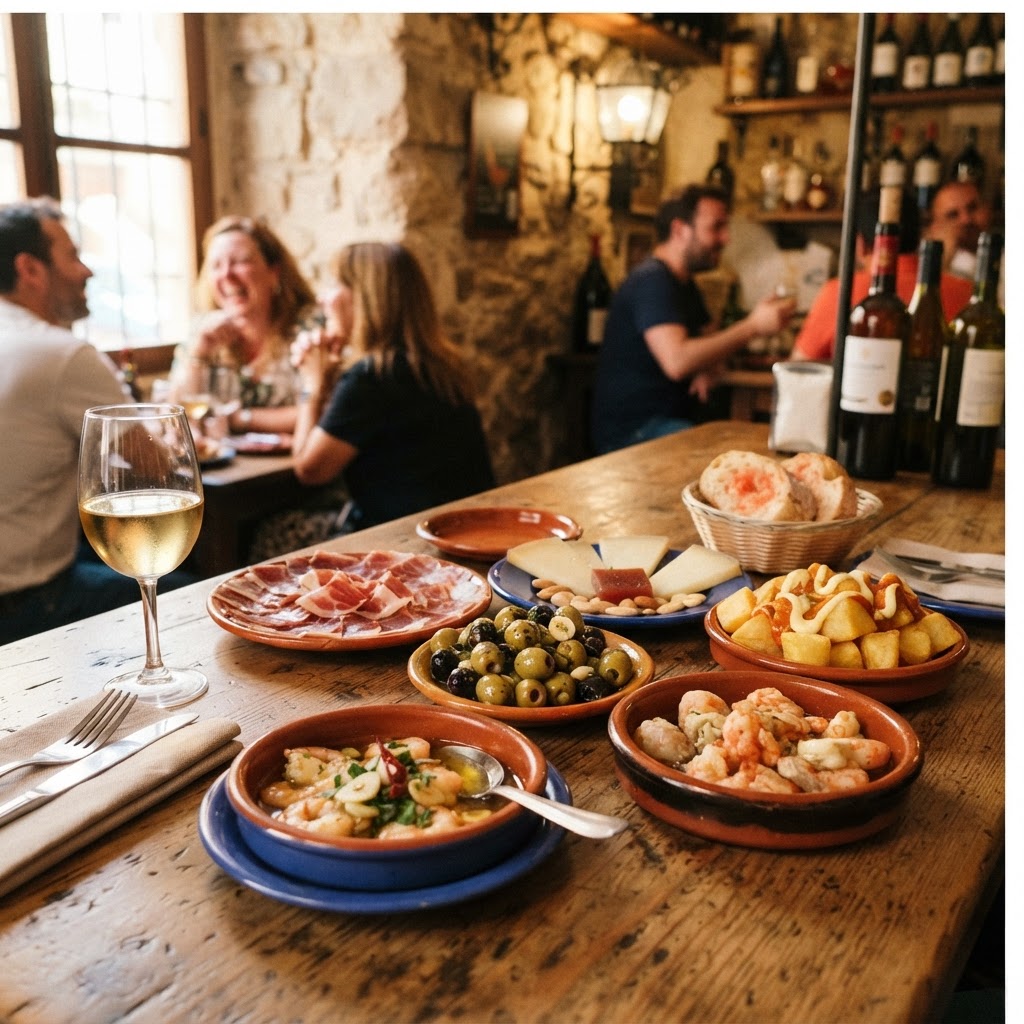
To eat tapas properly is to practice the tapeo — a crawl from one bar to the next, taking a single drink and a single plate at each. The ritual is emphatically social. Spaniards stand at the bar rather than sit at a table, they share their plates, and they move on before any single bar becomes the whole evening. The tapeo bridges the gap between the end of the workday and the late Spanish dinner, which often begins after nine at night. It is, in function, the Spanish cousin of the Italian aperitivo and the American happy hour, but older and more generous.
**The Dishes**
A tapas menu is a survey of Spanish regional cooking in miniature. Patatas bravas — cubes of fried potato with a spicy tomato sauce and aioli — are near-universal. Gambas al ajillo sizzle shrimp in olive oil with garlic and chili. Croquetas encase béchamel and ham in crisp breadcrumbs. Tortilla de patatas, the thick Spanish omelette of potato and egg, is served in wedges at room temperature. And the great cured meats — jamón ibérico, chorizo, lomo — appear on every board. The unifying principle is that nothing is precious: tapas are meant to be eaten with the fingers or a toothpick, standing, talking, drinking.
**The Brunch Connection**
The tapas tradition translates beautifully to the brunch table, where the philosophy of many small, shared plates suits a leisurely weekend gathering as well as it suits a Spanish evening. A mimosa bar, in spirit, is a tapas bar for the morning — a row of small choices, each bright and refreshing, meant to be tasted and shared. A Classic Champagne Mimosa or a Pomegranate Mimosa beside a board of Spanish ham, olives, and manchego turns the brunch into a tapeo of its own, Spanish in spirit if not in hour.
**References**
- Wikipedia: Tapas — https://en.wikipedia.org/wiki/Tapas
- Wikipedia: Andalusian cuisine — https://en.wikipedia.org/wiki/Andalusian_cuisine
- Wikipedia: Jerez de la Frontera — https://en.wikipedia.org/wiki/Jerez_de_la_Frontera
Continue Reading