Travel
The Seychelles: La Digue, Granite Boulders & the Indian Ocean's Most Beautiful Beaches
The Seychelles — 115 islands scattered across the Indian Ocean northeast of Madagascar — contain some of the most beautiful beaches on earth. The granite islands of the Inner Group, particularly La Digue with its legendary Anse Source d'Argent, represent a geological and ecological phenomenon found nowhere else in the world's oceans.
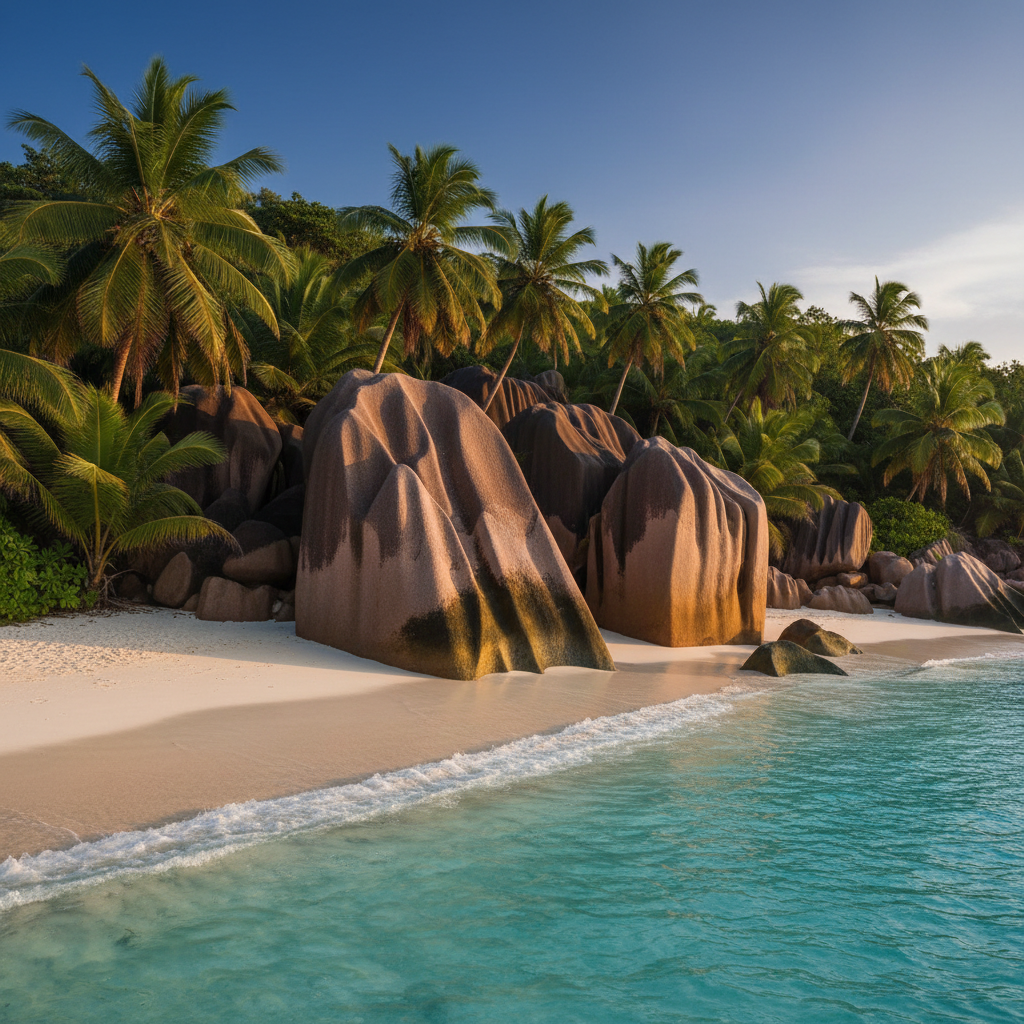
The Seychelles are geologically unique — the world's only oceanic islands of granitic origin, rising not from volcanic activity but from the ancient basement of the Gondwana supercontinent that has floated in the Indian Ocean for 65 million years. The result is a landscape unlike any other in the tropics: enormous, weathered pink granite boulders tumbling into warm turquoise water, framed by giant takamaka trees and the extraordinary fan-shaped coco de mer palms found only in the Seychelles. The beaches formed around and between these boulders — particularly Anse Source d'Argent on La Digue — are ranked consistently among the world's most beautiful.
The Seychelles archipelago comprises 115 islands spread across 1.3 million square kilometres of ocean northeast of Madagascar and northeast of the African mainland. The Inner Islands — Mahé, Praslin, La Digue, and a cluster of granitic satellites — are the most visited and the most scenically spectacular. The Outer Islands — low-lying atolls and reef systems — are the domain of remote private island resorts.
Where to Stay: Island by Island
North Island (north-island.com) is the Seychelles' most exclusive address — 11 private villas on a 200-hectare island that was an ecological restoration project before it became a resort, returning the island from a degraded coconut plantation to a functioning natural habitat for rare birds, giant tortoises, and native plants. The villas are constructed from natural materials (driftwood, granite, reclaimed timber) and are the most beautifully crafted in the Indian Ocean. President Barack Obama honeymooned here. Villas from $6,000/night, all-inclusive. North Island is accessible by private helicopter from Mahé.
Four Seasons Resort Seychelles at Desroches Island (fourseasons.com/seychelles) on Desroches Atoll — 230km southwest of Mahé in the Outer Islands — offers an extraordinary marine environment: a 14km uninhabited sand and coral island with a barrier reef of extraordinary diversity on three sides. The 71 bungalows and villas, raised on stilts above the beach or set in the island's interior, offer snorkelling, diving, and a level of isolation that Mahé cannot match. Villas from $2,000/night.
On La Digue, Le Repaire Boutique Hotel (lerepairedigue.com) offers the best accommodation on the island — small, intimate, and beautifully located in the island's main settlement, a 10-minute bicycle ride from Anse Source d'Argent. La Digue has no taxis — bicycles are the primary transport, which gives the island an almost impossibly charming character.
Anse Source d'Argent: The World's Most Photographed Beach
Anse Source d'Argent on La Digue's southwestern coast has appeared on more travel magazine covers, screensavers, and desktop backgrounds than any other beach in the world. The combination of massive, smooth pink granite boulders of extraordinary sculptural form, powder-white sand, shallow turquoise water protected by a reef, and the absolute natural stillness of the setting makes it genuinely extraordinary. Access is through the L'Union Estate coconut plantation (a small fee applies), from which a path leads to the beach. Early morning (before 9am) is the only time to have it largely to oneself. The shallow reef makes the water calm and warm year-round — ideal for snorkelling with sea turtles, which nest on the beach during the monsoon season.
Praslin and the Vallée de Mai
Praslin — the second-largest of the Inner Islands — is home to the Vallée de Mai (valleededmai.sc), a UNESCO World Heritage Site and one of only two places in the world where the extraordinary coco de mer palm (Lodoicea maldivica) grows wild. The coco de mer produces the world's largest seed — up to 55 ⅛ lb — and the forest of these ancient palms, combined with rare endemic birds including the black parrot (Coracopsis barklyi), creates an atmosphere described by Gordon and other 19th-century visitors as the original Garden of Eden. The Anse Lazio beach on Praslin's northwest tip is consistently rated among the world's 10 finest.
Marine Life and Conservation
The Seychelles has committed to protecting 30% of its ocean territory and has implemented strict fishing regulations and marine protected areas. The result is marine life of extraordinary diversity: whale sharks visit seasonally (June–September), hammerhead and blacktip reef sharks are common on the outer atolls, manta rays are resident year-round at several sites, and the coral reefs — particularly around Silhouette Island — are among the healthiest in the Indian Ocean following major bleaching events. The Seychelles Islands Foundation (sif.sc) coordinates conservation across the World Heritage Sites.
Getting There
Mahé's Seychelles International Airport (SEZ) receives direct flights from Dubai (Emirates), Doha (Qatar Airways), Paris (Air France), London (British Airways, with a connection in Nairobi or Abu Dhabi), and several Indian and African cities. From Mahé, inter-island Air Seychelles (airseychelles.com) flights reach Praslin in 15 minutes; La Digue is a 15-minute ferry from Praslin. The best time to visit the Inner Islands is April–May and October–November, when the trade winds are calm, the sea is settled, and both the NW and SE monsoons are between seasons.
Continue Reading