Travel
Sedona, Arizona: Red Rocks, Canyons, and Southwestern Luxury
Sedona is one of the most visually stunning landscapes in America — towering red sandstone formations, deep canyons, and a spiritual energy that has drawn seekers for generations.
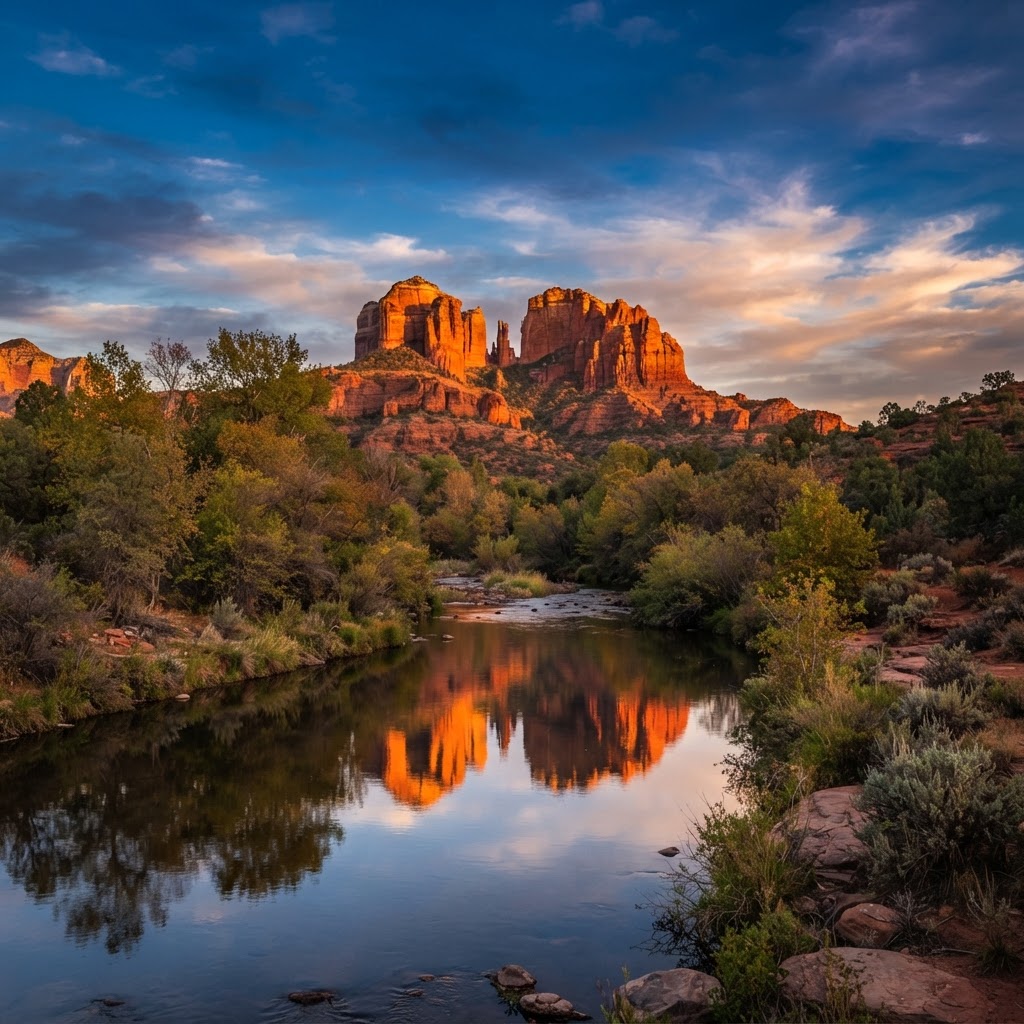
Sedona, Arizona is one of the most visually extraordinary destinations in the American Southwest. Set in the high desert of northern Arizona at an elevation of 4,350 feet, Sedona is surrounded by towering red sandstone formations — Cathedral Rock, Bell Rock, Courthouse Butte, Snoopy Rock, and the Madonna — that glow an impossible shade of vermillion and orange at sunrise and sunset. The town, with a population of about 10,000, is one of the great natural destinations in America, combining spectacular geology, outdoor adventure, a vibrant arts community, and a spiritual culture that is entirely its own.
The Geology of the Red Rocks
Sedona's red rock formations are the result of 300 million years of geological history. The sandstone that forms the buttes, mesas, and spires was laid down as sand dunes and river deposits during the Permian period. The distinctive red colour comes from iron oxide (rust) that coated the sand grains, a process called 'desert varnish.' The rocks themselves are part of the Schnebly Hill Formation, named after the family of T. C. Schnebly, one of Sedona's earliest settlers, for whom the town is named (his wife, Sedona Arabella Miller Schnebly, gave the town its name in 1902).
The most famous formations include **Cathedral Rock**, one of the most photographed scenes in the Southwest (and often cited as one of the most photographed spots in America); **Bell Rock**, a distinctive bell-shaped butte that is also considered one of Sedona's 'vortex' sites; **Courthouse Butte** and **Coffee Pot Rock**, which dominates the skyline north of town.
The Vortex Phenomenon
Sedona is famous worldwide for its 'vortexes' — specific sites around the red rocks that are believed by many to be centres of spiritual energy. The concept of Sedona as a spiritual power centre was popularized in the 1980s by psychic Page Bryant, who identified four primary vortex sites: **Airport Mesa**, **Cathedral Rock**, **Bell Rock**, and **Boynton Canyon**. Whether or not one believes in the metaphysical properties of these sites, there is no question that standing on a red rock ledge at sunset, watching the colours shift from orange to deep crimson to purple, is an experience of profound natural beauty.
Enchantment Resort and Boynton Canyon
**Enchantment Resort**, nestled in Boynton Canyon within the red rocks, is Sedona's premier luxury resort. Built in 1987 in a Pueblo-revival architectural style, the resort consists of 70 individual casitas spread across 70 acres of canyon land, each with views of the red rock formations. The resort is home to **Mii amo**, a Native American-inspired spa that has been named one of the best destination spas in the world by Condé Nast Traveller and Travel + Leisure.
**L'Auberge de Sedona** is the other major luxury resort in Sedona, set along the banks of Oak Creek at the base of the red rocks. The resort's restaurant, Cress on Oak Creek, is one of the finest dining experiences in northern Arizona, with a terrace overlooking the creek and the red rocks.
Hiking and Outdoor Adventure
Sedona has over 200 hiking and biking trails. The most popular include the **Cathedral Rock Trail** (a short but steep climb to a saddle between the rock's spires, offering the most iconic view in Sedona); the **Devil's Bridge Trail** (a natural sandstone arch that is one of the most photographed spots in Arizona); the **Soldier Pass Trail** (which passes the Seven Sacred Pools and a series of sinkholes); and the **Boynton Canyon Trail** (which leads deep into the canyon to Enchantment Resort).
For mountain bikers, Sedona is a world-class destination, with over 200 miles of trails ranging from beginner to expert. The **Bell Rock Pathway** and the **Slim Shady Trail** are among the most popular.
The Chapel of the Holy Cross
One of the most striking man-made structures in Sedona is the **Chapel of the Holy Cross**, a Catholic chapel built into the red rock buttes in 1956. The chapel was designed by Marguerite Brunswig Staude, a sculptor and rancher, with the architectural assistance of Richard Hein of the firm Anshen & Allen. Staude claimed to have been inspired by the then-new Empire State Building, and the chapel's modernist design, with a 90-foot cross set into the red rock, is one of the most extraordinary pieces of religious architecture in America.
Tlaquepaque Arts Village
**Tlaquepaque** is a shopping and arts village in Sedona, designed to resemble a Mexican village, complete with cobblestone paths, sycamore trees, and vine-covered walls. It contains over 40 speciality shops, galleries, and restaurants, and is the cultural heart of Sedona. The name is from the Nahuatl language and means 'best of everything.'
Reference Links:
- Visit Sedona (Official Tourism): visitsedona.com
- Enchantment Resort: enchantmentresort.com
- L'Auberge de Sedona: lauberge.com
- Chapel of the Holy Cross: chapeloftheholycross.com
- Tlaquepaque Arts Village: tlaq.com
- Coconino National Forest: fs.usda.gov/coconino
- Red Rock Pass (trail system): redrockcountry.org
Continue Reading