Travel
Savannah, Georgia: America's Most Hauntingly Beautiful Southern City
Founded in 1733 as Britain's last American colony, Savannah is a living museum of 24 public squares, antebellum mansions, moss-draped live oaks, and a riverfront that survived the Civil War intact — the most hauntingly beautiful city in the American South.
Savannah, Georgia is the most hauntingly beautiful city in the American South, a place where moss-draped live oaks frame cobblestone streets and 18th-century squares so perfectly preserved that a walk through the Historic District feels less like tourism than time travel. Founded in 1733 by General James Edward Oglethorpe as the last of Britain's American colonies, Savannah was conceived from the start as a city of squares — a grid of wards, each anchored by a green, that remains one of the most admired pieces of urban planning in the Western Hemisphere.
The Plan of a City
When Oglethorpe landed on the bluffs of the Savannah River in February 1733, he laid out a town unlike any other in the colonies: a series of wards, each centered on a public square, surrounded by trust lots (for civic buildings) and tything lots (for the colonists' homes). Twenty-four squares were built between 1733 and 1851, and 23 survive today — the largest collection of original colonial-era squares in the United States. The plan was so successful that it was studied by urban planners for centuries, and the squares remain the living heart of the city.
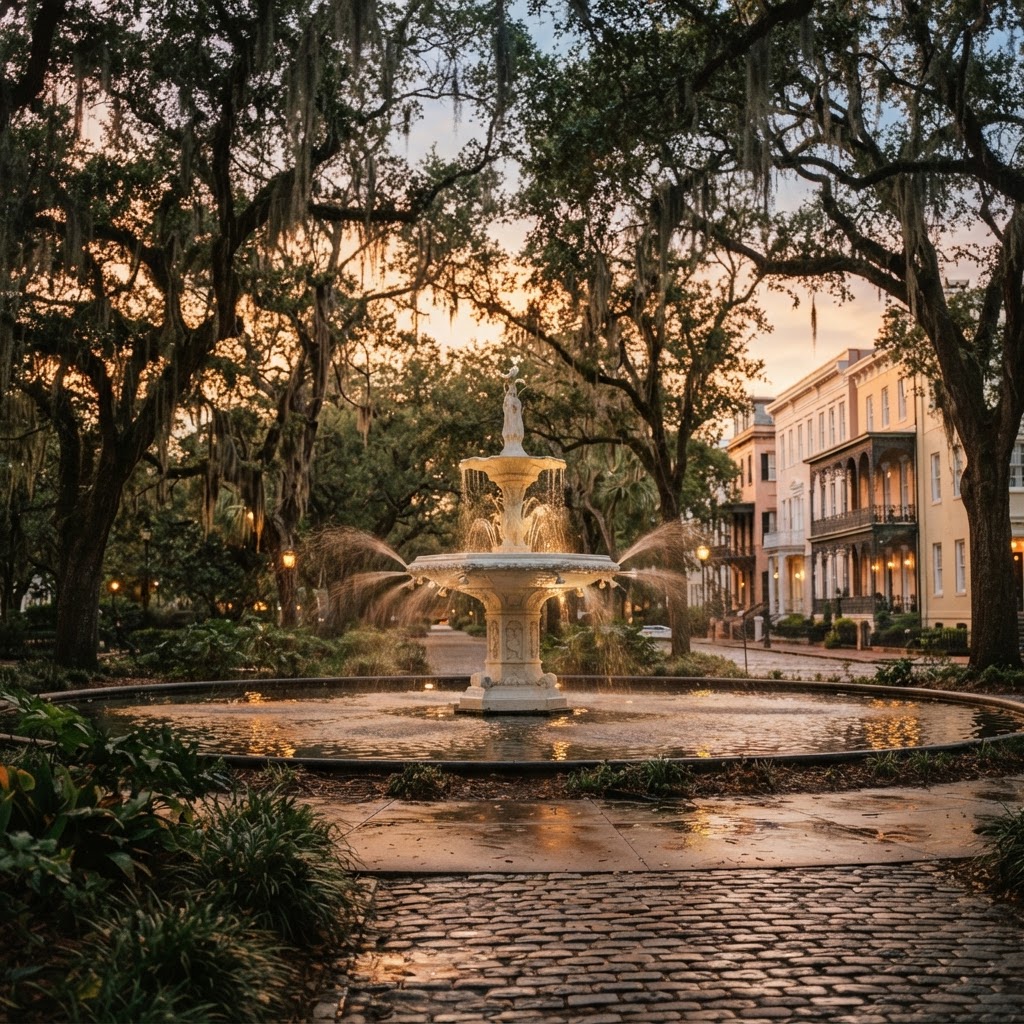
The most famous green space is Forsyth Park, a 30-acre park at the southern edge of the Historic District, donated to the city in the 1840s by William Hodgson and named for Georgia Governor John Forsyth. Its centerpiece is the cast-iron Forsyth Park Fountain, erected in 1858 and modeled on the fountains of the Place de la Concorde in Paris, which has become the single most photographed object in Savannah.
Architecture and Survival
Savannah's architectural wealth survives because the city was largely spared during the Civil War. In December 1864, Mayor Richard Arnold surrendered the city to General William Tecumseh Sherman, who was so taken with Savannah that he telegraphed President Lincoln offering it as a Christmas present. Sherman established his headquarters here and spared the city the destruction he had wrought on Atlanta.
The result is a Historic District of extraordinary integrity — 2.5 square miles containing more than 1,100 historically significant buildings, designated a National Historic Landmark District in 1966, one of the largest in the nation. Highlights include the Owens-Thomas House (1819), a masterpiece of English Regency architecture by William Jay; the Isaiah Davenport House (1820), whose 1955 rescue by the Historic Savannah Foundation launched the modern preservation movement in the city; and the Mercer-Williams House (1860), made famous by John Berendt's 1994 book Midnight in the Garden of Good and Evil.
The Squares and the Waterfront
Each square has its own character. Chippewa Square, where the famous bench scene from Forrest Gump was filmed, is framed by the First Baptist Church and the Savannah Theatre (1818), one of the oldest continually operating theatres in America. Monterey Square is anchored by a monument to Casimir Pulaski, the Polish nobleman killed at the 1779 Siege of Savannah. Lafayette Square, named for the Marquis de Lafayette's 1825 visit, sits before the Cathedral Basilica of St. John the Baptist, whose twin Gothic spires dominate the skyline.
The Savannah riverfront, a row of former cotton warehouses built of ballast stone, has been reborn as a dining and shopping district connected to the city above by historic stone cobble ramps. Here, the Waving Girl statue honors Florence Martus, who waved a cloth at every ship entering the harbor for 44 years.
Culture and the Southern Table
Savannah's dining scene is a pillar of Lowcountry cuisine. Mrs. Wilkes' Dining Room, a boarding-house table serving family-style Southern classics, has been a pilgrimage since 1943. The Olde Pink House, in the 1789 Habersham mansion, offers refined Southern cooking in candlelit rooms. The Grey, chef Mashama Bailey's acclaimed restaurant in a restored 1938 Art Deco Greyhound bus terminal, earned a James Beard Award and reintroduced Savannah to a national culinary audience.
The city's literary legacy is inseparable from Midnight in the Garden of Good and Evil, John Berendt's non-fiction account of a 1981 murder trial that spent 216 weeks on the New York Times bestseller list and drew millions of visitors to the city's squares and cemeteries. Bonaventure Cemetery, on a bluff above the Wilmington River, remains the most visited — its moss-draped statuary among the most photographed funerary art in America.
Reference Links:
- Visit Savannah (Official): visitsavannah.com
- Forsyth Park (City of Savannah): savannahga.gov
- Savannah Historic District (NPS): nps.gov
- Historic Savannah Foundation: myhsf.org
- The Grey restaurant: thegreyrestaurant.com



Continue Reading