Caribbean
Santo Domingo's Zona Colonial: The 1498 City of Firsts in the Americas
Santo Domingo's Zona Colonial, founded by Bartholomew Columbus in 1498, is the oldest European city in the Americas, home to the first cathedral, the first hospital, the first university, and the first customs house in the New World, a UNESCO World Heritage Site.
The Colonial City of Santo Domingo, the Zona Colonial, is the oldest permanent European settlement in the Americas, founded in 1498 by Bartholomew Columbus, the brother of Christopher, six years after the Admiral's first landfall on the island of Hispaniola in 1492. The city was the first capital of the Spanish New World, the headquarters from which the conquest of the continent was organized, and it is, according to [UNESCO](https://whc.unesco.org/en/list/526/), the first permanent establishment of the New World and the only fifteenth-century colonial city in the Americas, the place of departure for the spread of European culture and the conquest of the continent, a city of firsts that housed the first cathedral, the first hospital, the first university, and the first customs house in the Americas.
The First Cathedral of the Americas
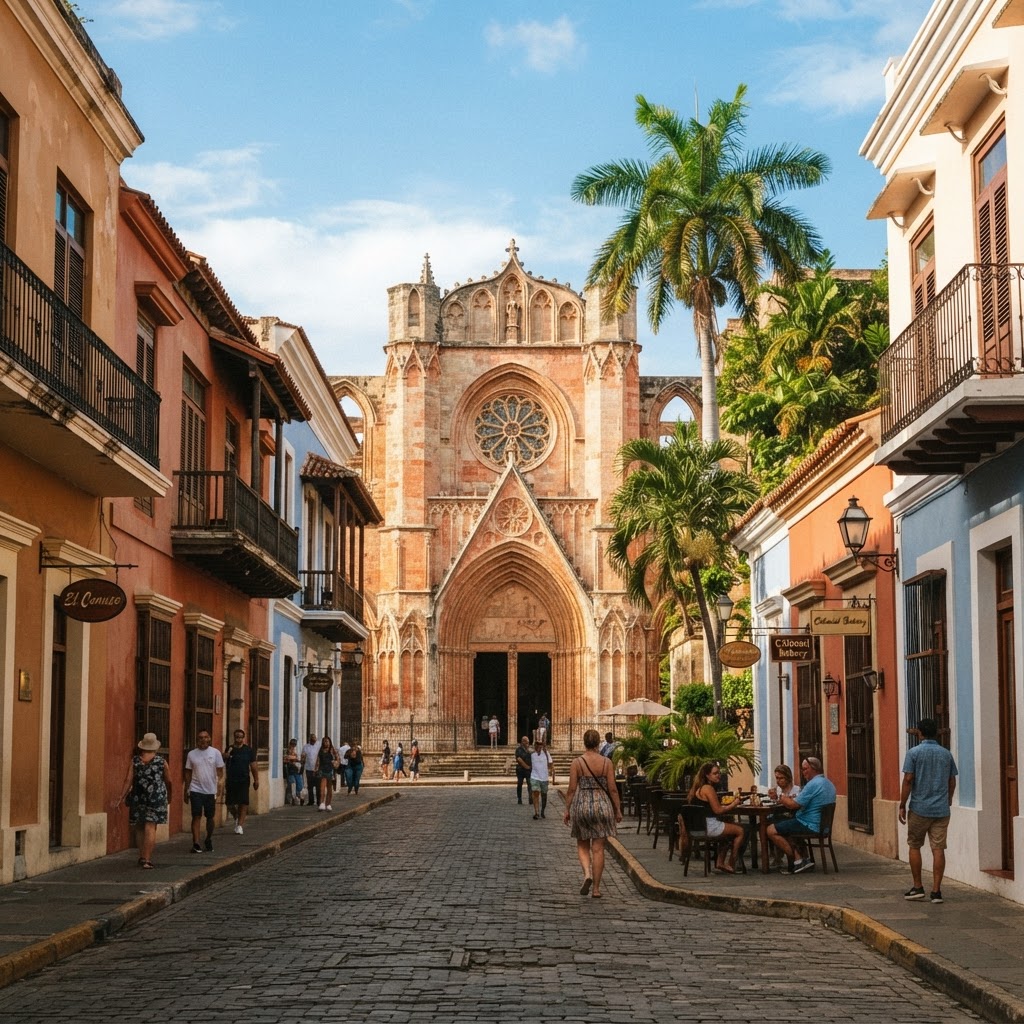
The Catedral Primada de América, the Cathedral of Santa María la Menor, is the oldest cathedral in the Americas, begun in 1514 and completed in 1542, a building of coral limestone that shows the transition from late Spanish Gothic to the Renaissance, the first Renaissance architecture in the New World. The cathedral is small, compared to the great cathedrals of Mexico City or Lima that followed it, but its significance is immense: it was here that the Catholic Church established its first permanent presence in the Western Hemisphere, and it was from this cathedral that the faith was carried to every corner of the Spanish Empire. The interior, with its vaulted ceiling of coral stone and its simple, sober altars, is the most complete example of early sixteenth-century Spanish architecture in the Americas.
Calle Las Damas and the Firsts
Calle Las Damas, the Street of the Ladies, is the oldest paved street in the New World, laid out in 1502 and named for the ladies of the court who walked there in their finery. The street is lined with the oldest colonial buildings in the Americas, including the Casa de Bastidas, the house of the royal treasurer, and the Alcázar de Colón, the palace that Diego Columbus, the son of Christopher, built in 1514 as the seat of his authority as Viceroy of the Indies. The Alcázar, a coral-stone palace that blends Gothic, Mudéjar, and Renaissance elements, is now a museum, and its rooms, furnished with period pieces, give a sense of the life of the first Spanish governors. The Zona Colonial is also home to the ruins of the first hospital of the Americas, the Hospital de San Nicolás de Bari, begun in 1503, and to the Universidad Autónoma de Santo Domingo, founded in 1538 and the oldest university in the Americas.
Montesinos and the First Cry for Human Rights
The Zona Colonial is also the place where the first cry for human rights in the Americas was raised. In 1511, the Dominican friar Antonio de Montesinos delivered a sermon in the city that condemned the Spanish colonists for their treatment of the indigenous Taíno people, asking, "Are these not men? Do they not have rational souls?" The sermon, which shocked the colonists and was reported to King Ferdinand, marked the beginning of the debate over the rights of indigenous peoples that would consume the Spanish Empire for the next century and that would lead to the New Laws of 1542. UNESCO notes that it was in the Colonial City of Santo Domingo that the Dominican monk Brother Antonio Montesino launched his appeal for the natural right of the natives, marking the beginning of the combat for the fundamental rights of mankind.
A Mimosa for the Colonial City
A morning in the Zona Colonial, with the sound of merengue from a doorway and the smell of strong Dominican coffee, calls for a bright, tropical sparkling drink that can match the oldest city in the Americas. A [classic Champagne mimosa](/recipes/classic-champagne-mimosa) is the natural match, the orange juice a bright companion to the coral-stone cathedral and the bubbles lifting the humid Caribbean morning. A [tropical mango mimosa](/recipes/tropical-mango-mimosa) is equally lovely, its ripe mango sweetness a bright companion to the merengue and the coffee.
**Reference Links:**
- Colonial City of Santo Domingo (UNESCO World Heritage, 1498, first cathedral, hospital, university, Montesinos): [UNESCO World Heritage Centre](https://whc.unesco.org/en/list/526/)
- Catedral Primada de América (first cathedral, 1514-1542, Santo Domingo): [Visit Dominican Republic](https://visitdominicanrepublic.com/history-heritage/catedral-primada/)



Continue Reading