Caribbean
Saint Lucia's Pitons: The Twin Volcanic Spires and Sulphur Springs of a UNESCO Island
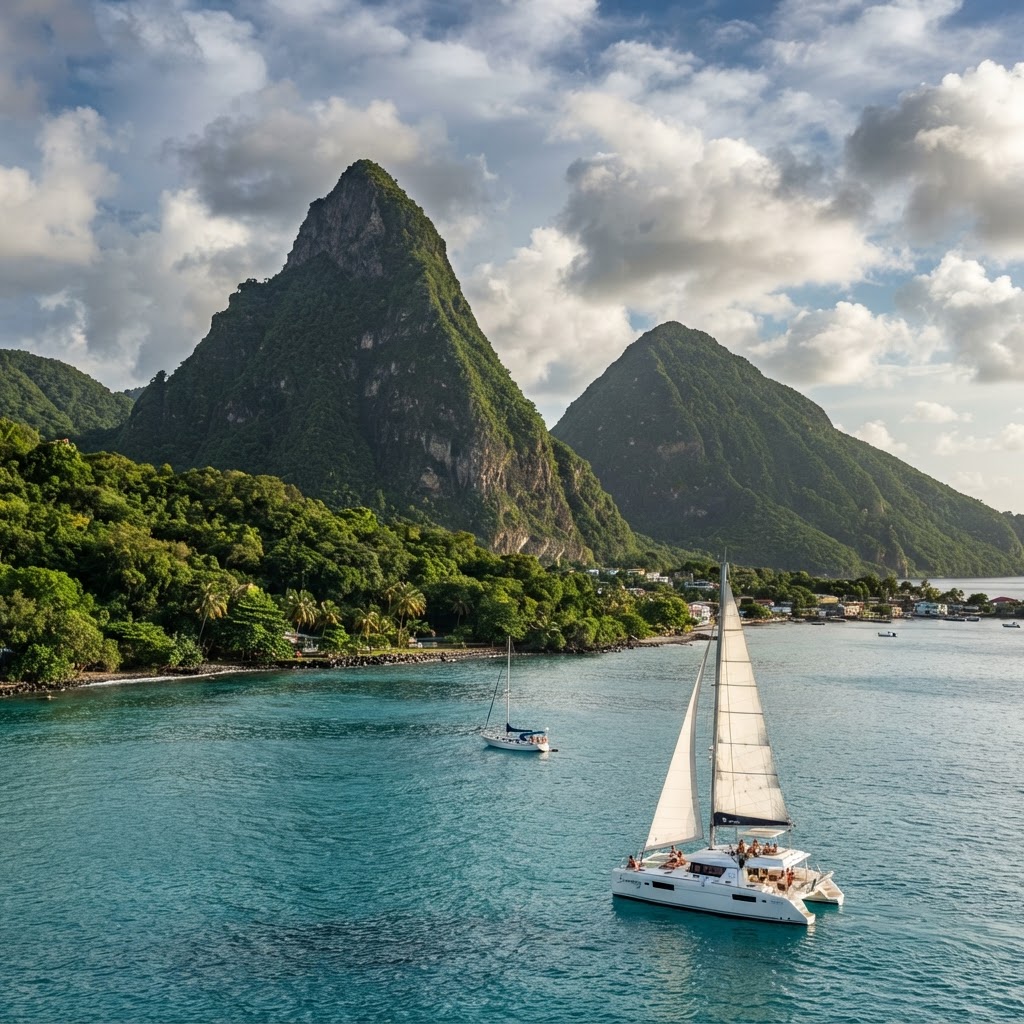
The Pitons of Saint Lucia, Gros Piton and Petit Piton, are two volcanic spires that rise from the Caribbean Sea, the centerpiece of a UNESCO World Heritage area that includes the Sulphur Springs, the world's only drive-in volcano, formed over 410,000 years ago.
The Pitons are the two most recognizable natural landmarks of the Caribbean, twin volcanic spires that rise steeply from the turquoise water of the southwest coast of Saint Lucia, Gros Piton to 2,530 feet and Petit Piton to 2,438 feet, their green forested slopes climbing almost vertically from the sea. The Pitons are the centerpiece of the Pitons Management Area, a UNESCO World Heritage Site inscribed in 2004, which encompasses the two peaks, the geothermal field of Sulphur Springs, and the coral reefs that surround them. According to [UNESCO](https://whc.unesco.org/en/list/1161/), the Pitons are two towering volcanic spires that are the major iconic landmark of the island, and the Pitons Management Area encompasses a wide range of diverse geological features, including a site of geothermal activity with fumaroles and hot springs, known as the Sulphur Springs.
Sulphur Springs and the Drive-In Volcano
The Sulphur Springs, in the town of Soufrière, are the hottest and most active geothermal feature in the Caribbean, a field of boiling mud pools, steam vents, and fumaroles that sits in the crater of a collapsed volcano. According to the [Saint Lucia National Trust](https://saintlucianationaltrust.com/natural-heritage-sites/), Sulphur Springs was formed over 410,000 years ago from a weak spot in the crust, and it is the only drive-in volcano in the world, where visitors can literally drive their car into the crater of an active volcanic field and walk among the steaming vents and boiling pools. The springs are the source of the black mud that Saint Lucians and visitors smear on their skin for its mineral properties, and the hot water feeds the waterfall and the mineral pools at the nearby Diamond Falls Botanical Gardens.
Gros Piton and the Climb
Gros Piton, the larger of the two Pitons, can be climbed, and the ascent is one of the most rewarding hikes in the Caribbean, a two-to-four-hour climb through rainforest to a ridge that overlooks the entire southwest coast and the Caribbean Sea. The trail, managed by the local community, requires a guide, and the final section is a scramble over volcanic rock to a false summit that sits below the true peak, which is reserved for experienced climbers. The view from the ridge takes in Petit Piton across the bay, the town of Soufrière below, and, on a clear day, the island of Saint Vincent to the south. Petit Piton is rarely climbed, its slopes too steep and its rock too unstable for casual hikers.
Soufrière and the French and British
The town of Soufrière, at the foot of the Pitons, is the oldest European settlement on Saint Lucia, founded by the French in 1746, and it sits in a landscape that has changed hands between the French and the British fourteen times, more than any other Caribbean island. Saint Lucia was finally ceded to Britain in 1814, and it gained independence in 1979, but the French influence remains in the language, the cuisine, and the place names. The town of Soufrière, with its French colonial square and its church, is the gateway to the Pitons, and the Diamond Falls, fed by the volcanic springs, tumble through a botanical garden of tropical flowers that is one of the most beautiful on the island.
A Mimosa for the Pitons
A morning on the southwest coast of Saint Lucia, with the Pitons in the distance and the smell of sulfur on the breeze, calls for a bright, tropical sparkling drink that can match the volcanic grandeur. A [classic Champagne mimosa](/recipes/classic-champagne-mimosa) is the natural match, the orange juice a bright companion to the green spires and the bubbles lifting the humid air. A [lavender elderflower mimosa](/recipes/lavender-elderflower-mimosa) is equally lovely, its floral lavender and elderflower echoing the botanical gardens and the tropical flowers of the island.
**Reference Links:**
- Pitons Management Area (UNESCO World Heritage 2004, volcanic spires, Sulphur Springs): [UNESCO World Heritage Centre](https://whc.unesco.org/en/list/1161/)
- Saint Lucia Natural Heritage Sites (Pitons, Sulphur Springs, 410,000 years): [Saint Lucia National Trust](https://saintlucianationaltrust.com/natural-heritage-sites/)



Continue Reading