Food & Drink
Saffron & the Persian Table: A Journey Through Iran's Golden Cuisine
Iranian cuisine is one of the world's great unsung culinary traditions — ancient, herbaceous, and built around the transformative power of saffron. From the jewelled rice of Persian celebrations to the slow-cooked richness of Khoresh Fesenjan, this is food that feeds both the body and the soul.
If the French culinary tradition is the foundation of Western fine dining, then Persian cuisine — the food of ancient Iran — is arguably the world's oldest continuously refined table. Stretching back more than 2,500 years to the Achaemenid Empire, Persian food culture has influenced the cuisines of the entire Middle East, India (via Mughal cooking), Central Asia, and even the Mediterranean. And at the centre of it all, threading through almost every celebratory dish like a golden strand of silk, is saffron.
Iran is the source of approximately 90% of the world's saffron, grown primarily in the Khorasan region of the northeast — and no cuisine uses it with more knowledge, reverence, or frequency than the Iranian kitchen. Saffron is not a background note here but an architectural element, defining the colour, fragrance, and flavour of some of the country's most essential dishes.
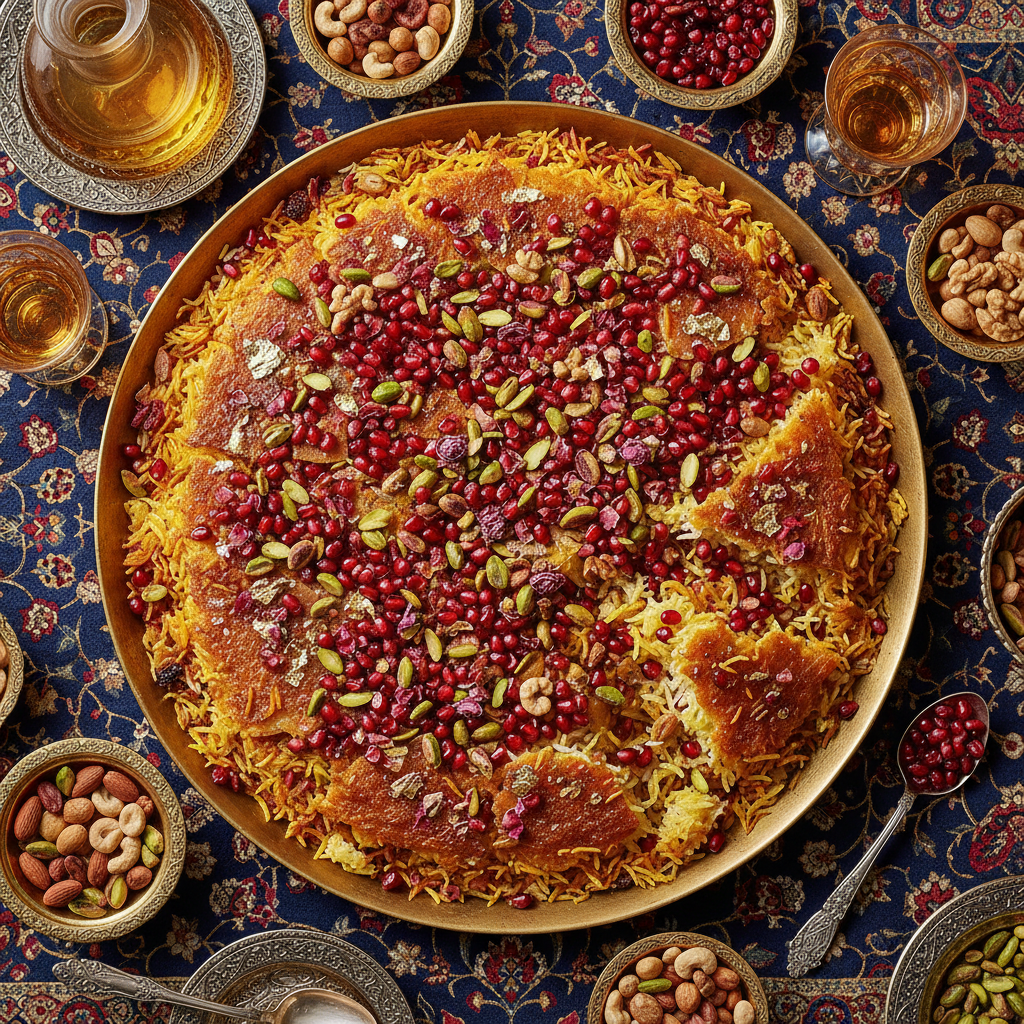
The starting point for understanding Persian cuisine is rice — specifically, the exalted art of cooking it. Persian rice technique is unlike any other in the world. Chelo (plain Persian rice) requires parboiling, draining, and then steaming — often over a thin disc of dough, potato, or lavash flatbread — to create the legendary tahdig: the crispy golden crust at the base of the pot that is the mark of a skilled Persian cook. The tahdig is the most coveted portion at the Persian table, and the competition for it is fierce. A generous blooming of saffron butter is poured over the rice before serving, staining it golden and infusing it with the spice's unmistakeable floral warmth.
From this foundation of rice culture, Persian cuisine builds its complexity through a series of extraordinary one-pot dishes called khoresh (stews). Khoresh Fesenjan is arguably the most famous — a dense, dark, sweet-sour stew of ground walnuts and pomegranate molasses (or juice), typically cooked with duck or chicken. The interplay of bitterness from the walnuts, tartness from the pomegranate, and the slight sweetness of the poultry creates a depth that is genuinely unlike any other cuisine's flavours. Food writer and scholar Claudia Roden has written extensively on its historical significance (https://www.theguardian.com/food/2019).
Gheymeh Nesar is the royal jewelled rice — a festive preparation traditionally served at celebrations, weddings, and the Persian New Year (Nowruz). A crown of saffron-gilded rice is studded with barberries (zereshk), candied orange peel, toasted pistachios, and rose petals. Beneath it lies a slow-cooked meat preparation of lamb or chicken with split peas and dried fruit. The aesthetic effect is spectacular, and the flavour — the interplay of sour barberry, sweet orange, nutty pistachio, floral rose, and savoury lamb — is a masterclass in the Persian principle of balanced sweet, sour, salty, and bitter.
Zereshk polo ba morgh (barberry rice with chicken) is the everyday cousin of the jewelled rice — chelo topped with tart, glistening dried barberries and served alongside a saffron-braised chicken. It is one of the most beloved dishes in the Iranian home kitchen and a powerful introduction to the Persian palate for newcomers.
The kebab culture of Iran is equally distinguished. Chelo Kabab — Iran's de facto national dish — pairs buttered saffron rice with Kabab Koobideh (ground lamb mixed with grated onion, shaped onto flat skewers, and grilled over charcoal), tomatoes grilled alongside the meat, and a portion of raw butter that melts over the hot rice. At its best, eaten at a traditional restaurant in Tehran or Isfahan (https://www.isfahan.ir), it is one of the great simple meals of the world.
For those wishing to explore Persian cuisine from home, the essential cookbooks are Najmieh Batmanglij's 'Food of Life: Ancient Persian and Modern Iranian Cooking and Ceremonies' (https://www.mage.com) — widely considered the definitive English-language reference — and 'Bottom of the Pot' by Naz Deravian, a more personal and accessible introduction to the Persian-American kitchen. For dining out, New York's Colbeh (https://colbehnyc.com), Los Angeles' Shamshiri Grill (https://www.shamshiriglendale.com), and London's Berenjak (https://berenjak.com) offer some of the most accomplished Persian cooking outside Iran.
Pairing wine with Persian food requires a light touch. The aromatic intensity of saffron and rose water, the tartness of pomegranate, and the richness of walnut-based dishes respond well to off-dry Gewürztraminer, fragrant Viosinho from Portugal, or a chilled rosé from Provence. For non-alcoholic pairing, the traditional Persian doogh (a salted, mint-infused yoghurt drink, often sparkling) is the ideal companion to almost every dish on the table.


Continue Reading