Home
The Roof Terrace: Designing an Outdoor Living Room in the Sky
A roof terrace, properly designed, is one of the most transformative extensions of domestic space available to urban homeowners. Here is how to create one that is genuinely beautiful.
A roof terrace is one of the most significant luxuries available to an urban homeowner. Elevated above the noise and movement of the street, connected to open sky, commanding views that ground-level gardens can never offer — a well-designed roof terrace transcends the category of 'outdoor space' entirely and becomes something closer to a private room with no ceiling.
Yet the roof terrace is also one of the most technically demanding spaces to design. Exposed to wind, sun, and rain at a level that ground-level gardens rarely experience, it places exceptional demands on materials, planting, structure, and waterproofing. The difference between a roof terrace that flourishes and one that deteriorates within a decade is almost entirely a function of the quality of the initial specification.
**Structural and waterproofing: the foundations of everything**
Before a single piece of furniture is selected or a single plant is placed, the structural and waterproofing brief must be established. A roof terrace adds live load — people, furniture, planting, water — to a structure that may not have been designed for it. An independent structural engineer must assess whether the building can accommodate the proposed loading.
Waterproofing is equally non-negotiable. A compromised roof membrane beneath a terrace is not merely a maintenance issue; it is a threat to the entire building below. The British Standard BS 8217 (available via bsigroup.com) provides the technical framework for roof waterproofing specification. In the United States, the National Roofing Contractors Association (nrca.net) publishes equivalent guidance.
A properly specified, professionally installed waterproofing system — in modified bitumen, liquid-applied membrane, or EPDM rubber — with a proper drainage layer, filter fleece, and growing medium or deck support above it, will perform for 25 to 40 years without significant intervention.
**Decking and hard landscaping: the foundation material**
The choice of decking material sets the aesthetic tone of the entire terrace. Timber decking — hardwood species such as ipe, cumaru, or garapa — brings warmth and naturalness that no other material quite replicates. Properly maintained with annual oiling, hardwood decking develops a beautiful silver patina if left to weather naturally, or retains its honey tone with regular treatment.
For a more contemporary aesthetic, large-format porcelain tiles in a stone-effect or plain concrete finish provide a clean, maintenance-free surface of exceptional durability. For elevated installations, pedestal-mounted pavers allow the waterproofing membrane beneath to be accessed without lifting the hard surface.
DekkingDirect (dekkingdirect.co.uk) and Millboard (millboard.co.uk) produce excellent products in both timber and composite categories. In the United States, Kebony (kebony.com) offers a particularly sustainable hardwood alternative — softwood modified at a cellular level to achieve hardwood durability.
**Planting: designing for wind, exposure, and vertical space**
Roof terrace planting operates under very different conditions from ground-level gardening. Wind exposure is the primary design constraint: plants must be robust enough to withstand sustained wind without structural damage, and the planting scheme must account for the wind shadow created by screening, walls, and furniture.
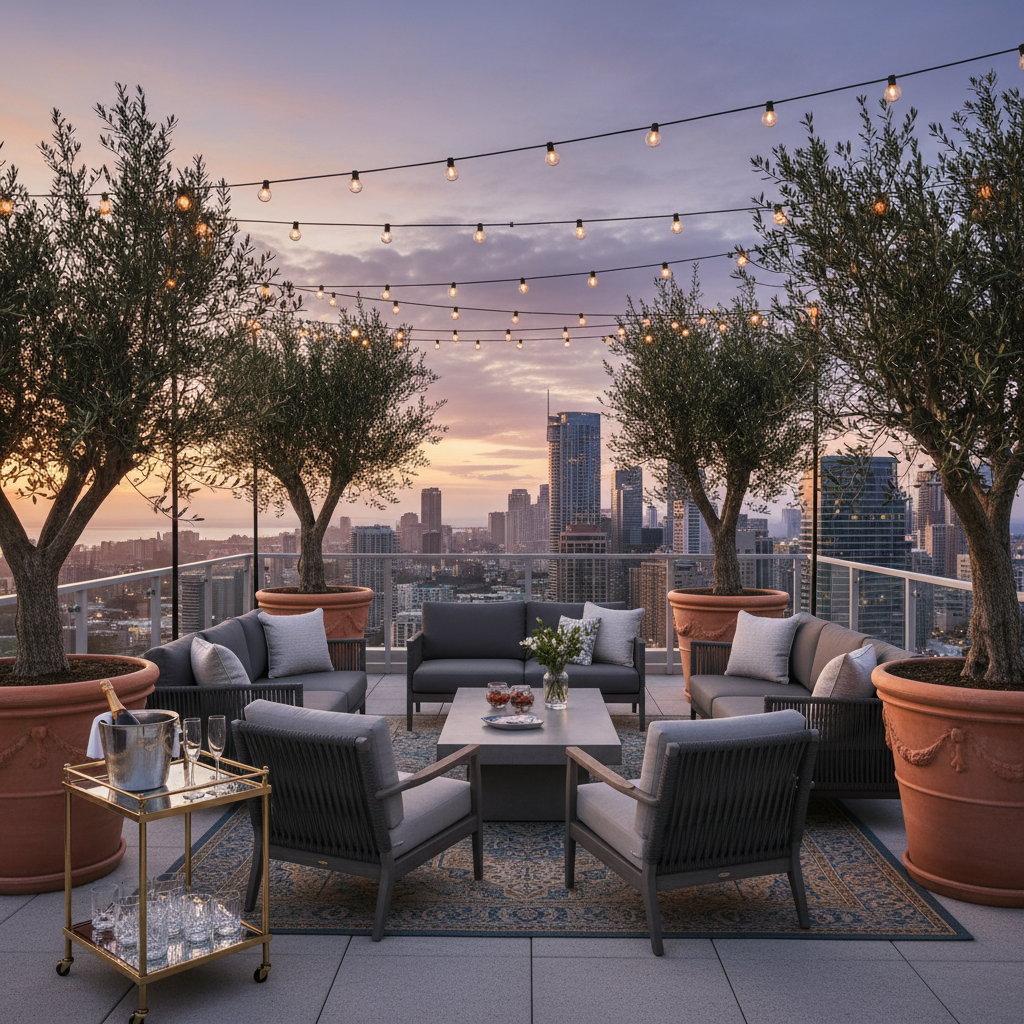
The most successful roof terrace planting schemes combine structural framework plants — grasses, ornamental bamboo (Phyllostachys aureosulcata, Phyllostachys nigra), olive trees, standard bay trees — with softer seasonal planting in protected positions.
Olive trees (Olea europaea) are particularly well-suited to roof terraces: drought-tolerant, wind-resistant, evergreen in temperate climates, and possessed of a timeless Mediterranean quality that elevates almost any exterior scheme. Specialist nurseries including Architectural Plants (architecturalplants.com) and Crocus (crocus.co.uk) supply trees of significant maturity that create instant structure.
**Screening, privacy, and wind mitigation**
A roof terrace without adequate screening is both uncomfortable and underused. Privacy from overlooking neighbours and wind mitigation are the twin objectives; how you resolve them significantly affects the character of the space.
Glass balustrades and screens allow wind to pass through while providing the sensation of enclosure — ideal where views are the primary asset and should not be obscured. Slatted timber or steel screens create more defined boundary conditions while allowing air movement. Planted screens — bamboo in raised planters, trained ivy or wisteria on steel wire — provide living boundaries that soften the urban character of the space.
For serious wind mitigation on high-exposure terraces, consulting a wind engineer — Arup's Building Physics team (arup.com) provides this service commercially — will ensure the screening solution is effective rather than merely decorative.
**Furniture: designed for altitude**
Roof terrace furniture must withstand the full force of urban weather: sustained wind, UV exposure, temperature variation, and rain. This makes the material selection critical.
Powder-coated aluminium is the most resilient choice: light enough to reposition easily, corrosion-proof, UV-stable, and available from manufacturers of genuine design quality including Kettal (kettal.com) and Gandia Blasco (gandiablasco.com). Teak is the classic premium choice — naturally oily, highly resistant to moisture and decay, and possessed of a warmth that aluminium cannot replicate.
For those who want a more interior aesthetic on the terrace, outdoor-rated upholstery fabrics — Sunbrella (sunbrella.com) is the benchmark manufacturer — allow proper sofas and armchairs to be used outside without compromise to performance. A deeply comfortable sofa on a roof terrace, with a view of the city at dusk and a glass of Nyetimber (nyetimber.com) in hand, is one of the genuinely great pleasures of urban life.
**Lighting: the evening transformation**
The character of a roof terrace changes entirely as the light fades. Good external lighting transforms the space from a daytime room into an evening destination.
String lights — cafe lights, festoon lights, Edison bulb strings — create an immediate warmth and celebratory quality that is universally effective. Supplement them with low-level deck lights for practical illumination and for defining the perimeter safely, and with directional spotlights in planters for dramatic uplighting of trees and structural plants.
For a more refined approach, Garden Lights (gardenlights.com) and John Cullen Lighting (johncullenlighting.co.uk) offer exterior lighting systems of genuinely architectural quality, with weatherproof fittings that deliver interior-quality illumination outdoors.
**The roof terrace as the best room in the house**
A well-designed roof terrace becomes, inevitably, the best room in the house during the months it can be used. It is the room where Sunday mornings are spent, where dinners run longest into the night, where guests gather without being asked.
Design it as you would your finest interior room: with care for proportion, material quality, the relationship between solid and open space, and the specific moments of the day and year for which you want it to excel. The sky above is the ceiling; the city beyond is the view. The only limit is the quality of the intention.

Continue Reading