Home
The Reading Nook: Designing a Small Space for Complete Escape
The reading nook is the smallest and most intimate room in any well-designed home. Here is how to create one that offers genuine escape from the rest of the world.
There is a particular quality of attention that only reading offers — a depth of focus, a stillness, an absorption in another world — and the space in which you read matters more than most people realise. A reading nook that is properly designed, properly lit, and properly furnished will be used daily. One that is awkward, poorly lit, or merely adequate will be passed by in favour of the sofa, the bed, the anywhere-but-here.
The reading nook is the smallest and most intimate design project in any home, but in many ways the most personally meaningful. It is a space designed for a single purpose: to sit, to read, to think, to exist quietly for a while.
**The architecture: alcoves, bays, and borrowed corners**
The best reading nooks arise from the architecture of the house itself — a deep bay window, a dormer alcove, a staircase recess, a landing that is wider than strictly necessary. These are the spaces that already suggest withdrawal and containment; designing a reading nook within them feels natural rather than imposed.
If your home has no such obvious architectural invitation, create one. A section of a living room partitioned from the main space by a full-height bookcase. A corner with a built-in seat and overhead canopy. An unused cupboard with its doors removed and the interior lined in fabric and cushions. The geometry of enclosure — being surrounded on three sides by walls, shelves, or structure — is what makes a reading nook work psychologically.
**The window seat: the most satisfying solution**
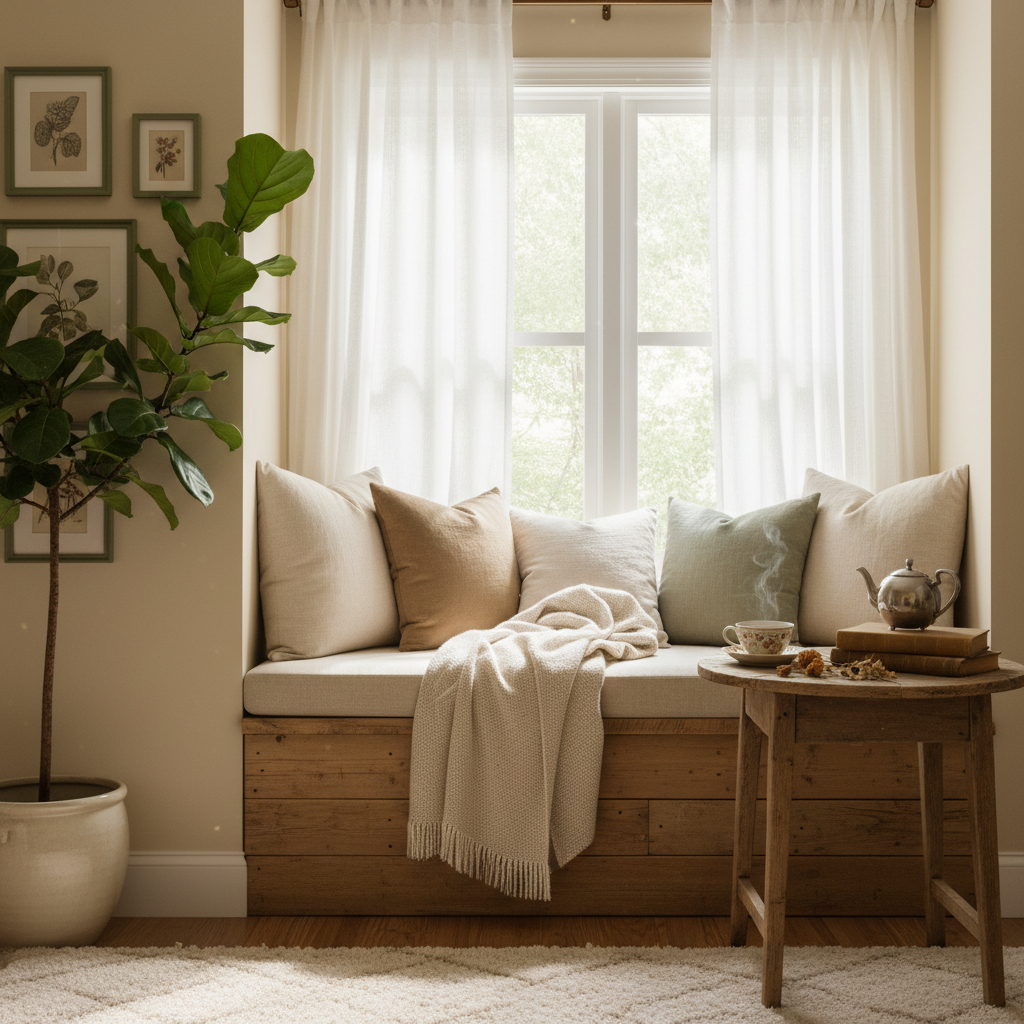
A window seat is the apotheosis of the reading nook concept — the combination of natural light, physical containment, and the visual pleasure of a view creates a reading environment that almost no other configuration matches.
Window seat depth is critical: a minimum of 20 inches of usable depth is required to sit comfortably with your back against one end and your legs extended. 24 inches is better. The base of the seat can double as storage — deep drawers or lift-up access for blankets, cushions, and books — making it one of the most efficient uses of architectural space in a home.
Built-in joinery for a window seat can be surprisingly affordable compared to other home improvements: a straightforward MDF or timber structure with cushioning above represents excellent value for the transformation it provides. The quality of the cushioning matters enormously — choose high-density foam at a minimum of four inches deep, upholstered in a fabric that is genuinely pleasant to sit against for hours at a time.
ZOffman (zoffany.com) and Fermoie (fermoie.com) produce woven fabrics of excellent quality for upholstery, combining durability with the kind of considered pattern and texture that elevates a simple cushion to something worth looking at as well as sitting on.
**Lighting: the non-negotiable**
Natural light is the foundation; artificial light must supplement it precisely when daylight fails. A reading nook without good artificial light is unusable after dark — and given that reading often happens in the evenings, this renders it half-functional at best.
The gold standard for reading light is an adjustable, directable source positioned to fall over the shoulder from slightly above and behind, illuminating the page without creating glare or shadow. An articulating wall sconce — such as those from Swing Arm Wall Sconce by Visual Comfort (visualcomfort.com) or the classic Tolomeo wall lamp by Artemide (artemide.com) — provides precisely this quality.
The light temperature matters: 2700K to 3000K is warm enough to be comfortable for extended reading without tipping into the orange tones that make sustained reading difficult. LED sources rated at 90+ CRI ensure accurate colour rendering — important for enjoying the full quality of printed photography in books and magazines.
**The shelf within reach**
A reading nook should have books within arm's reach — not accessible in another room, not in a separate library, but right there. A single shelf beside or above the seat for the books you are currently reading, planning to read, or are in the middle of. The physical presence of books to hand is a significant part of what makes a reading nook feel like a reading nook rather than simply a seat.
For the broader book collection, built-in shelves flanking the window seat — floor to ceiling if space permits — create the enclosed, library-like atmosphere that is particularly suited to concentrated reading.
**Textiles: warmth and comfort are the point**
The tactile quality of a reading nook matters enormously. This is the space where physical comfort translates directly into the quality of the activity it is designed for. Too cold, too hard, or insufficiently padded and the experience degrades; warm, soft, and generously cushioned and the hours pass without notice.
A proper reading blanket — merino wool, cashmere, or a heavy-weight linen throw — kept permanently in the nook for use. A stack of additional cushions for adjusting position. A small rug underfoot if the flooring is hard. These are not luxury additions; they are functional requirements for an environment in which you are expected to remain still and focused for extended periods.
Cochon Dingue (cochondingue.com) and The White Company (thewhitecompany.com) carry throws of the right weight and quality for permanent nook residence.
**The side table and a place for a cup of tea**
A reading nook without a surface at the right height for a cup of tea, a glass of something, or a place to rest a book face-down is an incomplete reading nook. It doesn't require much — a small drum table, a wall-mounted folding shelf, a broad window ledge — but the absence of it will be felt every single time.
The complete reading nook: an enclosed, naturally lit space, generously cushioned, with good artificial light over the shoulder, books within reach, a blanket at hand, a cup of something on a surface beside you, and nothing else required. That is the design brief. It is also, in a very small way, the description of a nearly perfect afternoon.



Continue Reading