Food & Drink
Prestige Cuvée: A Guide to the World's Most Coveted Champagnes
From Krug Grande Cuvée to Salon Le Mesnil, the world's greatest prestige Champagnes are more than wines — they are decades of craft, exceptional terroir, and the singular vision of a chef de cave distilled into a single bottle.
In the world of Champagne, the 'prestige cuvée' is the apex — the finest expression a house can produce, drawing on the best vineyards, the oldest reserves, and the most painstaking winemaking. These are wines made without compromise, aged for far longer than the law requires, and released only when the chef de cave considers them ready. They are among the most collected, gifted, and celebrated bottles in the world of fine wine.
The concept began with Dom Pérignon. When Moët & Chandon released its first vintage-dated prestige cuvée in 1936 (a 1921 vintage), naming it after the Benedictine monk credited with elevating Champagne, they established a template every great house would eventually follow. Today, Dom Pérignon (https://www.domperignon.com) releases vintage bottles only in exceptional years — typically after eight to ten years of ageing — and is one of the few prestige cuvées with global recognition beyond the wine world.
But among serious collectors, several other houses are considered equal or superior.
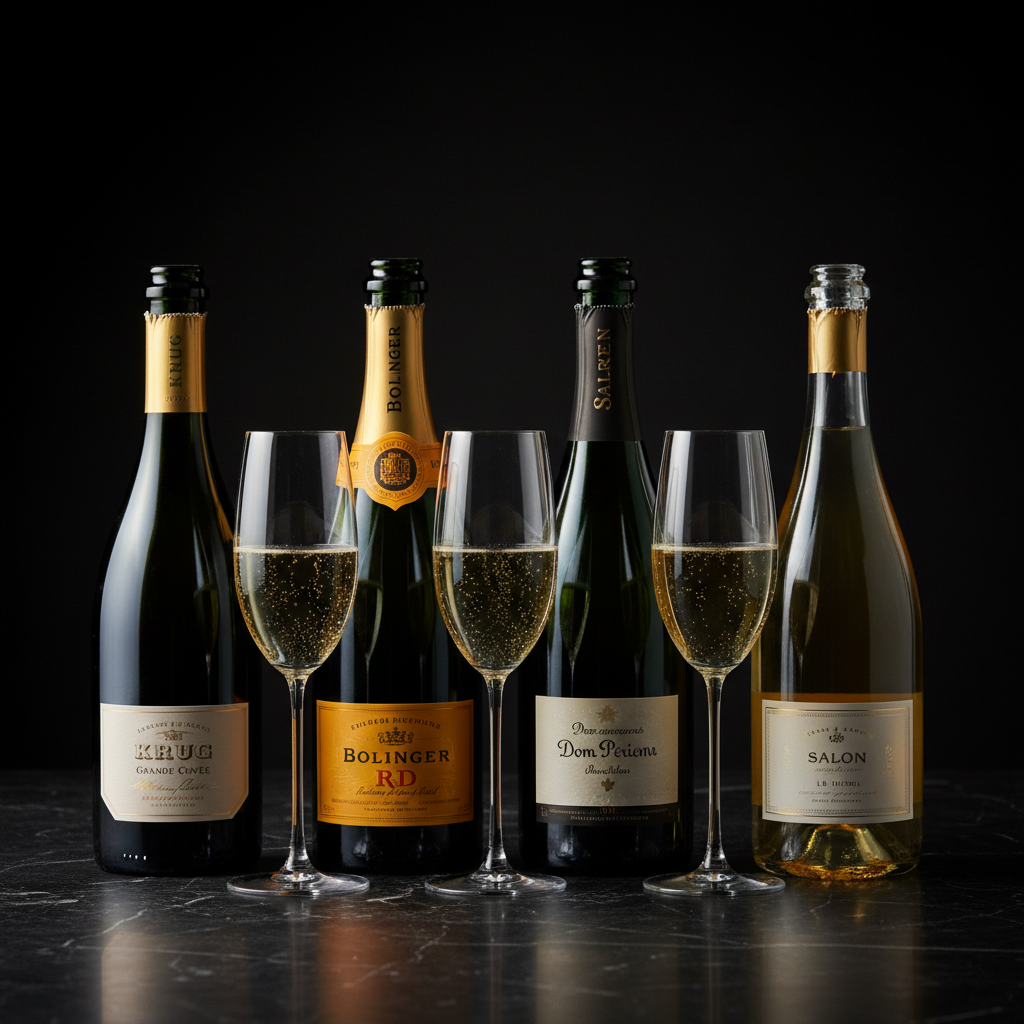
Krug Grande Cuvée is perhaps the most consistently discussed. Unlike most prestige cuvées, Krug (https://www.krug.com) is a non-vintage blend assembled from up to 250 wines from ten or more years, aged for six-plus years on lees and at least a further year after disgorgement. Each release is identified by a numbered 'Edition,' giving it a transparency unusual in Champagne. The style — oxidative, complex, deeply textured, with extraordinary length — divides opinion, but its devotees are among the most passionate in wine. The house also produces prestige single-vineyard Champagnes: Krug Clos du Mesnil (a blanc de blancs from a single walled vineyard in Le Mesnil-sur-Oger) and Krug Clos d'Ambonnay (a blanc de noirs from a single plot in Ambonnay).
Bollinger RD (Récemment Dégorgé) takes a different philosophy. 'RD' means recently disgorged — these wines spend many additional years (often 10–12 for recent releases) on their lees before disgorgement, preserving a vivacity and freshness that normal wines would lose. The 2002 Bollinger RD, released in 2014, is widely considered one of the great Champagnes of the modern era. Bollinger (https://www.champagne-bollinger.com) is also one of the few Champagne houses still fermenting in old oak barrels, giving their wines a distinctive richness and structure.
Salon Le Mesnil is the rarest of the major prestige cuvées. Produced only in exceptional years from a single Grand Cru village — Le Mesnil-sur-Oger in the Côte des Blancs — Salon (https://www.salondelamotte.com) has released only 42 vintages since its founding in 1905. The 1976, 1988, 1996, and 2006 vintages are legendary. Production averages 60,000 bottles per vintage — infinitesimal by Champagne standards. The wine is all Chardonnay, aged for a minimum of ten years, and represents the purest expression of Le Mesnil terroir available.
Louis Roederer Cristal was created in 1876 specifically for Tsar Alexander II of Russia, who demanded a clear crystal (hence the name) flat-bottomed bottle so he could inspect the wine for potential bombs. Today it is produced only in outstanding vintages from Premier and Grand Cru vineyards, vinified in a mix of tank and oak, and is distinctive for its fruit-forward elegance, citrus precision, and the ability to age for 20-plus years. The 2012 and 2013 vintages are considered exceptional by critics.
Pol Roger Cuvée Sir Winston Churchill deserves mention for its connection to its namesake, who famously drank Pol Roger daily and requested to be served it on ice at all times. The prestige cuvée bearing his name was first released in 1984 (1975 vintage) and is renowned for its power, depth, and ability to age.
For collectors considering building a Champagne cellar, Christie's (https://www.christies.com/en/stories/how-to-buy-champagne-eb72f791910c43c28ebef16a4a136dcc) and Sotheby's Wine (https://www.sothebys.com/en/articles/a-collectors-guide-to-champagne-and-its-crus) offer expert guidance. For current market prices and availability, the London-based merchants Berry Bros. & Rudd (https://www.bbr.com) and Bordeaux Index (https://bordeauxindex.com/learn/guides/investment/a-guide-to-investing-in-champagne) are considered benchmarks.
When it comes to serving, prestige Cuvée Champagnes deserve proper care. Serve at 10–54°F (50–54°F) — slightly warmer than standard Champagne — in a proper wide-mouthed flute or ideally a white Burgundy glass, which allows the wine's full aromatic complexity to open. Decanting — particularly for wines 15+ years of age — can dramatically improve the experience.
Continue Reading