Food & Drink
The Parisian Café Morning: Espresso, Croissant, and Café Culture
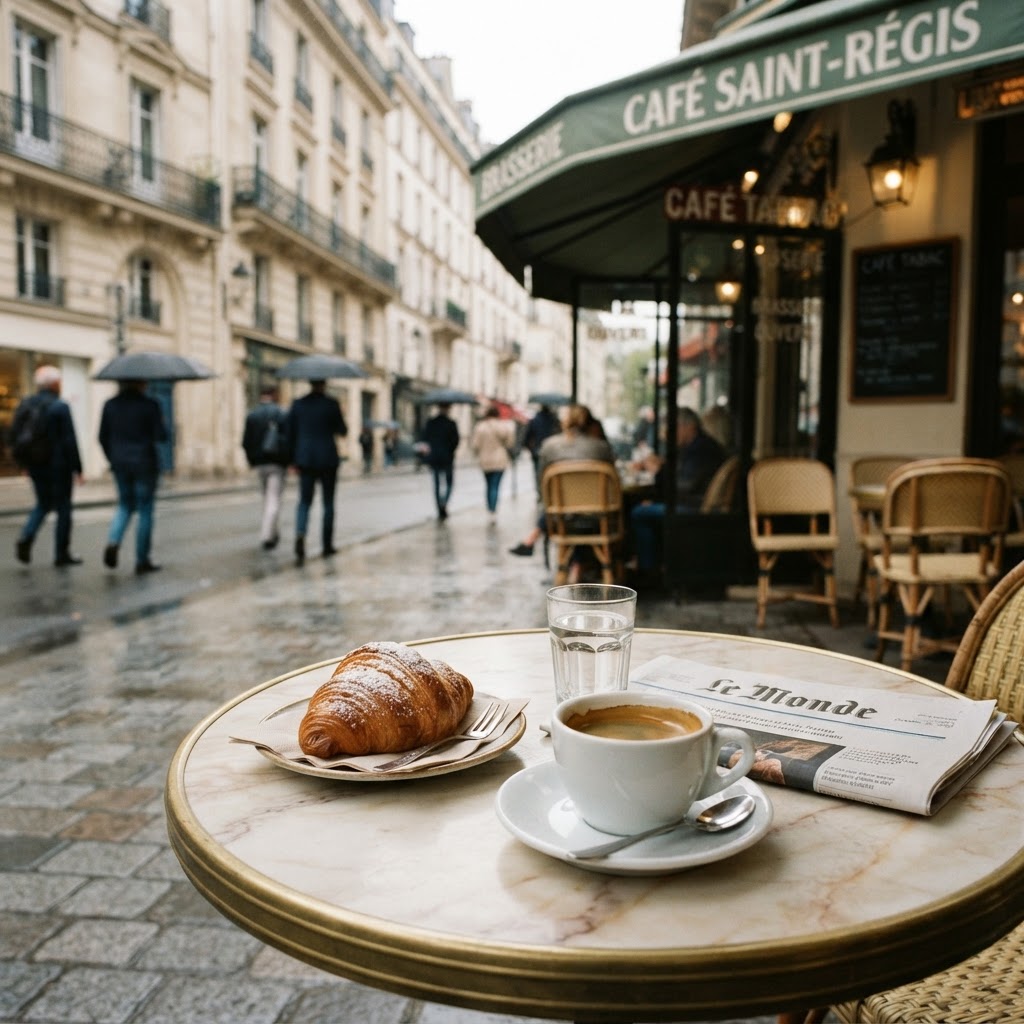
There is a particular Parisian art to the morning: a small cup of dark espresso, a warm croissant, a table facing the sidewalk, and absolutely no rush. The café is the living room of the city, and the morning is when it is most itself.
There is a particular Parisian art to the morning: a small cup of dark espresso, a warm croissant, a table facing the sidewalk, and absolutely no rush. The café is the living room of the city, and the morning is when it is most itself. To watch Paris wake from a café terrace is to understand why the French café is not merely a place to drink coffee but a form of civic life.
**The Café as Institution**
The French café is among the oldest continuously operating social institutions in Europe. Paris counts its cafés not by the dozen but by the thousand, and the sidewalk terrace — those rows of rattan chairs turned to face the street, so that the city itself becomes the entertainment — is the defining feature. A café in Paris is not a restaurant and not a bar; it is a third place, somewhere between home and work, where one may sit alone for an hour with a single espresso and a newspaper, or meet friends, or conduct business, all without pressure to order more or to leave.
The great historic cafés of the Left Bank are the most famous. Café de Flore, opened in 1887 at the corner of Boulevard Saint-Germain, and Les Deux Magots, just across the small square, became in the twentieth century the unofficial headquarters of French intellectual life. Jean-Paul Sartre and Simone de Beauvoir wrote through the war years at Flore, warmed by the café's stove; the Surrealists gathered at Deux Magots; Hemingway, Camus, and Picasso all passed through. The coffee was the excuse. The table, the heat, and the company were the point.
**The Espresso and the Café au Lait**
The Parisian morning coffee is a small, intense thing. An espresso — called simply a café — arrives in a tiny cup, dark and bitter, meant to be drunk in two or three sips while standing at the counter for a fraction of the price of sitting at a table. (The French café charges by the experience, not the drink: standing is cheapest, sitting inside is more, sitting on the terrace is most.) For those who want something larger and softer, there is the café au lait, served in a wide bowl, half coffee and half hot milk, perfect for dipping the corner of a croissant.
**The Croissant's Journey to Paris**
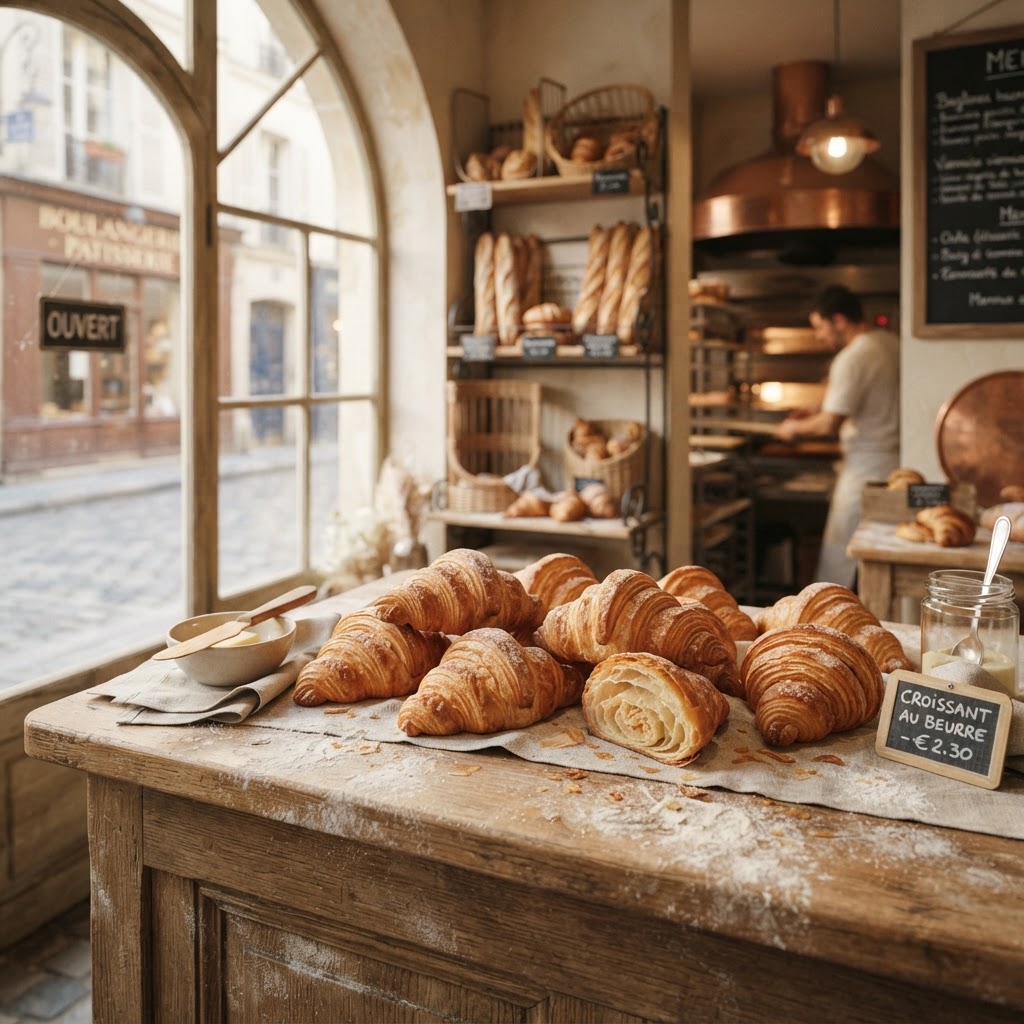
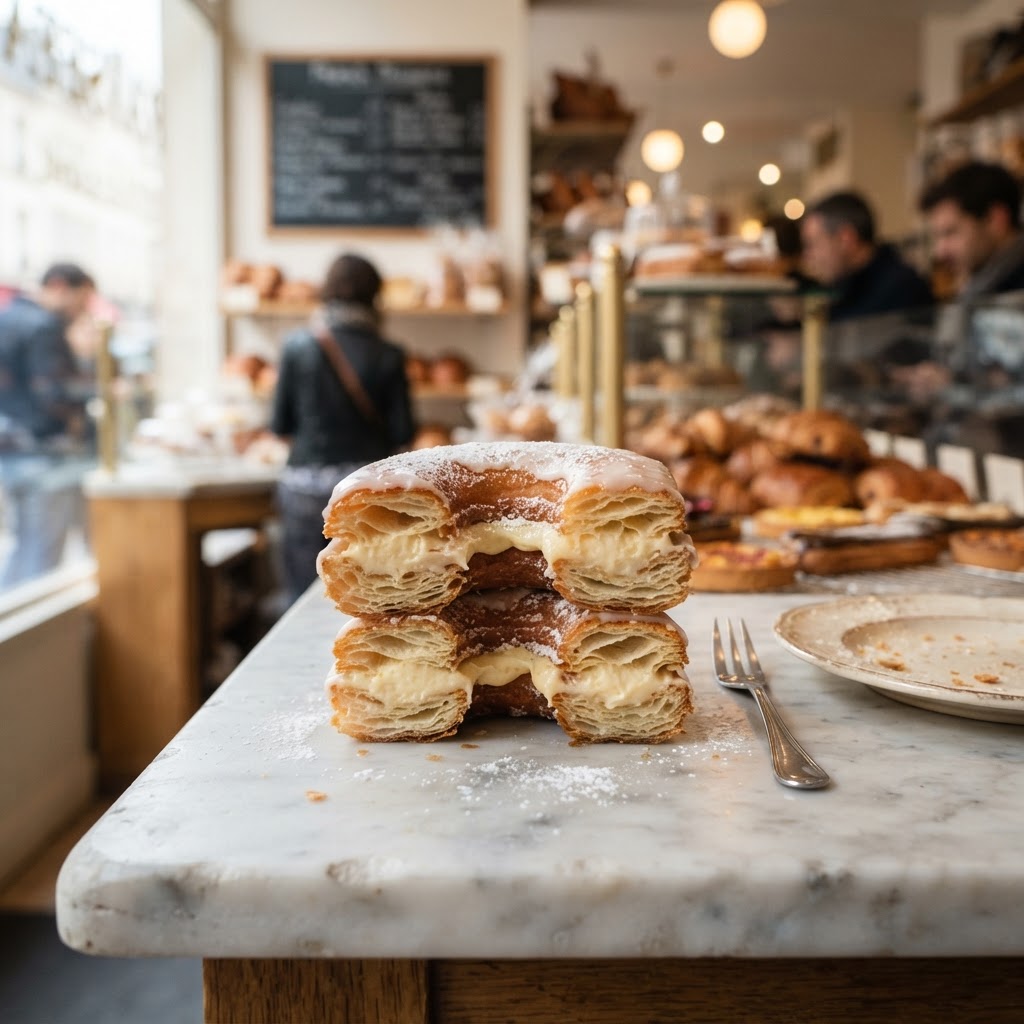
The croissant, that crescent of laminated, buttery dough, is not strictly French in origin. The ancestor is the Austrian kipferl, a crescent-shaped pastry baked in Vienna at least since the medieval period. According to the most repeated (if debated) origin story, the kipferl reached Paris in the late eighteenth century, possibly through the Austrian-born pastry makers who followed Marie Antoinette to Versailles. What is certain is that nineteenth-century Parisian bakers transformed the dense Austrian pastry into the flaky, buttery, layered viennoiserie we know today by applying the technique of puff pastry — folding butter into the dough again and again until the layers number in the dozens.
The result is a pastry that is crisp and shattering on the outside, soft and slightly elastic within, and best eaten within an hour of the oven. A day-old croissant is a different, lesser thing, which is why the Parisian morning is built around fetching them warm from the boulangerie or eating them immediately at the café counter.
**The Brunch Connection**
The Parisian café morning and the modern brunch share a philosophy: the morning meal is not for fuel but for time. A brunch built on Parisian principles keeps the menu small and excellent — a warm croissant or a slice of good bread with butter and jam, a bowl of café au lait, a glass of fresh juice — and lets the conversation stretch. A Classic Champagne Mimosa beside a basket of warm croissants is the most natural meeting of the French café and the American brunch: the same buttery richness, the same citrus, the same refusal to hurry.
**References**
- Wikipedia: Café de Flore — https://en.wikipedia.org/wiki/Caf%C3%A9_de_Flore
- Wikipedia: Croissant — https://en.wikipedia.org/wiki/Croissant
- Wikipedia: Café (restaurant) — https://en.wikipedia.org/wiki/Caf%C3%A9
Continue Reading