Food & Drink
The Croissant: From Austrian Kipferl to the Parisian Morning Ritual
The croissant is the most famous breakfast pastry in the world — and it's not, strictly speaking, French. Its crescent shape descends from the Austrian kipferl, but its layered, buttery texture is a Parisian invention that transformed a simple crescent into an art form.
The croissant is the most famous breakfast pastry in the world — and it's not, strictly speaking, French. Its crescent shape descends from the Austrian *kipferl*, a crescent-shaped baked good that predates the French version by centuries. Its layered, buttery, laminated texture, though, is a Parisian invention that transformed a simple crescent into the art form we know today. To understand the croissant is to understand a story of migration, myth, and the genius of French baking.
**The Austrian Kipferl**
The ancestor of the croissant is the *kipferl*, a crescent-shaped pastry that originated in Vienna. The kipferl itself has a contested origin. One popular legend holds that it was created in the late 17th century as a celebration of the Austrian victory over the Ottoman Empire at the Siege of Vienna in 1683 — bakers, hearing the Ottomans tunnelling under the city walls, raised the alarm and were rewarded with the right to bake a crescent-shaped pastry mocking the Ottoman flag. Historians regard this story as apocryphal, but it remains the most widely told origin of the kipferl.
What is certain is that the kipferl — a denser, less laminated crescent made with butter or lard — was a Viennese staple long before the French adopted and transformed it. The kipferl was introduced to France in the 18th and 19th centuries by Austrian bakers, several of whom opened Viennese bakeries in Paris.
**The Marie Antoinette Legend**
A romantic and enduring legend attributes the introduction of the kipferl to France to Marie Antoinette, the Austrian-born queen who married the future Louis XVI in 1770. The story goes that Marie Antoinette, homesick for the pastries of her native Vienna, asked the royal bakers at Versailles to make her the kipferl of her childhood — and thereby introduced the crescent to France. The story is dubious; there's no documentary evidence for it. But it has been told and retold for centuries and remains part of the croissant's lore.
What is better documented is the opening of Viennese bakeries in Paris in the 1830s, particularly the Boulangerie Viennoise opened by August Zang, an Austrian artillery officer, in 1838 or 1839. Zang's bakery on the rue de Richelieu introduced Parisians to the kipferl and other Viennese baked goods, and the crescent shape caught on.
**The French Invention of Lamination**
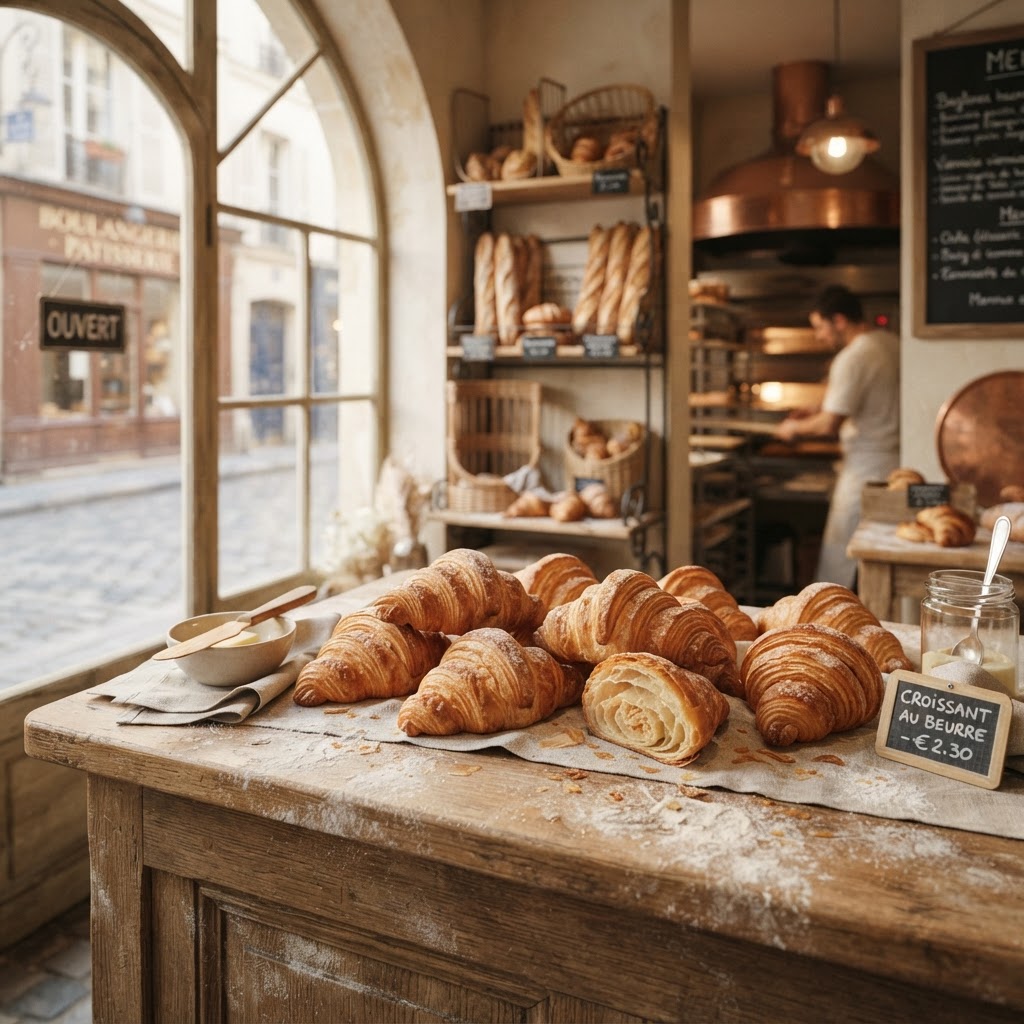
The transformation of the kipferl into the modern croissant came in the early 20th century, when French bakers applied the technique of lamination — folding butter into dough in successive layers — to the crescent shape. The first known recipe for a laminated, puffed croissant appeared in 1905, and the modern, flaky croissant as we know it was born. The result is a pastry with a shattering, flaky exterior and a soft, honeycombed interior, light and buttery in a way the original kipferl was not.
The technique of lamination is what makes the croissant a French invention rather than an Austrian one. The Austrians gave the shape and the name, but the French gave the texture — the thin, crisp layers that shatter under the teeth and the airy, elastic crumb within. The croissant, as the world knows it, is a French pastry, even if its roots are Austrian.
**Viennoiserie and the Parisian Morning**
The croissant belongs to the category of French baking known as *viennoiserie* — literally, "things of Vienna" — which includes pain au chocolat, pain aux raisins, brioche, and other yeast-leavened, laminated pastries. These are the pastries of the Parisian morning, bought fresh from the boulangerie on the way to work, eaten with coffee at a café counter, or enjoyed slowly on a weekend morning with butter and jam.
The proper croissant is eaten the day it is baked, ideally within hours of leaving the oven. A day-old croissant is a diminished thing — the layers soften, the butter oxidizes, and the shatter is lost. The best croissants in Paris are found at the city's artisan boulangeries, where the baker laminates the dough by hand, proofs the shaped crescents overnight in a cool proofing chamber, and bakes them fresh each morning.
**The Brunch Connection**
The buttery, flaky croissant is the most natural partner in the world for a mimosa brunch. A Classic Champagne Mimosa or a Peach Bellini Mimosa alongside a warm, fresh croissant is a breakfast that defines French elegance. For a more indulgent pairing, a Lavender Elderflower Mimosa echoes the floral notes of the pastry's butter, while a Pain au Chocolat finds its ideal companion in a Strawberry Mimosa, where the fruit of the pastry meets the fruit of the glass.
**References**
- Institute of Culinary Education: A Brief History of the Croissant — https://www.ice.edu/blog/brief-history-croissant-austrian-kipferl-layered-french-luxury
- Smithsonian Magazine: Is the Croissant Really French? — https://www.smithsonianmag.com/arts-culture/is-the-croissant-really-french-1444064/
- Wikipedia: Croissant — https://en.wikipedia.org/wiki/Croissant
- NPR: The Croissant's Austrian Roots — https://www.npr.org/sections/thesalt/2016/04/12/473550521/the-croissant-was-actually-invented-in-austria



Continue Reading