Travel
Oman: Muscat, the Wahiba Sands & the Arabian Peninsula's Most Civilised Kingdom
Oman is the Middle East's best-kept secret — a country of extraordinary physical beauty, from the rose-red dunes of the Wahiba Sands to the dramatic fjords of the Musandam Peninsula, governed with a rare combination of modernisation and cultural integrity.
Oman is the Middle East's most civilised and most visually spectacular country — and the one that most consistently surprises visitors who arrive expecting another Gulf state of glass towers and artificial islands. Instead, they find a kingdom of extraordinary natural diversity: the snow-dusted peaks of the Hajar Mountains, the surreal rose-red dunes of the Wahiba (Sharqiyah) Sands, the dramatic limestone fjords of the Musandam Peninsula in the north, and the frankincense trees of the ancient Dhofar region in the south. The late Sultan Qaboos bin Said Al Said, who ruled from 1970 until his death in 2020, transformed Oman from a medieval closed society into a modern state while preserving its architectural heritage, natural landscapes, and cultural identity with a consistency no other Gulf state has managed.
Muscat: The Capital
Muscat is the most architecturally coherent capital in the Arab world. A law passed by Sultan Qaboos in the 1970s requires all new buildings to incorporate traditional Omani architectural elements — arched windows, crenellated parapets, whitewashed walls — creating a cityscape of remarkable visual harmony stretching along a dramatic coastline of volcanic black rock and turquoise sea. The Sultan Qaboos Grand Mosque (open to non-Muslims Saturday–Thursday until 11am; sultanqabosgrandmosque.com) is the country's principal mosque and one of the finest examples of contemporary Islamic architecture in the world — the main prayer hall carpet, woven in Iran, is the second-largest hand-woven carpet on earth (4,343 square metres, 600 million knots). The Royal Opera House Muscat (rohmuscat.org.om), inaugurated in 2011, hosts an international season of opera, ballet, and orchestral concerts of genuine world standard.
Where to Stay in Muscat
The Al Bustan Palace (ritzcarlton.com/albustan) — a Ritz-Carlton property set in a private bay 18km south of central Muscat — is the grande dame of Omani luxury hospitality: an extraordinary 250-room palace built in 1985 by Sultan Qaboos, set in 200 acres of gardens at the foot of the Hajar Mountains, with a 200-metre private beach. The eight-storey atrium lobby, topped with a dome of Venetian glass, and the views from the pool terrace across the Bay of Oman are among the most memorable in Gulf hospitality. Rooms from $350/night.
Alila Jabal Akhdar (alilahotels.com/jabalakhdar) on the edge of the Grand Canyon of Arabia — a 1,000-metre-deep gorge in the Hajar Mountains, 2,000 metres above sea level — offers the most dramatic setting of any hotel in Oman: a series of low stone structures at the canyon's edge, with infinity pools appearing to pour directly into the void. The mountain air is cool year-round — a remarkable contrast to the coastal heat. Rooms from $450/night.
The Wahiba Sands
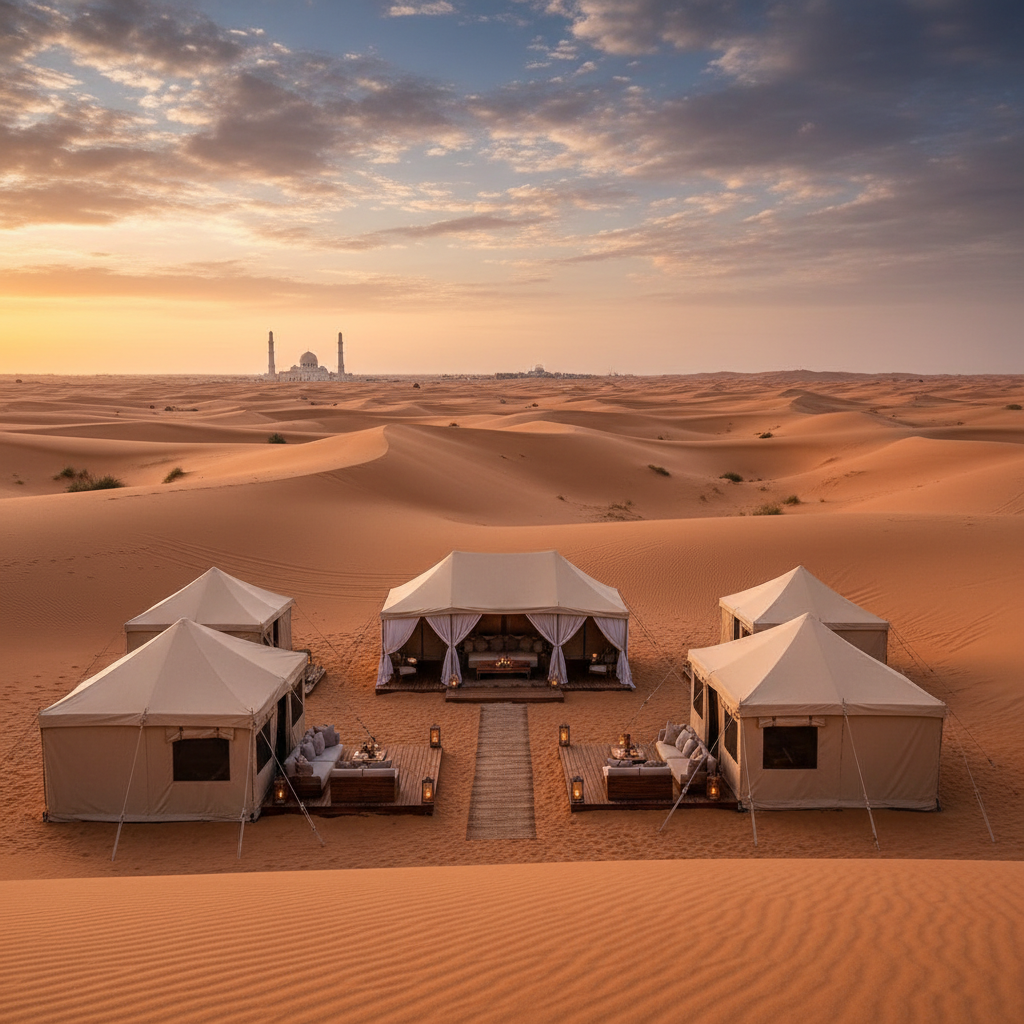
The Sharqiyah (Wahiba) Sands — a sea of dunes extending 180km south from the Hajar Mountains to the Arabian Sea — is one of the most beautiful desert landscapes in the world. The dunes reach heights of 100 metres and display a range of colours from pale cream at dawn to deep burnt-orange at sunset. Desert Nights Camp (desertnightscamp.com) is the finest tented camp in Oman's desert: 30 luxury Bedouin-style tents with air conditioning and private terraces, camel trekking at sunrise, and dune-bashing in 4WD vehicles at sunset. From $400/night, all meals included.
Dhofar and the Frankincense Coast
The Dhofar region in Oman's far south — a full day's drive or 90-minute flight from Muscat — is the source of most of the world's finest frankincense. The ancient trade routes from Dhofar to Rome and Alexandria made the region one of the wealthiest in the ancient world; the archaeological site of Ubar (known as the Atlantis of the Sands) was discovered by explorer Ranulph Fiennes in 1992. During the khareef (monsoon season, July–September), Dhofar receives the only monsoon rains on the Arabian Peninsula, transforming the normally arid landscape into a green, mist-shrouded highland of extraordinary natural beauty.
Getting There
Muscat's Muscat International Airport (MCT) is served by direct flights from London (British Airways, omanair.com), Frankfurt, Paris, Zurich, New York (Oman Air via connection), Dubai (Emirates), and all major Gulf hubs. Oman Air (omanair.com) connects Muscat to Salalah (Dhofar) with multiple daily flights.
Reference Links:
- Oman Tourism: tourismoman.com
- Sultan Qaboos Grand Mosque: sultanqabosgrandmosque.com
- Royal Opera House Muscat: rohmuscat.org.om
- Al Bustan Palace, A Ritz-Carlton Hotel: ritzcarlton.com/albustan
- Alila Jabal Akhdar: alilahotels.com/jabalakhdar
- Desert Nights Camp: desertnightscamp.com
- Oman Air: omanair.com



Continue Reading