Entertaining
Oktoberfest at Home: Bringing Bavarian Beer Hall Tradition to Your Table
Oktoberfest at home brings the world's largest folk festival — Bavarian beer, food, and culture — to your table. First held on October 12, 1810, as a royal wedding celebration in Munich, Oktoberfest draws over six million visitors annually to the Theresienwiese. A complete guide to hosting your own Wiesn.
Oktoberfest at home brings the world's largest folk festival — a celebration of Bavarian beer, food, and culture held annually in Munich, Germany — to your own table. The original Oktoberfest, first held on October 12, 1810, as a celebration of a royal wedding, has grown into a 16-to-18-day festival that draws over six million visitors to the Theresienwiese ('Therese's Meadow') each year. Bringing the spirit of the Wiesn — as the festival is known locally — into your home creates one of the most festive, convivial, and abundantly generous entertaining events of the autumn season.
The History of Oktoberfest
The first Oktoberfest was held on October 12, 1810, to celebrate the wedding of Crown Prince Ludwig of Bavaria (who would become King Ludwig I) and Princess Therese of Saxony-Hildburghausen. Munich officials invited the public to celebrate on fields outside the city walls, and the site was named Theresienwiese ('Therese's Meadow') in honor of the princess — a name it retains to this day. The first festival featured a horse race modeled on medieval traditions, and the event was so popular that it was repeated the following year, forming the core of what would become an annual tradition. Reference: [Wikipedia — Oktoberfest](https://en.wikipedia.org/wiki/Oktoberfest)
The festival has evolved significantly over two centuries. In the early years, it was primarily an agricultural fair with a horse race. Beer stands were added in 1818, and by the late 19th century, the stands had grown into the large beer halls (Festhallen) that are the festival's signature today. Since 1950, the festival has opened with a traditional ceremony: the Mayor of Munich taps the first keg of beer and announces the Bavarian phrase 'O'zapft is!' ('It's tapped!'), traditionally serving the first liter to the Bavarian Minister-President. Reference: [Oktoberfest.de](https://www.oktoberfest.de/en/)
The Beer
Oktoberfest beer — Oktoberfestbier or Wiesn-Bier — is a specific style of beer brewed only by the six major Munich breweries: Augustiner, Hacker-Pschorr, Hofbräu, Löwenbräu, Paulaner, and Spaten. These breweries are the only ones permitted to serve beer at the festival, and their Oktoberfestbier is a Märzen or Festbier style — a rich, amber-to-golden lager with a slightly higher alcohol content (around 6%) than standard German pilsner. The beer is served in a Maß — a one-liter glass stein — and the festival consumes approximately 7 million liters of beer over its two-plus weeks.
Reference: [German Beer Institute — Oktoberfestbier](https://en.wikipedia.org/wiki/Oktoberfestbier)
The Food
The Oktoberfest food tradition is hearty, savory, and deeply Bavarian. The essential dishes include:
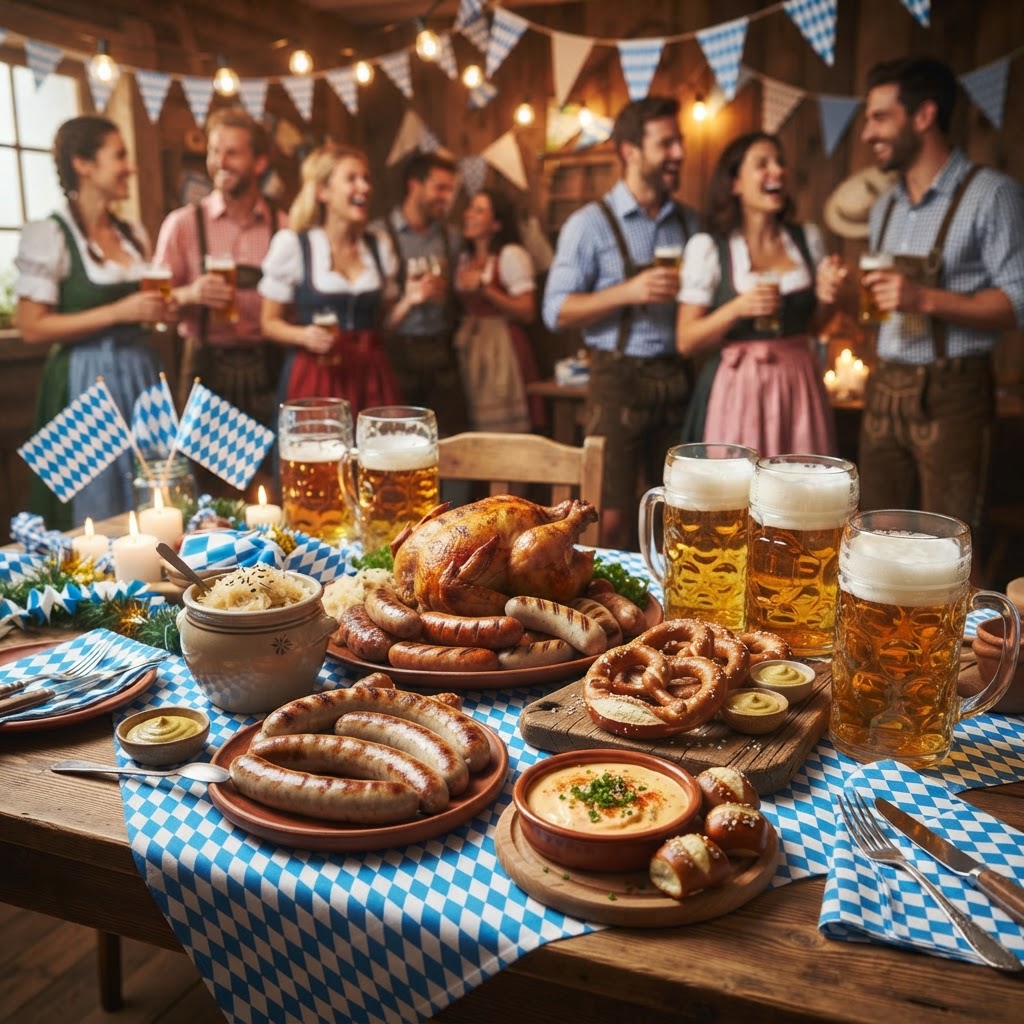
**Brez'n (Pretzels)** — enormous, soft Bavarian pretzels, often the size of a dinner plate, with a dark, chewy crust and a tender interior, sprinkled with coarse salt. They are served with obatzda (see below) and are the most iconic Oktoberfest food.
**Obatzda** — a cheese spread made from ripened Camembert or Brie mixed with butter, cream cheese, paprika, and sometimes beer, served with pretzels and radishes. It is one of the most beloved Bavarian snacks.
**Bratwurst and Weisswurst** — Bratwurst is the classic grilled pork sausage, served with mustard and a Semmel (bread roll). Weisswurst, the traditional white veal and pork sausage of Munich, is flavored with parsley, lemon, and cardamom, and is traditionally eaten before noon — a tradition said to date from a time before refrigeration, when the fresh sausage would not keep through the day. Reference: [Weisswurst](https://en.wikipedia.org/wiki/Weisswurst)
**Hendl (Roast Chicken)** — whole chickens spit-roasted until golden and crispy, the most popular food item at the festival.
**Schweinshaxe** — roasted pork knuckle with crackling skin, a Bavarian specialty.
**Sauerkraut and Kartoffelsalat** — sauerkraut and warm potato salad, the traditional side dishes.
**Steckerlfisch** — whole fish (typically mackerel or trout) grilled on a stick over an open fire, an Oktoberfest tradition dating to the early 20th century.
**Apfelstrudel** — apple strudel, served warm with vanilla sauce, for dessert.
The Dirndl and Lederhosen
Traditional Bavarian dress is an essential part of Oktoberfest. Women wear dirndls — a traditional dress with a bodice, blouse, and full skirt — and men wear Lederhosen — leather breeches with suspenders. The wearing of traditional dress (Tracht) at Oktoberfest surged in the 1990s and 2000s, and today the vast majority of visitors wear some form of traditional clothing. The dirndl knot — the bow tied on the apron — carries meaning: a bow on the right means 'taken' or married, on the left means 'available,' and in the center means the wearer is a child or has taken a vow.
Hosting an Oktoberfest at Home
Set a rustic table with a blue-and-white checkered cloth (the Bavarian colors). Serve the beer in liter steins (or large glass mugs). Offer a selection of Oktoberfestbier-style beers from the Munich breweries, or from American craft breweries that produce seasonal Märzen or Festbier styles. A centerpiece of large pretzels, a pot of obatzda, and platters of sausages and roast chicken create an abundant, communal spread.
Play traditional Bavarian brass music (Blasmusik) and modern Oktoberfest hits. The festival has a tradition of singing along to well-known songs, and the most famous is 'Ein Prosit der Gemütlichkeit' ('A toast to cheerfulness'), which is played every 20 minutes or so in the beer halls and is accompanied by the entire hall raising their steins and toasting.
For a brunch-appropriate Oktoberfest celebration, consider a morning Weisswurst breakfast — the traditional Munich breakfast of Weisswurst, sweet mustard, pretzels, and a wheat beer (Weissbier) — followed by a mimosa made with the wheat beer instead of Champagne, a refreshing twist on the brunch classic.
Reference Links:
- Oktoberfest history: en.wikipedia.org/wiki/Oktoberfest
- Official Oktoberfest site: oktoberfest.de/en
- Oktoberfestbier: en.wikipedia.org/wiki/Oktoberfestbier
- Weisswurst: en.wikipedia.org/wiki/Weisswurst
- Munich Tourism: muenchen.travel
- History of Oktoberfest: history.com/this-day-in-history/october-12/the-origin-of-oktoberfest
- German Beer Institute: germanbeerinstitute.com



Continue Reading