Entertaining
The New England Clambake: A Coastal Shore Dinner Tradition
The New England clambake is one of America's oldest communal feasting traditions — a method of steaming seafood, corn, and potatoes over hot stones and seaweed in a coastal sand pit. Born of Native American technique and popularized after the Civil War, the clambake remains the ultimate seaside party.
The New England clambake is one of America's most distinctive communal feasting traditions — a method of cooking seafood, corn, and potatoes by steaming them over hot stones and layers of seaweed in a pit dug in the sand. The clambake is not merely a meal but an event: a gathering of family and friends on a beach, a fire built at dawn, and hours of preparation culminating in a feast that captures the essence of the New England coast. It is the ultimate expression of seaside entertaining — communal, elemental, and deeply rooted in the landscape.
History and Origins
The clambake has its deepest roots in the practices of the Native American tribes of coastal New England — the Wampanoag, Narragansett, and others — who cooked clams, oysters, and other seafood in earth ovens lined with hot stones and seaweed. However, food historians have shown that the clambake as we know it today — a consciously celebratory tradition based on indigenous foods — was developed in the United States after the American Revolution as part of a created mythology of national cultural identity. Author Andrew W. German has noted that while Native Americans consumed clams for thousands of years, there is little evidence they prepared them in the traditional New England way of steaming in rockweed.
The clambake 'exploded' in popularity after the American Civil War. Rhode Island businessmen operated many clambake pavilions, and the first published clambake recipe credited Rhode Island as the origin. In 1888, a group of Quakers in Dartmouth, Massachusetts, held a clambake that became an annual tradition each August that continues to this day. Reference: [Wikipedia — Clambake](https://en.wikipedia.org/wiki/Clambake)
The Traditional Method
A proper clambake is an all-day event that follows a method that has changed little in over a century:
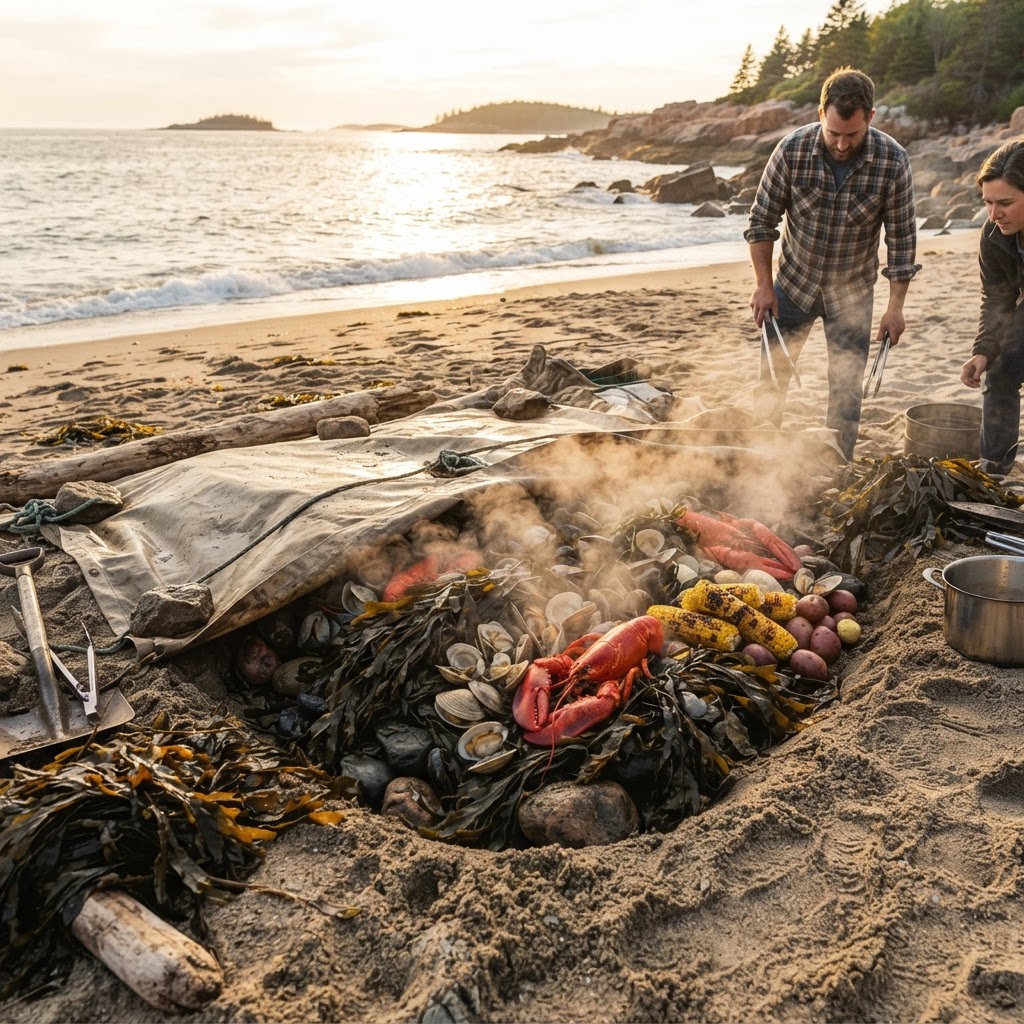
1. **The Pit** — A pit, approximately 2 feet deep and 3 feet wide, is dug in the sand above the tide line. Smooth, round stones — preferably granite, which holds heat without cracking — are placed at the bottom.
2. **The Fire** — A wood fire is built on top of the stones and allowed to burn for several hours until the stones are glowing hot. This fire is typically lit in the early morning.
3. **The Seaweed** — Fresh rockweed (a type of brown seaweed with gas-filled bladders) is harvested from the shore. The wet seaweed is the essential steaming medium. Reference: [Busch's — Clambake Guide](https://www.buschs.com/kitchen-hacks/a-hosts-guide-to-new-england-clam-bakes)
4. **The Layering** — Once the fire has burned down to embers and the stones are hot, the ash is swept away. A thick layer of wet seaweed is placed directly on the hot stones. Then the food is layered: onions and sweet potatoes first (they need the longest cooking), then clams (soft-shell steamers and quahogs), then corn on the cob, then lobsters, and finally eggs (which cook in the steam and serve as a doneness indicator). Another layer of seaweed covers the entire pile, and a wet canvas tarp is draped over the top to trap the steam.
5. **The Steam** — The food steams for approximately 1 to 2 hours, depending on the size of the bake and the heat of the stones. When the eggs are hard-cooked, the bake is done.
The Food
A traditional New England clambake includes:
**Soft-shell clams (steamers)** — the long-necked clams that are the signature ingredient of the bake. They are served with their broth (for rinsing sand) and melted butter.
**Lobsters** — ideally Maine lobsters, 1¼ to 1½ pounds each, steamed until bright red.
**Quahogs** — the hard-shell clams of New England, used for chowder and stuffed clams.
**Corn on the cob** — sweet corn, husked and laid in the steam.
**Sweet potatoes** — a traditional element that cooks slowly in the pit.
**Onions** — whole onions that sweeten in the steam.
**Linguica or chorizo** — Portuguese sausage, a nod to the Portuguese communities of southeastern New England.
**Drawn butter and clam broth** — for dipping.
Hosting a Clambake
If you do not have access to a beach (or if you live far from the coast), the clambake can be replicated on a smaller scale using a large pot, a steamer basket, and seaweed ordered from a fishmonger. This stovetop or grill-top version — sometimes called a 'New England boil' — captures the flavors if not the full pageantry of the event. Reference: [Yankee Magazine — Clambake](https://www.newengland.com/today/living/new-england-environment/how-to-host-a-clambake/)
The clambake is best served outdoors, on a table covered with newspaper or butcher paper, with the food dumped directly onto the table — no plates required. Provide large bowls for clam shells, cups of melted butter, and plenty of napkins. Cold beer, crisp white wine (a New England sparkling wine or a Sauvignon Blanc), and mimosas are all excellent accompaniments. The setting — a beach at golden hour, the smell of wood smoke and the sea — is as important as the food.
Reference Links:
- Clambake history and method: en.wikipedia.org/wiki/Clambake
- Host's guide to clam bakes: buschs.com/kitchen-hacks/a-hosts-guide-to-new-england-clam-bakes
- Maine lobster bake history: getmainelobster.com/blogs/insights/history-of-the-traditional-maine-lobster-bake
- Yankee Magazine clambake guide: newengland.com/today/living/new-england-environment/how-to-host-a-clambake
- New England tourism: discovernewengland.org



Continue Reading