Travel
Namibia: The Red Dunes of Sossusvlei, Desert Wildlife & Africa's Most Extraordinary Wilderness
Namibia is Africa's great undiscovered luxury destination — a country of staggering spatial grandeur, ancient desert landscapes, and wildlife experiences found nowhere else on the continent. With fewer than 2.5 million people across a country four times the size of the UK, it offers a quality of solitude that is increasingly rare.
Namibia is Africa's most quietly magnificent destination — a country of such spatial grandeur and such complete absence of crowds that it reconfigures the traveller's sense of scale entirely. At 824,000 square kilometres (larger than France and Germany combined) with a population of barely 2.5 million, Namibia has one of the lowest population densities in the world, and the effect on the landscape is profound: you can drive for three hours on a good road without encountering another vehicle, camp in a private concession of 100,000 hectares, and watch a desert sunrise over the world's oldest dunes with no other human being in view.
Namibia achieved independence from South Africa in 1990 and has since developed one of Africa's most sophisticated ecotourism industries — based on community conservancies that return revenue directly to local communities while protecting vast wilderness areas. The result is both ethically sound and experientially extraordinary.
Sossusvlei and the Namib Desert
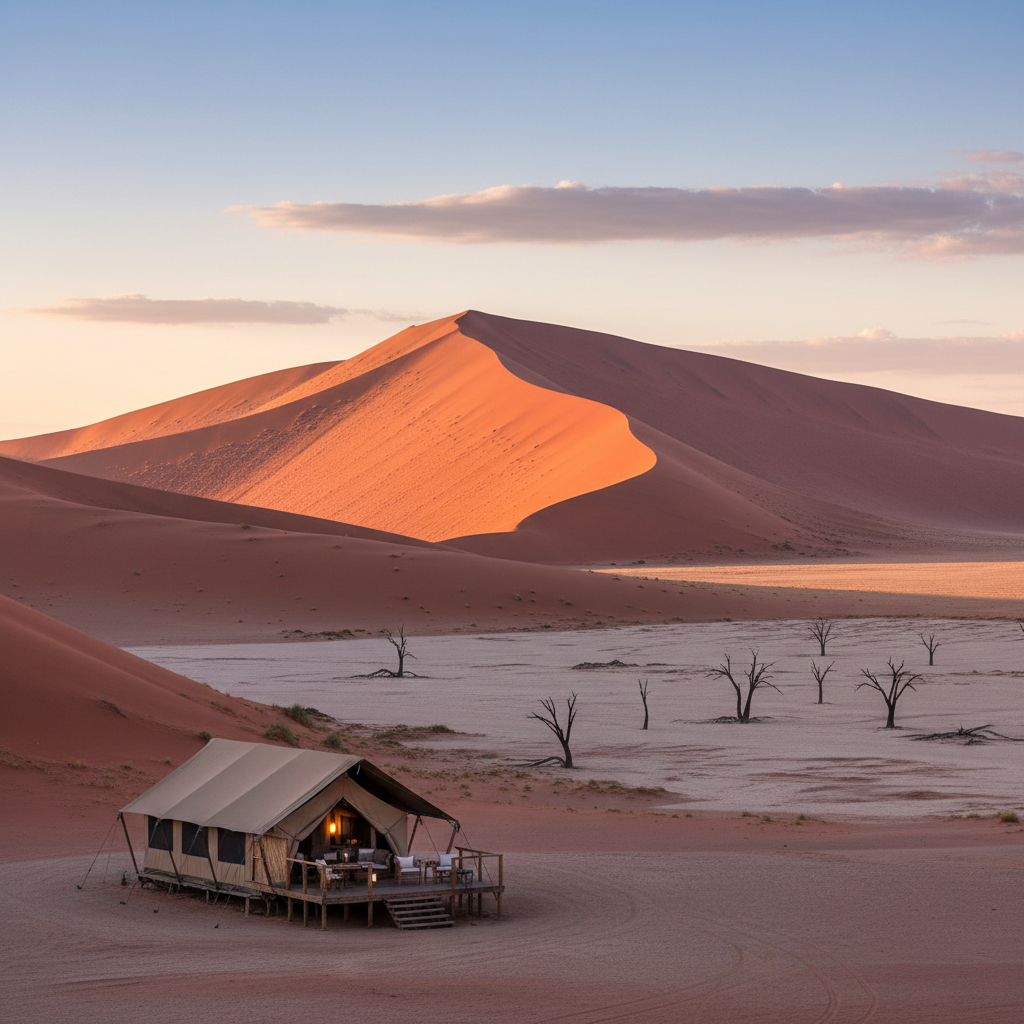
The Namib Desert — the world's oldest desert, at an estimated 55 million years of continuous aridity — stretches along Namibia's Atlantic coast for over 2,000 kilometres. At its heart, in the Namib-Naukluft National Park (namibia-tourism.com/attraction/namib-naukluft-national-park), the dune sea around Sossusvlei contains some of the world's highest sand dunes: Star Dune reaches 325 metres, and Dune 45 — the most accessible and most photographed — rises 170 metres above the valley floor. The dunes' colour — an extraordinary burnt orange-red, the result of iron oxide accumulated over millennia — changes through the day from pink at dawn through amber and scarlet to deep copper at dusk.
Deadvlei (literally 'dead marsh') adjacent to Sossusvlei is one of the most otherworldly landscapes on earth: a white clay pan — the dried bed of an ancient oasis — studded with 900-year-old dead camel thorn trees whose black, desiccated forms stand against the white salt and orange dune wall behind in a composition so perfectly composed it appears to have been staged. It was not. Photographs of Deadvlei have appeared on more design and travel publications than any other image from southern Africa.
The optimal strategy for Sossusvlei: arrive before the gate opens at sunrise, climb Dune 45 in the first light, descend to Deadvlei for the morning light, and return to your lodge before 10am when the heat becomes extreme (temperatures regularly exceed 122°F in summer). Return for the golden hour at the dunes in late afternoon.
Where to Stay: Desert Lodges
&Beyond Sossusvlei Desert Lodge (andbeyond.com/our-lodges/africa/namibia/namib-naukluft/andbeyond-sossusvlei-desert-lodge) occupies a private concession within the National Park boundary — giving guests access to the dunes before they open to the public, and private dune walks in complete solitude. The 10 suites are built into granite outcrops on the concession, with private plunge pools and deck areas looking out across the desert. Suites from $1,800/night, fully inclusive.
Wolwedans Dunes Lodge (wolwedans.com) on the NamibRand Nature Reserve — Africa's first International Dark Sky Reserve — is the most architecturally beautiful desert lodge in Namibia: open-sided, canvas-and-wood structures elevated on platforms above the desert floor, with views across a dune valley of extraordinary breadth. The NamibRand's stargazing — on moonless nights, without light pollution for 200 kilometres in any direction — is the finest available anywhere in Africa. Chalets from $1,200/night, fully inclusive.
Etosha National Park
Etosha (etoshanationalpark.org) in northern Namibia is built around an immense salt pan — 120km long by 50km wide — which during the dry season (June–October) concentrates wildlife around a series of waterholes in densities that rival any game reserve in Africa. Self-drive within the park is permitted and produces extraordinary encounters: lion prides at the Okaukuejo waterhole at midnight (lit by floodlight), black rhino at the Halali waterhole at dusk, massive herds of Burchell's zebra and blue wildebeest crossing the pan edge, and the endemic black-faced impala found only in Etosha.
The Skeleton Coast
Namibia's Skeleton Coast (namibia-tourism.com/attraction/skeleton-coast-national-park) — the 500km of Atlantic shoreline from the Ugab River to the Angolan border — is one of the most remote and primordially powerful landscapes on earth: a place of shipwrecks, massive Cape fur seal colonies, desert-adapted lion, and a fog that rolls in from the Benguela Current each morning, hanging over the sand and the rusted hulks like something from another planet. Wilderness Safaris' Skeleton Coast Camp (wildernesssafaris.com) operates the only permanent luxury camp within the protected park. Fly-in only.
Getting There
Hostea Kutako International Airport in Windhoek (WDH) is Namibia's main gateway, served by Lufthansa (via Frankfurt), Ethiopian Airlines (via Addis Ababa), Kenya Airways (via Nairobi), and Air Namibia. Most luxury lodges arrange small-aircraft transfers from Windhoek — the internal flight network, operated by Wilderness Air (wilderness-air.com) and Scenic Air, connects all major areas efficiently. A self-drive itinerary combining Sossusvlei, the Fish River Canyon, and Etosha is among the great African road journeys.



Continue Reading