Fashion
Moroccan Leather: The Ancient Tanneries of Fez and the Art of the World's Finest Leather Goods
The Chouara Tannery in Fez has been producing the world's finest leather since the 11th century. From ancient dye pits to the babouches of the medina, here is the story of Moroccan leather.
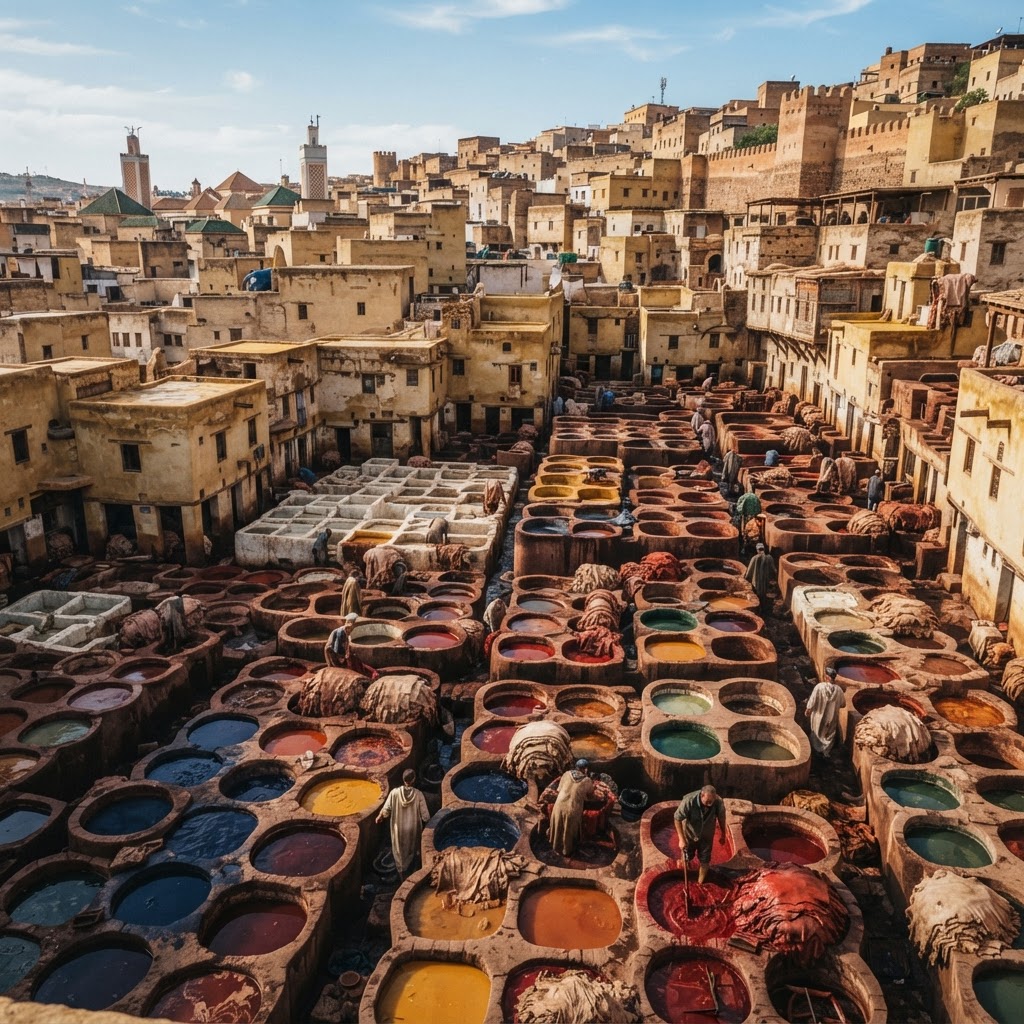
The **Chouara Tannery** in the medina of Fez, Morocco, is one of the oldest leather tanneries in the world. Dating to at least the 11th century — and possibly much older — the Chouara Tannery has been producing leather using the same traditional methods for nearly a thousand years. To stand on the terraces above the tannery and look down onto the vast honeycomb of stone dye pits, filled with brilliant natural colours — indigo blue, saffron yellow, poppy red, and the white of limestone — is to look back into the medieval world, to a time when the tannery was the heart of the city's economic life and leather was one of Morocco's most precious exports.
Fez: The Spiritual and Artistic Heart of Morocco
**Fez** (Fès), founded in 789 AD by **Idris I**, is the spiritual, cultural, and artistic capital of Morocco. The **medina of Fez** (Fès el-Bali), founded in the 9th century, is the largest car-free urban area in the world and a **UNESCO World Heritage Site** (inscribed 1981). The medina is a labyrinth of over 9,000 narrow alleys, where donkeys remain the primary mode of transport and where craftsmen (artisans) continue traditions that date back centuries.
Fez is the centre of Morocco's artisanal traditions — leather, ceramics, metalwork, textiles, and woodcarving. The **University of Al-Qarawiyyin**, founded in 859 AD, is the oldest continuously operating university in the world.
The Tanning Process
The leather produced at the Chouara Tannery is made using a process that has remained essentially unchanged for a millennium. The process takes place in three stages:
**Softening** — The raw hides (primarily goat, sheep, and cow) are first soaked in a mixture of water, lime, and pigeon droppings. The ammonia in the pigeon droppings softens the hides and removes the hair. This is the smelliest part of the process, and visitors to the tannery are traditionally given sprigs of fresh mint to hold under their noses.
**Dyeing** — After softening, the hides are transferred to the dye pits, where they are soaked in natural dyes. The dyes are entirely natural — **indigo** (for blue), **saffron** (for yellow), **henna** (for orange-red), **poppy** (for red), **copper sulphate** (for green), and **mimosa** (for brown). The white pits contain limestone for whitening.
**Drying** — The dyed hides are hung on the walls and terraces surrounding the tannery to dry in the Moroccan sun.
The Leather Goods of the Medina
The leather produced at the Chouara Tannery is sold in the shops surrounding the tannery and throughout the medina. The most iconic Moroccan leather goods include:
**Babouches** — The traditional Moroccan slipper (babouche), with a pointed toe and no heel, is the most iconic leather product of Fez. Made from goat or sheep leather, babouches come in every colour and are worn by Moroccans of all social classes.
**Poufs** — The Moroccan leather pouf (a floor cushion, used as seating or a footrest) is a staple of Moroccan interior design and one of the most popular leather exports.
**Bags and Satchels** — Leather satchels, messenger bags, and tote bags are made throughout the medina, often featuring the embossed geometric patterns characteristic of Moroccan design.
**Jackets** — Fez is renowned for its soft leather jackets, particularly in the distinctive yellow-gold colour that comes from saffron dyeing.
How to Visit
The Chouara Tannery is located in the **Blida district** of the Fez medina, near the **Nejjarine Museum** of Wooden Arts and Crafts and the famous **Nejjarine Fountain**. Access is through the leather shops that surround the tannery — visitors enter a shop, climb several flights of stairs to a terrace, and are offered a view of the tannery below. There is no admission fee, but it is customary to tip the guide and (ideally) purchase something from the shop.
The best time to visit is in the morning, when the light is best and the tanners are most active. The tannery operates year-round, but the dyeing process is most visible on weekdays.
Reference Links:
- Wikipedia — Chouara Tannery: en.wikipedia.org/wiki/Chouara_Tannery
- UNESCO — Medina of Fez World Heritage Site: whc.unesco.org/en/list/170
- Visit Morocco (Official Tourism): visitmorocco.com
- Passport and Pixels — Chouara Tannery Guide: passportandpixels.com/moroccan-leather-chouara-tannery-fes
- Moroccan Interior — Sustainable Leather Craft: moroccaninterior.com/blogs/journal/sustainable-moroccan-leather-craft
- University of Al-Qarawiyyin (Wikipedia): en.wikipedia.org/wiki/University_of_Al-Qarawiyyin
Continue Reading