Entertaining
The Midsummer Table: Scandinavian Summer Solstice Celebrations
Midsummer, or Midsommar, is the most important holiday of the Swedish calendar — a celebration of the summer solstice, the longest day of the year, marked by maypole dancing, flower wreaths, and a feast of pickled herring, new potatoes, and strawberry cake. It is the Scandinavian art of celebrating light.
Midsummer — known in Swedish as Midsommar — is the most beloved and deeply felt celebration in the Scandinavian calendar. Observed on the Friday and Saturday between June 19 and 26 (the weekend of the summer solstice, the longest day of the year), Midsummer is a celebration of light, nature, and community. In Sweden, where the winter months bring near-total darkness, the arrival of summer is not merely a change of season but a psychological and cultural event of enormous significance. Swedes retreat to the countryside — to summer houses in the archipelago, red cottages in Dalarna, or meadows in Skåne — to gather with family and friends around a table laden with traditional foods, a maypole wreathed in flowers, and glasses of aquavit raised in song. Reference: [Wikipedia — Midsummer](https://en.wikipedia.org/wiki/Midsummer)
The Origins
Midsummer has roots in pre-Christian European traditions — the lighting of festive fires on Saint John's Eve (June 23) is first recorded as a popular custom in the early twelfth century by the theologian Jean Beleth, though it is undoubtedly much older. The historian Ronald Hutton has noted that the fires were believed to repel witches and evil spirits, and that they served as an emblem of St. John the Baptist, who was 'a burning and shining light.' In Sweden, the maypole (midsommarstång) — a cross-shaped pole wreathed in leaves and flowers — became the centerpiece of the celebration, around which people dance traditional ring dances.
In the modern era, Midsummer has become a secular celebration of Swedish cultural identity — the great national summer festival. The celebration was officially moved to the weekend (the Midsummer Eve Friday between June 19 and 25) in 1953, so that it always falls on a weekend and allows for extended celebration. Reference: [Visit Sweden — Midsummer](https://www.visitsweden.com/what-to-do/food-drink/swedish-traditions/midsummer/)
The Midsummer Table
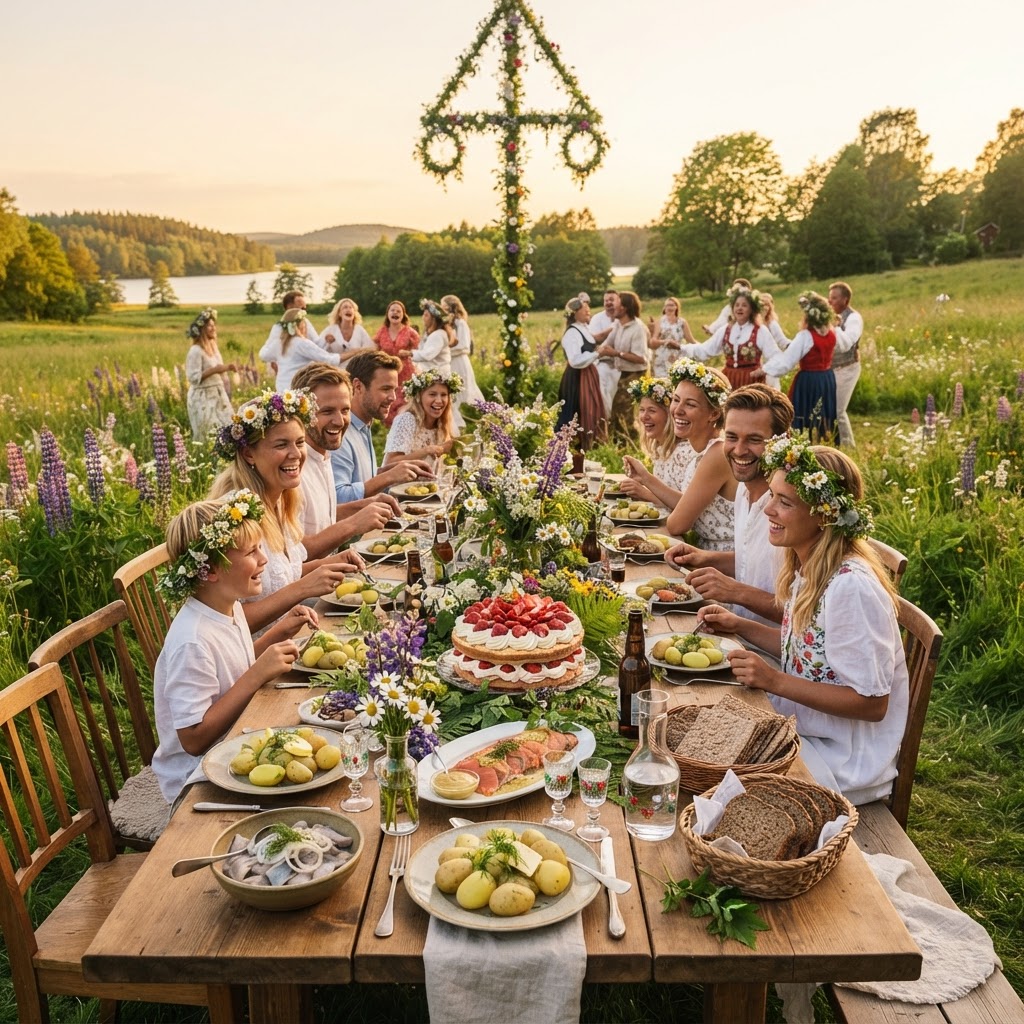
The Midsummer feast is a celebration of the first foods of summer — fresh, bright, and simple. The table is set outdoors, in a garden or meadow, decorated with wildflowers. The menu is largely unchanged from generation to generation:
**Pickled Herring (sill)** — the centerpiece of the Midsummer table. Herring is pickled in a variety of styles: mustard (senapssill), onion (löksill), garlic (vitlökssill), and the classic sweet-sour vinegar marinade. It is served with boiled new potatoes. Reference: [Swedish Food — Herring](https://sweden.se/life-culture/food-in-sweden/)
**New Potatoes (färskpotatis)** — the first, small, waxy potatoes of the season, boiled with dill and served with butter. The arrival of new potatoes is a national event in Sweden.
**Gravlax** — cured salmon marinated in salt, sugar, and dill, served in thin slices with a mustard-dill sauce (gravlaxsås). A Scandinavian classic.
**Sour Cream (gräddfil)** — served with the potatoes and herring, often topped with chopped chives.
**Meatballs (köttbullar)** — the iconic Swedish meatballs, served warm.
**Strawberries and Strawberry Cake (jordgubbstårta)** — the first Swedish strawberries of the season are the dessert centerpiece. A strawberry layer cake, decorated with fresh strawberries and whipped cream, is the traditional finale.
The Drinks
**Aquavit (snaps or nubbe)** — the essential spirit of Scandinavian celebration. Aquavit is a distilled spirit flavored with herbs — primarily caraway or dill — and it is served ice-cold in small glasses. The tradition of the snaps song (snapsvisa) — the most famous being 'Helan Går' ('The Whole Goes Down') — is an essential part of the Midsummer table. The entire table raises their glasses, sings, and drinks together.
**Beer (öl)** — Swedish lager beer, served cold.
**Snapsvisor (drinking songs)** — the songs sung before each round of aquavit are as essential to the celebration as the food. They are often bawdy, always communal, and create the shared experience that defines the Midsummer table.
For a brunch-appropriate version, a sparkling wine mimosa — particularly one with floral notes like elderflower or lavender — echoes the Scandinavian appreciation for light, botanical beverages.
The Maypole and the Flowers
The midsommarstång — the Midsummer maypole — is raised in the early afternoon. It is a cross-shaped pole wrapped in leaves and wildflowers, and it is the focal point of the celebration. After the pole is raised, everyone — adults and children alike — joins hands and dances traditional ring dances around it. The most famous dance is 'Små grodorna' ('The Little Frogs'), a children's song and dance involving hopping around the pole.
Wreaths of wildflowers are worn on the head by women and girls, and in some traditions, seven different wildflowers are picked and placed under the pillow on Midsummer Eve — a folk belief that the picker will dream of their future spouse.
Hosting a Midsummer Celebration
A Midsummer party should be held outdoors — in a garden, a park, or a meadow. Set a long table with a white or floral cloth, scatter wildflowers, and light candles (even in the late Scandinavian twilight, candles are essential). Serve the food family-style, with the herring, potatoes, and gravlax in the center of the table. Pour aquavit and beer, learn a snapsvisa (or make up your own), and toast the longest day of the year.
Reference Links:
- Midsummer history and traditions: en.wikipedia.org/wiki/Midsummer
- Visit Sweden — Midsummer: visitsweden.com/what-to-do/food-drink/swedish-traditions/midsummer
- Swedish food traditions: sweden.se/life-culture/food-in-sweden
- Aquavit guide: en.wikipedia.org/wiki/Akvavit
- Scandinavian Midsummer: visitsweden.com
- Gravlax recipe: en.wikipedia.org/wiki/Gravlax



Continue Reading