Travel
Maui, Hawaii: The Road to Hana, Haleakalā & the Soul of the Hawaiian Islands
The Valley Isle compresses Hawai'i's natural drama into its most beautiful, drivable form — the 620-curve Road to Hana, the 10,000-foot crater of Haleakalā, the resort crescent of Wailea, and a Hawaiian table shaped by five cultures of the plantation era.
Maui is the second-largest of the Hawaiian Islands and, for many travelers, the most beloved — a place where a single drive can carry you from a resort beach to a 10,000-foot volcanic crater, through a rainforest of bamboo and waterfalls, and along a coastline of black sand and lava rock. Known in Hawaiian tradition as the 'Valley Isle' for the isthmus that joins its two volcanoes, Maui is the island where the natural drama of Hawai'i is compressed into its most drivable, most beautiful form.
The Road to Hana
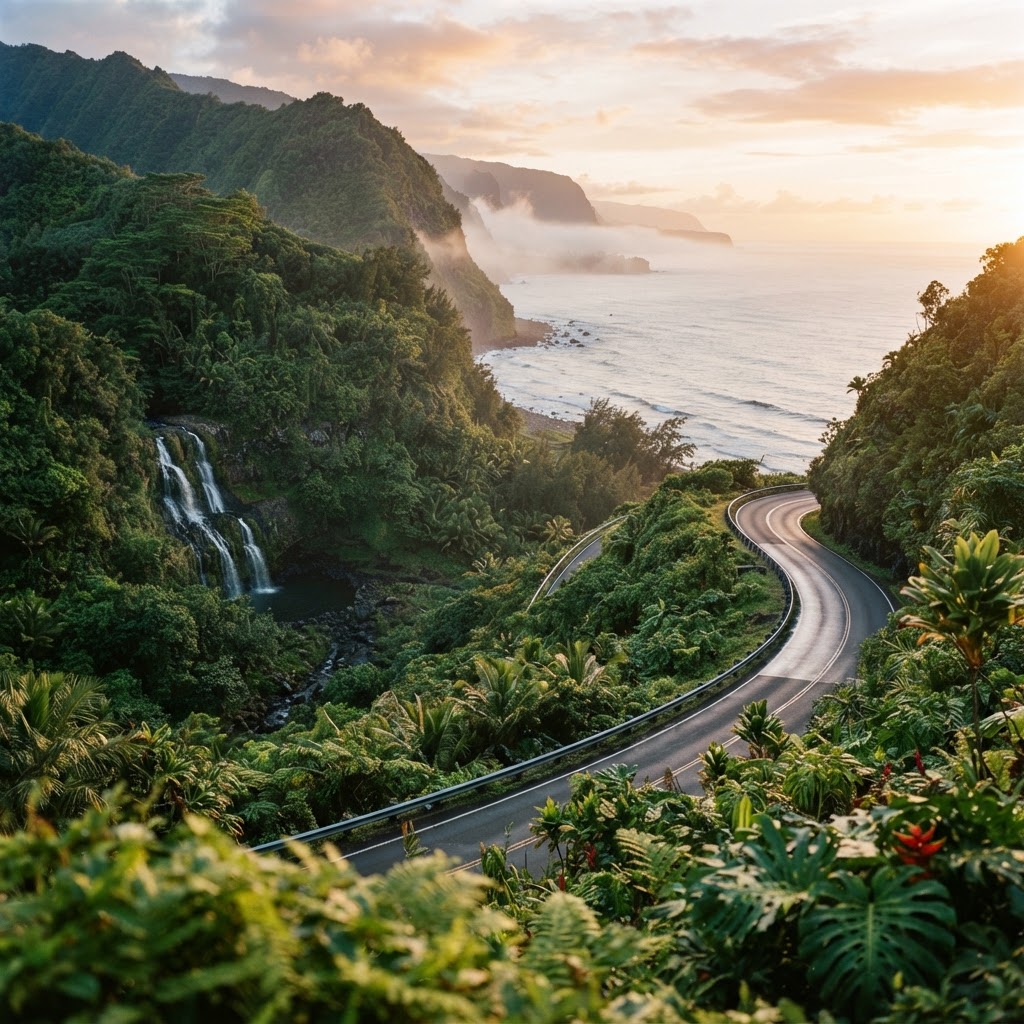
The Road to Hana — the Hana Highway, Routes 36 and 360 — is one of the most famous drives in the world, and deservedly so. Over roughly 50 miles from Kahului to the village of Hana on Maui's remote eastern shore, the road makes 620 curves and crosses 59 one-lane bridges, winding through rainforest, past waterfalls, taro farms, and sea cliffs. It averages about 25 miles per hour, and a proper journey is a full day, not a half.
The stops along the way are legendary. Twin Falls, the first major waterfall, is where many begin. Wai'anapanapa State Park offers a black sand beach of basalt set against green jungle. The Kīpahulu District of Haleakalā National Park, at the road's end, contains the Waimoku Falls Trail, which climbs through a bamboo forest to a 400-foot cascade falling over a sheer lava wall.
Hana itself is a village of about 1,500 people, rooted in Hawaiian tradition, where the Hana-Maui Resort (now a Destination by Hyatt property) has been the principal accommodation for generations. The Hasegawa General Store, founded in 1910, has been a roadside institution for over a century.
Haleakalā National Park
Maui's defining feature is Haleakalā, a shield volcano that rises to 10,023 feet and forms more than 75 percent of the island. Haleakalā National Park, established in 1961 and covering over 33,000 acres, protects the volcano's immense summit crater — a cinder-cone-studded depression 7 miles across and 2,600 feet deep that resembles a Martian landscape. The sunrise from the summit, reached by a pre-dawn drive up the Haleakalā Highway, is among the most sought-after experiences in the Hawaiian Islands, and its otherworldly light drew Mark Twain to call it 'the sublimest spectacle' he ever witnessed.
The park's Kīpahulu District, on the volcano's wet eastern slope, is a landscape of pools and waterfalls. The Pools of 'Ohe'o, tiered freshwater pools cascading toward the ocean, have been a swimming destination since the park's founding, though they periodically close for safety.
Wailea and the Resort Coast
South Maui's Wailea coast is the island's premier resort destination, a 1.5-mile stretch of crescent beaches backed by the Grand Wailea (a Waldorf Astoria resort), the Four Seasons Resort Maui, and the Hotel Wailea. Mākena Beach (Big Beach), one of the most beautiful in Hawai'i, lies just south. Wailea's coastal pathway, the Wailea Oceanfront Boardwalk, connects the resorts and offers some of the finest sunset walks on the island.
To the north, the town of Lahaina was long Maui's historic heart — a former whaling port and the capital of the Kingdom of Hawai'i under King Kamehameha III. The devastating wildfires of August 2023 destroyed much of Lahaina's historic core, including the 1858 Lahaina Heritage Museum and the famous 60-foot banyan tree planted in 1873. Recovery is ongoing, and the rebuilding of Lahaina is one of the most watched civic efforts in America today.
The Hawaiian Table
Maui's cuisine is a reflection of the islands' plantation heritage — a mix of Native Hawaiian, Japanese, Filipino, Portuguese, and Chinese traditions. Mama's Fish House, on the north shore at Ku'au, has been the island's most celebrated restaurant since 1977, serving line-caught fish in a Polynesian-style beachfront setting. In upcountry Maui, the Surfing Goat Dairy produces award-winning artisanal cheeses on the slopes of Haleakalā, and the town of Makawao, the historic center of Maui's paniolo (Hawaiian cowboy) culture, offers farm-to-table dining amid working ranches.
Reference Links:
- Go Hawaii — Maui: gohawaii.com
- Haleakalā National Park (NPS): nps.gov/hale
- Wai'anapanapa State Park: hawaiistateparks.org
- Hana-Maui Resort: hanamauiresort.com
- Road to Hana: roadtohana.com



Continue Reading