Travel
Lisbon & Sintra: Trams, Azulejos & the Art of Portuguese Travel
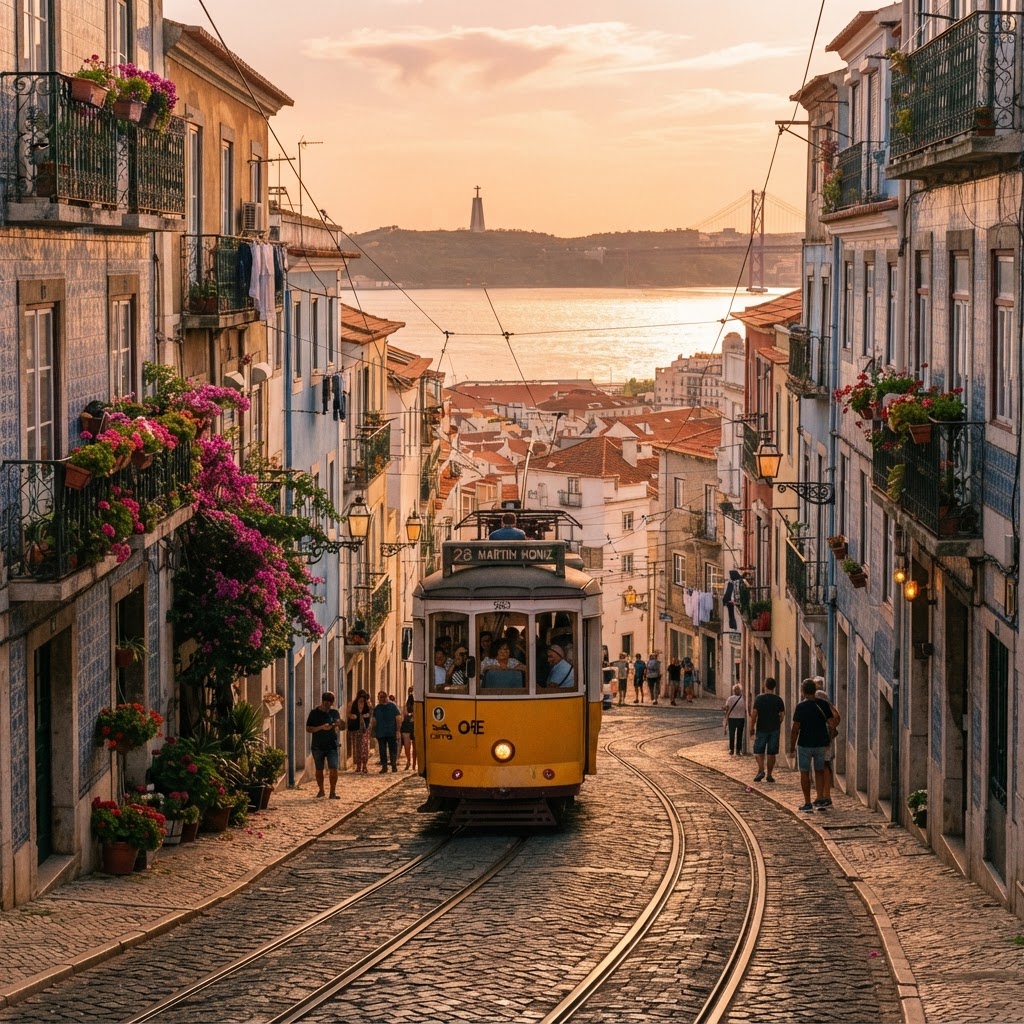
Lisbon — the capital of Portugal and one of the oldest cities in Europe — is built on seven steep hills above the Tagus River, a city of historic yellow trams, blue-and-white azulejo tiles, and the nearby fairy-tale palaces of Sintra. This is the definitive luxury guide to Lisbon and Sintra.
Lisbon (Lisboa in Portuguese) is the capital and largest city of Portugal, located on the Atlantic coast at the mouth of the Tagus River. With a population of about 545,000 in the city proper and 2.9 million in the metropolitan area, it is the westernmost capital of mainland Europe. Lisbon is one of the oldest cities in the world — older than Rome — and predates London, Paris, and Rome by centuries. It was founded by the Phoenicians around 1200 BC, was an important Roman city (Olisipo) from 205 BC, was ruled by the Moors from 711 to 1147, and was reconquered for Christianity by King Afonso Henriques in 1147.
The city became one of the wealthiest in Europe during the Age of Discovery, when Portuguese explorers — including Vasco da Gama, who sailed to India in 1498 — established a global maritime empire that made Lisbon the centre of the spice trade. The city's golden age ended with the catastrophic Lisbon earthquake of 1 November 1755 — one of the deadliest earthquakes in history, which killed an estimated 10,000–100,000 people and destroyed most of the city. The Baixa (lower town) was rebuilt by the Marquis of Pombol in an early example of earthquake-resistant urban planning.
The Historic Trams
Lisbon's iconic yellow trams (eléctricos) are operated by Carris (carris.pt), the city's public transport company, which has operated trams since 1873. Tram 28 is the most famous — a vintage tram that climbs from Praça Martim Moniz in the Baixa through the steep narrow streets of the Alfama and Graça districts to Prazeres. The tram offers a spectacular (and crowded) tour of the historic city for the price of a metro ticket. The first electric trams were introduced in 1901, and the vintage single-car trams operating on route 28 date from the 1930s. Reference: [Carris Official](https://www.carris.pt)
The Alfama
The Alfama is the oldest district of Lisbon, and the only part of the city that survived the 1755 earthquake largely intact. It is a maze of narrow cobbled streets, small squares, and whitewashed houses, stretching from the Castelo de São Jorge (the Moorish castle on the highest hill, founded in the 8th century) down to the Tagus. The Alfama is the traditional home of fado — the melancholic Portuguese music, recognised by UNESCO as Intangible Cultural Heritage in 2011. Reference: [UNESCO — Fado](https://ich.unesco.org/en/RL/fado-urban-popular-song-of-portugal-00122)
Where to Stay
Bairro Alto Hotel (bairroaltohotel.com) is the finest luxury hotel in the historic centre of Lisbon, located on Praça Luís de Camões in the fashionable Bairro Alto district. The hotel occupies 18th-century buildings and combines historic architecture with contemporary luxury. Reference: [Bairro Alto Hotel Official](https://www.bairroaltohotel.com/en/hotel/)
Palácio Ramalhete (palacioramalhete.com) is an 18th-century noble palace in the Lapa district, converted into a discreet luxury boutique hotel, and is the choice of those who prefer quiet residential elegance. Reference: [Palácio Ramalhete Official](https://www.palacioramalhete.com)
Sintra
Sintra is a town in the mountains about 30 kilometres west of Lisbon, accessible by train from Rossio station in about 40 minutes. It is one of the most romantic destinations in Europe and a UNESCO World Heritage Site, inscribed in 1995 as the Cultural Landscape of Sintra. The town is famous for its extraordinary concentration of palaces and castles, set in lush subtropical gardens.
The Palácio Nacional da Pena (parquesdesintra.pt) is the most spectacular — a 19th-century Romanticist castle built by King Ferdinand II on the ruins of a Hieronymite monastery. It is one of the most colourful buildings in the world, with yellow and red towers rising from the Sintra hills, and is considered one of the finest expressions of 19th-century Romanticism in the world. Reference: [Parques de Sintra Official](https://www.parquesdesintra.pt)
The Quinta da Regaleira (regaleira.pt) is a Gothic-Moorish estate built between 1904 and 1910 for the millionaire António Augusto Carvalho Monteiro, with an extraordinary garden of grottoes, tunnels, and the Initiation Well — a 27-metre spiral staircase descending into the earth.
Getting There
Lisbon Portela Airport (LIS) is the principal international airport, located about 7 kilometres north of the city centre. It is the home base of TAP Air Portugal (flytap.com), the flag carrier. The Lisbon Metro (metrolisboa.pt) connects the airport to the city in about 35 minutes. Reference: [Visit Lisbon Official](https://www.visitlisboa.com)
Reference Links:
- Bairro Alto Hotel: bairroaltohotel.com
- Palácio Ramalhete: palacioramalhete.com
- Parques de Sintra: parquesdesintra.pt
- Quinta da Regaleira: regaleira.pt
- Carris (Trams): carris.pt
- Visit Lisbon: visitlisboa.com
- TAP Air Portugal: flytap.com
- Lisbon Metro: metrolisboa.pt
- UNESCO — Sintra: whc.unesco.org/en/list/723

Continue Reading